
Says India’s breach of treaty is a challenge to international law, global peace and downstream states’ rights
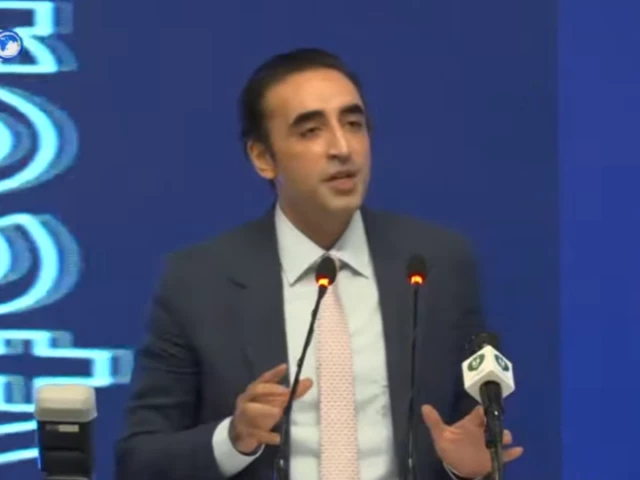
Pakistan Peoples Party (PPP) Chairman Bilawal Bhutto Zardari was addressing an international seminar titled The Indus Waters Treaty: A Key Instrument for Peace and Regional Stability held at the Jinnah Convention Center in Islamabad. SCREEN GRAB
Pakistan Peoples Party (PPP) Chairman Bilawal Bhutto Zardari on Tuesday called for a new international convention against “weaponisation of waterways”, arguing that India’s decision to suspend the Indus Waters Treaty (IWT) was not just a bilateral dispute but a challenge to international law, global peace and the rights of downstream states.
Addressing the session of the international seminar, The Indus Waters Treaty: A Key Instrument for Peace and Regional Stability, at the Jinnah Convention Center in Islamabad, Bilawal urged Pakistan to pursue its legal, diplomatic, humanitarian, climate and deterrence cases simultaneously, while warning that attempts to manipulate shared rivers than a form of technical disagreement should be treated as a form of technical disagreement.
Bilawal extended the discussion beyond South Asia and argued that water coercion should be recognized internationally as a distinct form of aggression. He proposed what he described as “a new international convention against the weaponization of waterways,” saying that international law should explicitly prohibit states from exploiting civilian dependence on shared rivers.
The convention, he said, should establish that no upstream state could hold downstream populations hostage, that waterways could not be used as instruments of coercion or extortion, and that “water is not a weapon”, “thirst is not diplomacy”, and “hunger is not statecraft”.
He argued that the principle should apply globally, citing waterways including the Strait of Hormuz, the Suez Canal, the Panama Canal, the Nile, the Tigris, the Euphrates and the Indus, arguing that waterways that sustain civilians and international stability “cannot be turned into weapons of coercion”.
Bilawal also urged Pakistan to pursue its cause internationally.
“We must take the climate case to every summit. We must take the diplomatic case to every capital,” he said, adding that Pakistan should also present “the deterrence case to any strategist who thinks South Asia can survive random experiments with the Indus”.
On domestic policy, he said Pakistan must strengthen water security regardless of India’s actions. Projects already approved before India’s unilateral move, including reservoirs, barrages, canals and flood protection systems, should continue, he said, because “Pakistan needs water security”.
“We are strengthening Pakistan because we have a duty to survive,” Bilawal said.
He also argued that the dispute formed part of a wider campaign against Pakistan along with border tensions, proxy violence, propaganda, economic pressure and hybrid warfare. “A bullet is not the only weapon. A blockade is a weapon. A sanction can be a weapon. A lie can be a weapon. A proxy can be a weapon.”
“A river can be turned into a weapon.”
Bilawal compared the strategic importance of the Indus River to the Strait of Hormuz and argued that regional peace depended on preserving both. “And no peace can be achieved between the United States and Iran with the Strait of Hormuz closed,” he said. “Similarly, how can an India-Pakistan ceasefire hope to last without the IWT being restored?”
While addressing the International Seminar on the Indus Waters Treaty, Chairman PPP Bilawal Bhutto Zardari said the world was witnessing the Strait of Hormuz becoming a point of tension between the US and Iran and warned that the closure of the strategic waterway was tantamount to… pic.twitter.com/jnJvKsgQiD
— Pakistan TV (@PakTVGlobal) June 30, 2026
“A strait can carry the oil of nations,” he added, “the Indus carries the life of nations.”
He argued that the treaty had never been merely a mechanism for sharing water, but a cornerstone of peace between India and Pakistan. According to Bilawal, the agreement represented the principle that shared rivers could not be “left to the mercy of wrath”, and warned that allowing a state to unilaterally suspend a binding international agreement would undermine confidence in treaties worldwide.
Read: ‘We are talking about our lifeline, not a treaty,’ says Tarar at the IWT seminar
Bilawal repeatedly emphasized that the debate extended far beyond water management. “This is not a technical dispute. This is not a clerical spat between commissioners. This is not technical,” he said. “This is the weaponization of water.”
He described the Indus as central to Pakistan’s identity and survival, saying it was “not a river on a map” but the source of the country’s food security, agriculture and livelihood. “It is our bread. It is our cotton. It is our wheat. It is our farmer at dawn. It is our mother who draws water. It is our children who eat roti. It is our worker in the mill,” he said, adding, “Cutting down the Indus is not pressuring a government. It is threatening a people’.
Much of Bilawal’s speech focused on deterrence and how Pakistan should respond to any attempt to alter the flow of water guaranteed under the treaty. He argued that deterrence should begin long before the water was actually diverted, saying Pakistan should not wait “until the last drop is gone” before acknowledging a threat.
“Pakistan’s deterrence does not begin when the last drop is gone,” he said. “Deterrence begins when the adversary first moves toward a nation’s stranglehold.”
He argued that every step in any effort to change Pakistan’s water supply – including surveys, tenders, canals, dams, diversions and what he described as the “legal fiction” of suspending the treaty – should be seen as part of a process of strategic escalation rather than isolated administrative measures.
“If total water denial is an existential threat, then the road to total water denial is not innocent,” he said.
Drawing an analogy, he said a noose not only becomes dangerous when the neck is broken, “it becomes dangerous when it is tied.”
Bilawal maintained that Pakistan was seeking peace, but rejected suggestions that restraint meant accepting pressure over its water rights. “We seek restraint, but not national suicide.”
He argued that attempts to control Pakistan’s water should be understood as strategic coercion rather than disputes over engineering or irrigation. “We are not discussing canals. We are discussing the deliberate manufacture of famine, migration, economic collapse and national paralysis.”
He warned that “a weaponized river can destroy a country in slow motion”, arguing that the consequences of disrupting water supplies would extend far beyond agriculture.
Bilawal also urged Pakistan to combine diplomacy with national preparedness. “Law without force is petition. Force without law is chaos. We need both,” he said.
He urged the country to simultaneously pursue “the legal case, the diplomatic case, the humanitarian case, the climate case and the deterrence case,” while calling for greater national unity. “The Hindu belongs to the farmer of Sindh, the cultivator of Punjab, the laborer of Karachi, the family of Balochistan, the mountains of Pakhtunkhwa and the future of every Pakistani child.”
He said Pakistan should continue to invest in reservoirs, dams, barrages, flood management systems and water conservation, but stressed that such measures should not be interpreted as accepting India’s position.
“We conserve water because our future demands wisdom, not because we accept extortion. We prepare for scarcity, but we do not legitimize suffocation.”
Calling for political consensus, Bilawal said Indus transcended party politics and provincial interests. He asserted that “The Hindus belong to Pakistan. It belongs to history,” he said, calling for “unity in Parliament”, “clarity in GHQ”, “decisiveness in the Foreign Office, science in our universities” and “discipline in our people”.
Read more: Pakistan calls on the UN Security Council to pressure Israel on settlements in occupied Palestinian territory
Concluding his speech, Bilawal warned the international community against dismissing the issue as an administrative dispute over water management, saying the Indus was not only “an artery of Pakistan’s economy” but “the lifeblood of Pakistan itself.”
He concluded by saying that the river was older than the flags of both India and Pakistan, a witness to empires that have come and gone, “the river remains. Pakistan will remain.”
“Indus is not for negotiation. Sindhu is not for surrender.”
Indus Waters Treaty
After several years of negotiations, facilitated by the World Bank, the IWT was signed in September 1960 by then Indian Prime Minister Jawaharlal Nehru and former Pakistani President Ayub Khan. India was given control of the three eastern rivers – Ravi, Sutlej and Beas – while Pakistan was awarded control of the three western rivers – Indus, Jhelum and Chenab. According to the treaty, India is legally bound to allow the waters of the western rivers to flow into Pakistan, with only a few exceptions.
According to the treaty, Pakistan has unrestricted use of these rivers, while India is allowed to build hydroelectric facilities on them under special conditions. These projects must conform to the design constraints outlined in the treaty annexes and ensure that they are “run-of-river” and do not significantly alter water flow or storage to Pakistan’s detriment.
Pakistan, which receives about 80 percent of the water in the Indus river system, is heavily dependent on these rivers. Of the 16.8 crore acre-feet of water in the system, India is allotted about 3.3 crore acre-feet. At present, India spends a little more than 90 percent of its permitted share, leaving Pakistan deeply dependent on the rest.
This addiction is deep. The Indus river network – comprising the Jhelum, Chenab, Ravi, Beas and Sutlej – forms the backbone of Pakistan’s agricultural sector. It sustains a population of tens of millions, meets 23 percent of the country’s agricultural water needs, and directly supports nearly 68 percent of rural livelihoods. Any interruption of this supply could trigger far-reaching consequences: reduced crop yields, food insecurity and further economic instability, especially in regions already burdened by poverty and an ongoing financial crisis.
Exacerbating the problem is Pakistan’s limited water storage capacity. Large dams such as Mangla and Tarbela have a total live storage of only 14.4 million acre-feet (MAF) – just 10 percent of the country’s annual entitlement under the treaty. In times of reduced water flow or seasonal variation, this lack of storage makes Pakistan acutely vulnerable.
Despite Pakistan’s heavy dependence on Indus waters, the treaty grants India certain rights. It allows development of 13.4 lakh acres of irrigation in Jammu and Kashmir and Ladakh. But right now only 6.42 lakh acres are irrigated in these Union Territories. Furthermore, the treaty allows India to store up to 3.60 million acre-feet of water from the western rivers – although no such storage infrastructure currently exists in Jammu and Kashmir.
Relations between the two nations took a sharp turn after India revoked the special autonomy of Jammu and Kashmir in 2019, followed by the Pahalgam attack in 2025. Since then, trust between New Delhi and Islamabad has further eroded.
In early June this year, Indian Water Minister Chandrakant Raghunath Patil told the media that India was planning the interruption of the Indus River’s flow into Pakistan – an action supported by Prime Minister Narendra Modi.
“It is certain, not a single drop of water will go (to Pakistan) in the coming years,” the Indian minister had told ANI news agency.
Meanwhile, Pakistan had warned the Modi-led government against such measures.


