
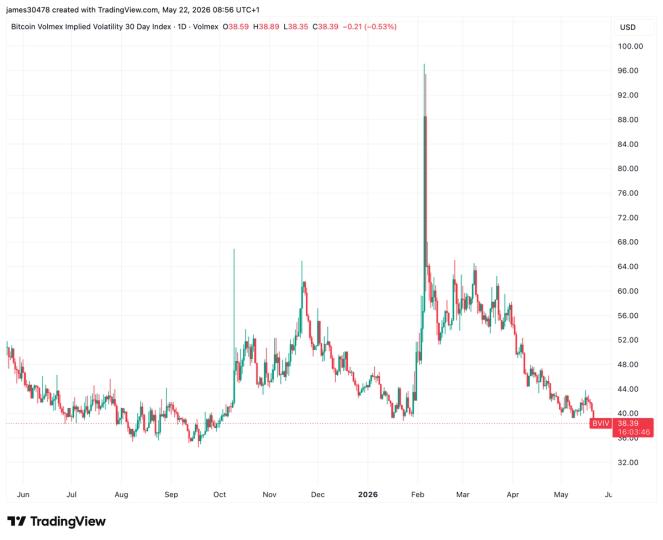
Financial headlines continue to warn of macro risks, but bitcoins volatility measurement seems to think it’s all noise.
The cryptocurrency’s annualized 30-day implied volatility index, BVIV, continues to slide, hitting 38%, its lowest reading since October 2025, according to data source Volmex. When implied volatility falls, it signals that traders expect calmer price action and fewer big moves ahead.
“Bitcoin volatility has collapsed, and you can see it clearly in the BVIV levels, which we follow closely to monitor market sentiment,” said Shiliang Tang, Managing Partner at Monarq Asset Management.
“First, the geopolitical risk from the Iran conflict is finally moving into the later stages. Second, the continued BTC buying by Strategy (MSTR) and its perennial favorite STRC complex is dampening downward BTC volatility by acting as a structural floor,” Tang added.
He also blamed systematic “call rewriters” for driving yields lower. Overwriting involves selling a higher strike-out-of-the-money call option to earn an additional return on top of the spot market. BTC is currently trading near $77,300, so anyone holding BTC and selling calls above this price is a call overwriter.
Systematic overwriters, typically institutional funds running return-enhancing strategies, continuously sell bitcoin options to collect premium income. This constant supply of options implicitly suppresses volatility and dampens expectations of large price swings.
“Finally, because Bitcoin has underperformed other risk assets to the upside, systematic overwriters are aggressively selling opportunities for returns, keeping a heavy lid on the entire volatility complex,” Tang noted.
Bitcoin is currently trading around $77,000, while oil markets, often used as a proxy for geopolitical risk, remain relatively subdued, with WTI crude trading below $100 a barrel. barrel.
Meanwhile, Strategy has purchased 171,238 BTC in 2026, significantly surpassing the roughly 63,450 BTC mined during the same period. This imbalance reinforces persistent institutional demand and reduces market supply.
Bitcoin’s declining volatility also reflects its maturation as an institutional asset. As adoption expands across ETFs, asset managers, corporates and treasury allocators, liquidity deepens and ownership becomes more diversified, naturally reducing the extreme volatility that characterized bitcoin in years past.


