
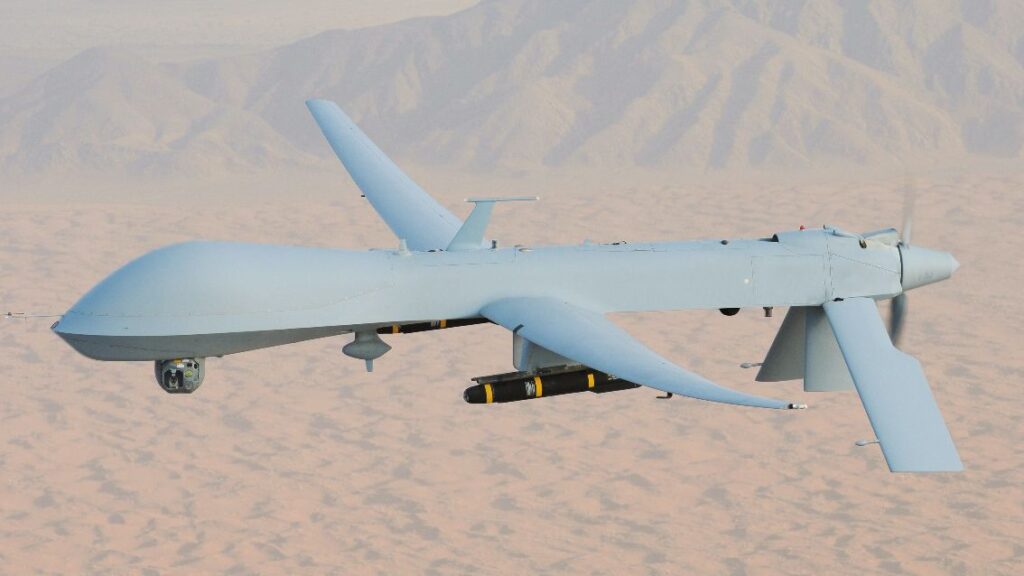
- Star-Navi, a Shenzhen-based company, is now selling access to stealth drone technology that normally has a multi-billion dollar barrier to entry as a standard package containing a spray gun
- The technology essentially makes a drone’s radar cross-section smaller and harder to track on modern radars
- The coatings are marketed as the XRAM-C series, offering 3 different variants that handle different threat radar frequencies.
While modern drone technology has evolved significantly from the rudimentary designs we first saw over a decade ago, it is becoming an increasingly important industry for the military of most countries to use and counter alike.
Two recent modern conflicts, including the war between Russia and Ukraine, as well as the war between the United States and Iran, have shown that drones are effective and often inexpensive ways to conduct an unconventional conflict that can often cause significant damage to a conventionally stronger opponent.
A Shenzhen-based Chinese company, Star-Navi, could have further enhanced the capabilities of both multi-use and disposable drones by offering radar-absorbing coatings, typically gate-ecepted by the world’s strongest militaries, and selling them by the container to interested parties.

A growing counterdrone problem
As modern drones have evolved, both commercially and militarily, the technology to stop or block them has also become increasingly sophisticated.
Counter-drone measures, also known as Counter-UAS (C-UAS) technology, utilize a variety of technologies to detect, track, and jam or take out hostile attack or surveillance drones.
The US Navy, for example, has invested in lasers to clear drone swarms, a capability with land-based applications as well.
Despite this, the most important part of neutralizing a drone is detecting it, and while RF sensors and cameras are handy, most conventional approaches rely on radar to obtain a threat signature.
Smaller drones are already notoriously difficult to track, given their small cross-section, and Star Navi’s offering will further exacerbate the situation, potentially giving smaller militias and the military access to what is normally considered a multibillion-dollar trade secret of some of the world’s most powerful war machines.
Star-Navis X-RAM-C series coating comes in 3 different variants, aimed at different frequencies:
XRAM-C105: Optimized for X- and Ku-band, aimed at reducing the effectiveness of counter-drone systems.
XRAM-C112: Optimized for S and C bands, aimed at countering surveillance radar detection.
XRAM-C113B: Broadband coverage across C- and X-bands, offering a more broad-based solution to detection problems.
The company states that the coating has been tested for heat resistance at 250 degrees Celsius for 100 hours without degradation and is sold in 1kg, 5kg and 10kg containers as a general offer. The relatively easy availability of what was previously a closely guarded national secret for many traditional players raises proliferation concerns, especially given the potential for abuse.
Star-Navi is not the only player in a market that is also seeing interest from researchers from Turkey, as well as more traditional US-based suppliers, including CFI Solutions and Intermat Defense; the latter supplies US military contractors including Lockheed Martin and Northrop Grumman.

Follow TechRadar on Google News and add us as a preferred source to get our expert news, reviews and opinions in your feeds.


