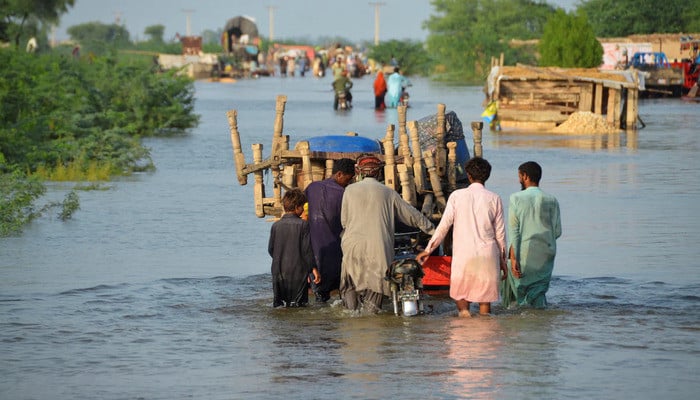
Pakistan’s climate budget debate is no longer just about allocations, but whether the country is building a governance system capable of surviving a climate-changed future.
Following the devastating 2022 floods and IMF-backed reforms, Pakistan introduced climate budget labeling, classifying spending under adaptation, mitigation and related categories. Yet the central question remains: does climate finance reach vulnerable communities, or is existing spending simply relabeled as climate spending?
Before 2023, climate finance was fragmented and largely invisible in sectors such as forestry, irrigation, disaster management and donor-funded projects, with no clear mechanism to assess whether spending supported resilience or preparedness. The 2022 floods revealed not only a climate crisis, but also serious budget and government failures.
Federal spending patterns remain modest. The Climate Change Division’s development allocation fell from around Rs 14 billion in FY2021-22 to Rs 9.5 billion in FY2023-24. Environmental protection development expenditure fell from Rs6.257 billion in FY2024-25 to Rs2.784 billion in FY2025-26, suggesting that climate remains a sideline rather than a development priority.
The shift after 2023 came through Climate Budget Tagging. The federal government reports that over 5,000 cost centers are now labeled for climate relevance, with FY2025-26 climate-related allocations representing 6.9% of current spending and 8.2% of development spending. It also classifies nearly 50% of subsidies, 35% of non-tax revenue and 9.4% of gross revenue as green tied. Still, these numbers require scrutiny because tagging alone does not create real climate resilience. Roads, irrigation schemes, subsidies or energy payments can be labeled climate-relevant without necessarily reducing vulnerability.
At the provincial level, the picture remains even more uneven. Punjab has moved the fastest in climate budgeting by labeling 3% as the climate label, partly because it has a stronger fiscal documentation system and has begun to integrate climate-related classifications into its budget strategy and development planning. In FY2025-26, Punjab allocated about Rs 15 billion for environment and climate change and about Rs 25 billion for forestry, wildlife and fisheries.
Punjab’s wider Climate Resilient Punjab Vision reportedly earmarked nearly Rs795 billion in development schemes under the categories of adaptation, mitigation and environmental protection. But Punjab’s contradiction is visible. The province is feeling climate costs while also facing extreme smog, heat stress, groundwater depletion, urban expansion into ecological zones and weak enforcement around floodplains and drainage corridors. Punjab’s budget is therefore not just a story of allocation, but a test of whether climate-branded spending can stop climate-blind development.
Sindh presents a much starker warning. It is one of Pakistan’s most climate-prone provinces, bearing Karachi’s urban heating and drainage crisis, degradation of the Indus Delta, coastal salinity, drought-prone districts, floods and repeated outbreaks of post-monsoon diseases. Yet Sindh’s climate spending has historically been weak.
Over 16 years, Sindh allocated Rs 48.8 billion to climate-related budgets, but spent only Rs 20.2 billion, meaning utilization was around 41 percent. Even more striking, the Sindh Environment sub-division reportedly spent only Rs336.56 million against allocations of Rs3.419 billion, less than 10 percent. For a province hit by the floods of 2022, this is not just a budget hole, but an indictment of government.
Sindh’s budget books list heads of environment, forest and wildlife, local government, public health engineering, irrigation and rehabilitation, but these remain fragmented. After tagging, Sindh must not only classify more expenditures as climate-relevant, but it must publish climate-tagged allocations, releases and actual expenditures in departments and districts. Without district-level expenditure data, climate budgeting in Sindh will remain a Karachi-to-provincial headquarters exercise, while climate impacts continue to be absorbed by Thatta, Badin, Dadu, Larkana, Jacobabad, Sanghar and flood-affected rural areas.
The climate budget story of Khyber Pakhtunkhwa is different. Its climate budget problem is shaped by mountains, forests, floods, GLOFs, landslides, merged districts and river basin vulnerability. KP has a stronger history of output-based budgeting and has legally moved towards performance-based budgeting through the Public Financial Management Act 2022. But climate spending in KP remains spread across forestry, wildlife, environment, irrigation, public health engineering, disaster management and local development.
KP’s budget strategy documents show the gap between development ambition and execution. For FY2021-22, development expenditure in built-up areas was budgeted at Rs271 billion and revised upwards to Rs322 billion, while tehsil and district development expenditure fell sharply from Rs15 billion budgeted to around Rs2 billion revised. In the merged areas, development expenditure was budgeted at Rs100 billion and revised to Rs99 billion, but development at the district level fell from Rs2 billion to zero. This is crucial from a climate perspective because adaptation is local in nature. If district development collapses or is not protected, then flood protection, slope stabilization, local drainage, watershed management, water supply resilience and community preparedness remain unfunded where they matter most.
KP has also started to institutionalize disaster risk financing. Provincial fiscal risk documents now recognize natural disasters as fiscal risks and refer to a 2025-2030 disaster management plan along with a 10-year disaster risk financing strategy. However, KP now needs climate-labeled performance data showing how much is being spent on adaptation, GLOF preparedness, watershed restoration and local disaster risk reduction in high-risk districts. Otherwise, plantation-focused spending will continue to dominate, while deeper resilience needs across Swat, Chitral, Dir, Kohistan, Nowshera, Karak, Charsadda and merged districts remain underfunded.
Balochistan is perhaps the most under-discussed climate finance case in Pakistan, despite being one of the most climate-stressed provinces. Its climate reality is defined by drought, water scarcity, groundwater mining, land degradation, flooding, coastal vulnerability, heat stress and weak institutional capacity.
The Balochistan White Paper for 2025-26 reports total development expenditure of Rs336.576 billion, including a provincial PSDP allocation of Rs249.45 billion. The province also allocated Rs32.328 billion for irrigation, reflecting the importance of water management in an arid province. Most importantly, Balochistan allocated Rs500 million to establish a Balochistan Climate Fund. But only about 17 percent of Balochistan’s environmental development budget was spent in FY2024-25, underscoring the province’s chronic implementation and absorptive capacity challenges despite rising climate vulnerability.
This provincial image shows the central flaw in Pakistan’s climate budget architecture. The federal government is beginning to make its mark, but the provinces have most of the implementing powers under the 18th Amendment. Water, agriculture, local government, environment, public health, land use planning, disaster preparedness and district development fall entirely within provincial domains. If climate labeling remains federal, Pakistan will produce elegant national numbers and weak local resilience. The next phase is therefore to make climate budget labeling mandatory across all provinces, using a harmonized framework but allowing for province-specific vulnerability indicators.
The reforms must also be enshrined in the Pakistan Climate Change Act 2017 and therefore the Pakistan Climate Change Fund must be notified and operationalized without further delay. Climate-related taxes, pollution taxes, carbon-related revenues, environmental sanctions, green taxes and climate support taxes should be delimited to this fund.
Pakistan already generates significant revenue through the petroleum tax. So if a tax is justified in climate language, it must not disappear into the general tax pool. It must finance mitigation such as investment in electricity infrastructure or clean energy transition or adaptation such as urban resilience, social protection of farmers, etc.
Pakistan also needs a differentiated accountability system. Climate budgeting should begin with the annual development plans at the district level. Each district’s ADP should identify climate risks, label relevant schemes, estimate adaptation and mitigation value and report on emissions, expenditure and results. The provincial grants and development approvals should be conditional on performance. Districts that protect floodplains, restore wetlands, improve drainage, reduce heat risk, manage waste, conserve water and meet resilience indicators should receive incentive-based funding. Those who continue climate-blind development should face fiscal sanctions and audit controls.
The National Finance Commission must also enter this debate as Pakistan’s tax transfer formula must move beyond a narrow population-heavy approach and incorporate vulnerability, climate risk and development needs. A revised NFC formula should include climate vulnerability, disaster exposure, ecosystem fragility and adaptation deficit as measurable indicators. Provinces facing recurring floods, droughts, glacial hazards or coastal degradation require predictable fiscal space, not relief.
If Pakistan stops noticing, climate budgeting will become another spreadsheet reform. The country will report billions in climate related spending as districts continue to drown, heat, dry and erode. The real measure of Pakistan’s climate budget is not the percentage marked in Islamabad. It is whether a village in Sindh is less flooded, a district in KP is better protected from floods, a settlement in Balochistan has safe water and a city in Punjab can breathe.
The author is an environmental researcher and heads the Ecological Sustainability and Circular Economy Program at the Sustainable Development Policy Institute (SDPI), Islamabad.
Disclaimer: The views expressed in this piece are the author’s own and do not necessarily reflect Pakinomist.tv’s editorial policy.
Originally published in The News