
CME Group has officially entered the ever-active crypto market. As of Friday, CME Bitcoin futures and options now trade 24 hours a day, seven days a week on Globex, CME’s electronic trading platform, with only a 60-minute weekly maintenance break between 22:00 and 23:00 UTC every Sunday.
While weekend trades will still fare the next business day, the broader implication is significant as the long-standing CME weekend gap has effectively disappeared.
For years, the Friday close to Sunday reopening created one of bitcoin’s most recognizable structural inefficiencies. Traders routinely positioned themselves around “gap fills,” taking advantage of the disconnect between the CME’s limited trading hours and Bitcoin’s continuous spot market. Thin weekend liquidity often exaggerated these moves, making the CME gap both a technical indicator and a speculative strategy.
Volatility would often rise sharply at Sunday’s re-opening at 23:00 UTC as futures markets recalibrated to where spot had drifted over the weekend. This weekend price action was characteristically low volume and largely noise, thin order books reinforcing moves that would often backfire as institutional participants logged in late Sunday.
With the CME maintenance window now scheduled for the same 22:00–23:00 UTC Sunday slot, it is worth noting that the window may retain some of its old character. Liquidity will thin as Globex goes offline and the reopening at 11pm may still see short bursts of volatility as the market finds its footing. It’s a dynamic worth watching closely in the coming weeks.
That era is now largely over. By aligning futures trading with bitcoin’s native 24/7 market structure, CME reduces weekend risk premiums and improves hedging efficiency for institutional participants. Asset managers, hedge funds and corporate treasury desks can now manage exposure continuously instead of waiting for markets to reopen.
Still, CME remains behind where the liquidity really sits. Founder and CEO Cole Kennelly of Volmex Labs told CoinDesk BlackRock’s IBIT ETF options currently have about $27 billion to $30 billion in open interest, dwarfing CME Bitcoin futures options, which are closer to $800 million to $900 million. This imbalance helps explain why the BVIV-US Index (BVUS), derived from IBIT’s deeper options market, has emerged as the preferred institutional benchmark for Bitcoin volatility.
Offshore perpetual futures and ETF options are likely to maintain their dominance for now. But CME’s move to 24/7 trading removes a critical friction point.
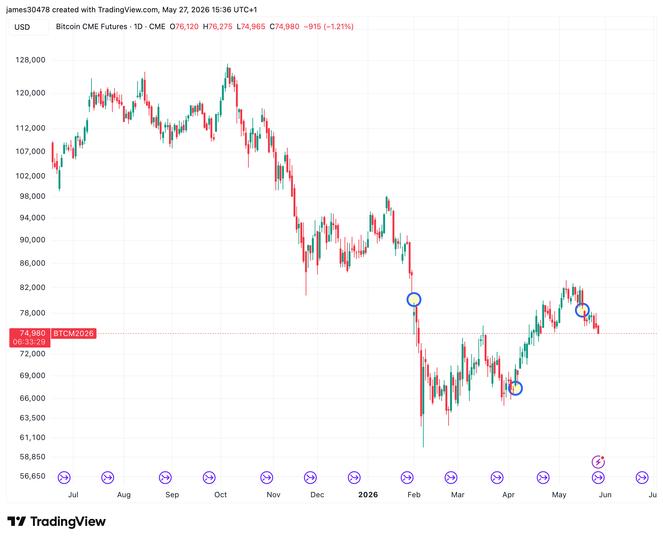
As it stands, there are currently three open CME slots, all created this year. Two sit above Bitcoin’s current spot price of around $73,000, one formed in late January near $80,000 and another around $78,500. The third remains open below the market, just below $70,000.


