
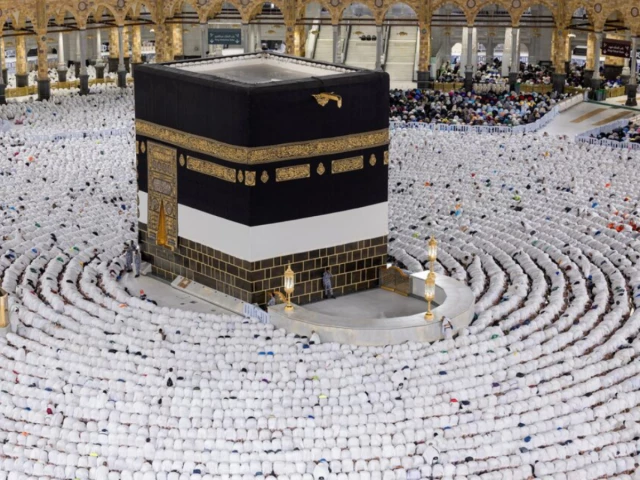
also approves the introduction of a Shariah-compliant Haj savings scheme to help citizens bear the costs of the ritual
Federal Cabinet Approves Haj Policy and Plan 2027-2030 Focusing on Incorporating Digitization
The federal cabinet on Tuesday approved the “first-ever” four-year Haj policy and plan, directing authorities to complete the digitization of the operation to ensure “better” facilities for pilgrims, state television reported. Radio Pakistan reported.
Prime Minister Shehbaz Sharif chaired the Federal Cabinet meeting today where the participants were briefed in detail on the latest long-term Haj policy.
Cabinet members were told that the new policy was designed to improve operations and provide better facilities to pilgrims, and standard operating procedures and other regulatory frameworks would be developed for its implementation. Furthermore, changes will be made to it, as necessary, to keep it in compliance with Saudi laws and regulations.
To ensure affordability, the Cabinet also approved the introduction of a Shariah Compliant Savings Scheme to enable aspiring pilgrims to benefit from a savings plan to perform Haj in the future.
The meeting was informed that under the latest policy, aspiring pilgrims would be able to register for Haj in any year up to 2030, allowing the ministry to prepare a priority waiting list.
The cabinet members were further informed that the entire Haj management system was digitized to support online payment mechanisms, with introduction of grievance management and monitoring systems.
The Prime Minister Muhammad Shahbaz Sharif has dressed the federal cabinet in Islamabad today.
The federal cabinet approved the Hajj policy and plan for 2027-2030.
The meeting was told in the briefing that official and private have been allocated under the policy. Long and short Hajj under the policy… pic.twitter.com/hyv7euo8FP
— Government of Pakistan (@GovtofPakistan) July 7, 2026
Under the newly approved policy, the Cabinet was told that separate quotas were allocated to state and private Haj schemes, including long and short stay options.
The policy also mandated training of pilgrims, schemes and emergency response mechanisms.
The Cabinet directed the authorities to appoint Haj Moavineen “on merit” through a transparent mechanism. It further directed that third party validation of both government and private Haj operations should also be ensured to facilitate pilgrims.
The Cabinet also commended Minister for Religious Affairs Sardar Muhammad Yousaf and his team for the successful management of this year’s pilgrimage.
Read: KSA allows Haj travel for children 12 years of age
The cabinet also approved a policy to outsource services at the Isolation Hospital and Infectious Treatment Center and Regional Blood Center in Islamabad to improve citizens’ access to healthcare, with the Ministry of National Health Services to implement it.
The cabinet members were also briefed on the performance of Pakistan Railways, including that its revenue increased from Rs95 billion in 2024-25 to over Rs115 billion in the last financial year, registering an increase of 24.19%, primarily driven by freight revenue.
Authorities said railways’ freight revenue increased by more than Rs8 billion, other revenue by Rs7 billion and property and land revenue by Rs6 billion. The meeting’s participants were informed that revenue from passenger transport increased by 3.37% in the same period.
They were further informed that in addition to improvements in rail operations, significant progress had also been made in freight logistics.


