
Aurangzeb says Pakistan has not yet requested any additions or changes to its $7 billion IMF loan program. USD because of the war between the US and Iran
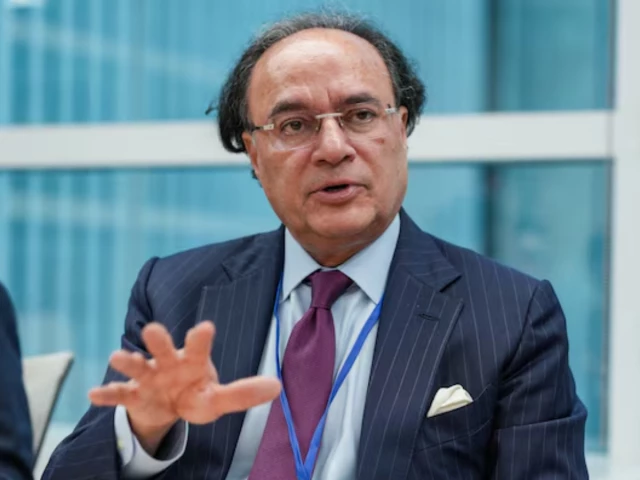
Pakistan’s Finance Minister Muhammad Aurangzeb speaks during an interview at the annual spring meetings of the International Monetary Fund and the World Bank Group in Washington DC, United States, April 13, 2026, PHOTO: REUTERS
Pakistan is considering Eurobonds, loans from other countries and commercial debt to replace a $3.5 billion facility from the United Arab Emirates (UAE) and manage its foreign exchange reserves, Finance Minister Muhammad Aurangzeb said.
Aurangzeb also told Reuters that the shock of the ongoing war in the Middle East meant Pakistan must consider a strategic oil reserve and a faster transition to renewable energy.
“All options are on the table,” Aurangzeb said when asked if the government was in talks with Saudi Arabia for a loan to replace the UAE facility.
Reuters reported that Pakistan will return a $3.5 billion loan to the UAE this month, putting pressure on its reserves and risking breach of its International Monetary Fund (IMF) targets.
Pakistan has been thrust into the international spotlight as it plays the role of a mediator between the US and Iran to end the war in the Middle East.
Aurangzeb, speaking on the sidelines of the IMF/World Bank annual spring meetings, said the country could meet all debt repayments and its reserves remained at about 2.8 months of import coverage. Maintaining at least that level, he said, would be “an important aspect of our overall macro stability going forward”.
“We are looking at Eurobond, we are looking at Islamic sukuk, we are looking at dollar-settled rupee-linked bonds,” Aurangzeb said, adding that they expected to issue Eurobonds this year and are also looking into commercial loans.
Read also: Fitch maintains Pakistan’s rating at ‘B-‘
Aurangzeb said that while Pakistan had not yet requested additions or changes to its $7 billion IMF lending program because of the economic shocks from the war in the Middle East, it was a potential possibility.
“Depending on how things develop over the next few weeks, that’s something that can be discussed,” he said.
The fund’s board is likely to sign off on the latest lending tranche at the end of this month or early next month, Aurangzeb said, which would release just under $1.3 billion through the Extended Fund Facility and the Resilience and Sustainability Facility.
Pakistan also expects to launch its first-ever Panda bond — debt denominated in Chinese yuan — next month, he said. The $250 million issuance, the first of a planned $1 billion program, will be supported by the Asian Development Bank and the Asian Infrastructure Investment Bank.
Read more: The salaried class pays Rs420b tax
Aurangzeb said the country’s projected GDP growth of close to 4%, remittances of about $41.5 billion and targeted aid to the poorest citizens could withstand the shock of war in Iran this fiscal year, which ends on June 30.
But the price increases meant the country needed to focus on establishing strategic reserves of fuel and LPG – rather than simply relying on commercial reserves – and accelerate its move towards renewable energy.
“When you go through a supply shock like this… it sends a very clear message that we need to speed up these journeys,” he said.


