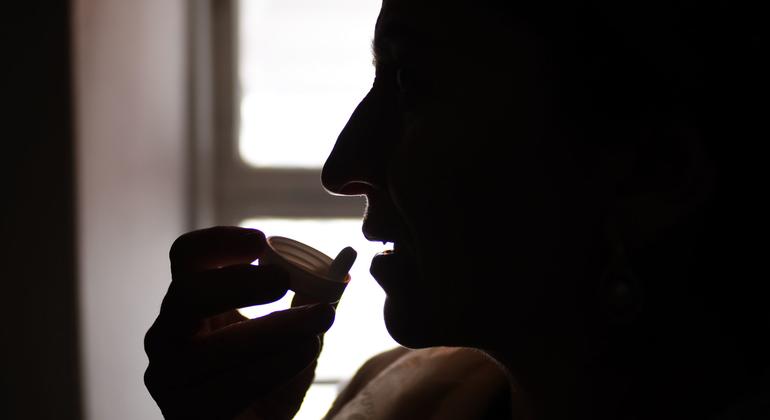
The sudden drop in funding is hitting the HIV response “like a shock wave,” said Winnie Byanyima, executive director of UNAIDS, adding that “the world is pulling back just when we need to push forward.”
Many countries are unprepared to sustain programs that have previously been supported by international funding, Ms. Byanyima told reporters at UN headquarters in New York, noting that prevention and support services are already collapsing in several countries.
Today, 9.3 million people living with HIV are still waiting to start treatment, while there were 1.3 million new infections worldwide in 2024.
‘Real consequences’
Mrs. Byanyima warned that the funding crisis is having “real consequences” across developing countries, as treatment expansion and community organizations – often the backbone of the HIV response – are forced to scale back or close altogether.
In Uganda, uptake of PrEP (pre-exposure prophylaxis), which can reduce the risk of contracting HIV through sexual transmission by up to 99 percent, fell by 31 percent between December 2024 and September 2025.
In Burundi, enrollment fell by 64 percent in the same period.
Even basic prevention tools are becoming less available. In Nigeria, the distribution of condoms fell by 55 percent between December 2024 and March 2025.
Funding shock
Charities and groups working with HIV/AIDS are increasingly being hit by funding cuts, with many reducing operations or closing down altogether.
In eight countries where UNAIDS operates, 99.9 percent of HIV prevention services are externally funded, with only 0.1 percent funded domestically, leaving programs highly vulnerable to reductions in aid.
“The fiscal constraints in the hardest-hit countries are enormous,” said Ms. Byanyima.
In 2024, around 570 girls and young women were infected with HIV every day. Yet 60 percent of women-led HIV organizations have either lost funding or closed down altogether.
Most vulnerable caught in ‘proxy wars’
“These are proxy wars for critical minerals, for energy, for influence that are being fought that instrumentalize the rights of the most marginalized people,” Ms. Byanyima.
In Kenya, most drop-in centers serving key populations, including the LGBTQ community, have closed. Nigeria has lost at least five similar clinics.
In Uganda, 45 percent of programs supporting key populations have been partially or completely shut down. In Zimbabwe, services for sex workers – including access to prevention, testing and treatment – have collapsed completely by 2025.
Science offers solutions
Despite the setbacks, Ms. Byanyima that scientific advances still offer a path to ending AIDS as a threat to public health by 2030.
“Science is offering us solutions that can end this epidemic by 2030; long-acting PrEP, long-acting prevention, long-acting treatments, medications that we wouldn’t have thought of 10 years ago. All of this is there,” she said.
But she warned that steep cuts in funding, combined with growing backsliding on human rights, are pulling the world further away from that goal.