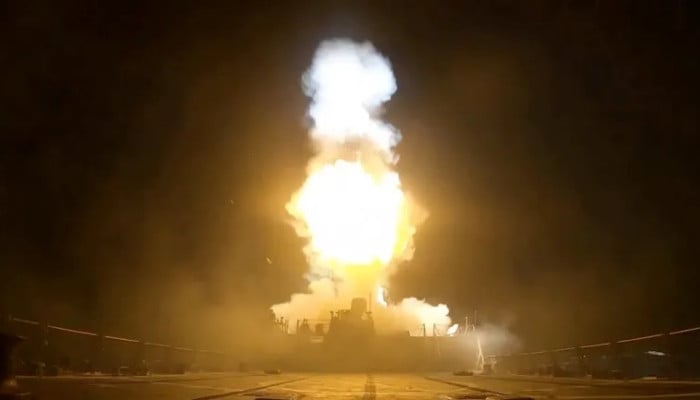
- US says it hit hundreds of Iranian targets after ship strikes.
- Tehran says it has closed the Strait of Hormuz again.
- Iran targeted US facilities across the Gulf states.
WASHINGTON/DUBAI: US and Iranian forces have exchanged heavy missile and drone strikes, with Tehran on Sunday targeting US facilities in states across the Gulf and saying it had again closed the vital Strait of Hormuz.
The renewed violence casts further doubt on the future of an interim US-Iran deal signed last month that was intended to reopen the strait and end the war after another 60 days of negotiations.
The attacks were the latest in a cycle of attacks and counter-attacks as Iran seeks to assert control over shipping through the Strait of Hormuz. However, the barrage marked an escalation in pace and range.
Iran’s attacks extended to Qatar, a mediator in ceasefire talks that had not been attacked since April. The United Arab Emirates, which has not been targeted since early May, said its air defenses had attacked missiles and drones from Iran.
The U.S. military began launching multiple strikes against Iran at 5 p.m. ET Sunday, Central Command said in a statement on social media platform X, “to continue to degrade its ability to attack civilian sailors and commercial ships freely transiting the Strait of Hormuz.”
US Central Command spokesman Tim Hawkins told CNN that US aircraft shot down an Iranian cruise missile and a one-way attack drone.
In a brief telephone interview with Reuters on Sunday afternoon, US President Donald Trump referred to the weekend attack on Iran. “We beat them,” he said.
Iranian media said on Sunday there had been missile attacks and explosions around the port cities of Sirik and Bandar Abbas, home to military facilities on the strait, and the nearby Qeshm Island.
In a statement, Iran’s foreign ministry condemned “aggressive” US strikes against Iran over the weekend. The ministry also said talks between Iran and Oman on Saturday in Muscat – focused on strait management arrangements and transit routes – were unable to reach a result due to “overt and covert” US pressure on Oman.
In the past week, Trump has said he considers the ceasefire over, while leaving the door open for more talks.
Iran’s top negotiator, Mohammad Baqer Qalibaf, wrote on X Sunday: “The era of one-sided deals is OVER. We told you: keep your word or pay the price. Reality is knocking.”
The war that the US and Israel launched against Iran on February 28 has destabilized the Gulf, where Iran has targeted countries that host US bases. Iran’s effective blockade of the strait has driven energy prices higher and fueled global inflation.
Higher prices, especially for gasoline, are politically sensitive for Trump ahead of November’s congressional elections.
Barrage of strikes
Iran has sought to establish a permanent tolling system in the strait, which it has waged war on for a fifth of the world’s oil and liquefied natural gas shipments, and has warned ships against sailing without its permission.
It said late Saturday it had closed the waterway after firing a warning shot that hit a vessel plying an unauthorized route. On Sunday, it said it had disabled another vessel.
India said one of its nationals was missing after an attack on the container ship GFS Galaxy off the coast of Oman. Oman said 23 crew members had been rescued. Qatar advised all vessels, including recreational boats, fishing boats and jet skis, to cease operations.
Iran’s newly created Persian Gulf Strait Authority said on Sunday that passage through the strait was currently not possible due to “recent illegal movements of US military forces in the region”. Permits will be issued “as soon as stability and calm are restored,” it said.
The United States, which revoked the license authorizing the sale of Iranian crude on Tuesday after earlier attacks on shipping, said its forces were positioned to ensure freedom of navigation despite what it described as “aggression, harassment, threats and arbitrary statements” from Iran.
“Iran does not control the strait. Traffic flows,” it said.
The US Navy-led Joint Maritime Information Center reiterated guidance that despite a serious security threat, an “expanded” southern route near Oman was available for two-way traffic.
On Saturday, the US Central Command said that US forces had struck 140 Iranian military targets and that more than 300 had been struck over three nights this week “to impair Iran’s ability to attack civilian sailors and commercial vessels freely passing through the strait.”
In response, Iran’s Revolutionary Guards said they had destroyed a command and control center and drone hangars in US ally Jordan, targeted a US radar site and later missile launch systems in Kuwait, attacked US aircraft carrier support and refueling platforms in Oman, and destroyed a jet maintenance center and command facility in Qatar.
“Keep your word or pay the price,” says Iran
Qatar, which has previously said it would not act as a mediator while it was under attack, said three people, including a child, had been injured by falling shrapnel. It said Iran was “fully legally responsible” for the attack.
The United Arab Emirates said it detected missile threats outside its borders, while Bahrain said it intercepted several Iranian airstrikes, Jordan reported missile strikes and Oman reported being targeted by drones. Kuwait’s army later reported casualties from strikes, saying an attack on an oil rig injured a worker.
Oman said it had summoned Iran’s ambassador to protest drone strikes in two regions, and the US embassy in Oman told its nationals in Duqm and Musandam to take shelter.