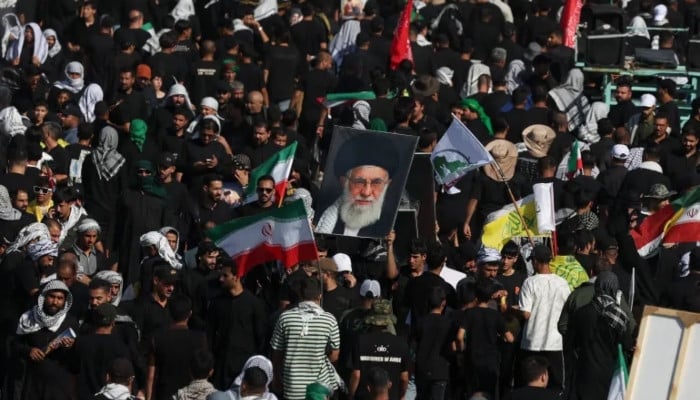
- Millions are expected to attend the funeral in Mashhad.
- Trump warns Iran of ‘much worse’ if attacks continue.
- Burial is to take place at the shrine of Imam Reza.
MASHHAD: Iranians on Thursday prepared to bury their slain leader Ali Khamenei in his hometown of Mashhad in northeastern Iran, as new US strikes threatened to trigger a new escalation in the Middle East war.
The funeral of the late supreme leader follows a multi-day funeral ceremony that attracted millions of mourners in various cities in both Iran and Iraq.
But just as the funeral rites entered their final day, the US launched new attacks on Iran in retaliation for attacks on shipping in the vital Strait of Hormuz.
President Donald Trump, who had previously said the US ceasefire with Iran was over, warned of “much worse” ahead if Iran continues to attack ships in the strait.
Khamenei was killed on February 28, the first day of the US-Israeli strikes that started the war.
After a marathon procession through the holy cities of Najaf and Karbala in neighboring Iraq on Wednesday, he was due to reach his final resting place in the holy city of Mashhad.
Observers have been watching closely for any sign of Khamenei’s son and successor Mojtaba Khamenei, who has yet to appear in public and is said to have been injured in the same strike that killed his father.
Mashhad Governor Hassan Hosseini was quoted on state television as saying he “expects 15 million people” to attend Khamenei’s funeral.
The funeral was originally scheduled to begin on Thursday at 06:00 (02:30 GMT), but local media later quoted organizers as saying it would begin at 14.00, because the ceremonies in Iraq had been delayed.
According to the official IRNA news agency, Khamenei will be buried on Thursday evening at the shrine of Imam Reza – Iran’s most revered place of worship. Imam Reza is the only one of the 12 Imams buried in Iran.
Khamenei’s funeral ceremonies included a variety of locations that reflect the religious, political and ideological pillars of the Islamic Republic.
His chief of staff, Mohammad Mohammadi-Golpaygani, had previously said on state television that Khamenei himself had wanted to be buried in Mashhad.
Several notable figures have been buried in the shrine over the centuries, including several former shahs of Iran, as well as former president Ebrahim Raisi.
Massive crowds
The ceremony has so far drawn massive crowds across various cities, starting with Khamenei’s three days of lying in state in the capital, Tehran.
The Islamic Republic hopes the ceremony will project strength and unity after the war in the Middle East and six months after a crackdown on anti-government protests.
Khamenei, who had ruled Iran since 1989, was killed at the age of 86 along with several members of his family and top officials in an Israeli strike.
After five weeks of intense hostilities, a fragile cease-fire and an initial agreement with the United States attempted to put the conflict in the Middle East on hold.
But the ceasefire looked increasingly under threat as US Central Command said it had carried out strikes to impair the ability of Iranian forces to “threaten freedom of navigation” in the Strait of Hormuz – a key bone of contention in US-Iran talks.
Calls for restraint abounded as US forces struck several locations on Iran’s coast in response to Iranian attacks on three ships in the waterway.
Tehran previously said it had hit US bases in Bahrain and Kuwait.
After ceremonies in Tehran, Khamenei’s remains were transported to the clerical city of Qom on Tuesday, then to neighboring Iraq on Wednesday, before his funeral on Thursday.
He will be buried alongside his infant grandson, son-in-law, daughter and Mojtaba Khamenei’s wife Zahra Haddad Adel, all of whom were killed in the February 28 strikes.