
- AI tool accelerates thermoelectric generator design while matching leading prototype performance
- TEGNet reduces simulation time from thousands of seconds to fractions of one
- Cheaper waste heat harvesters could follow, although manufacturing still needs to prove itself
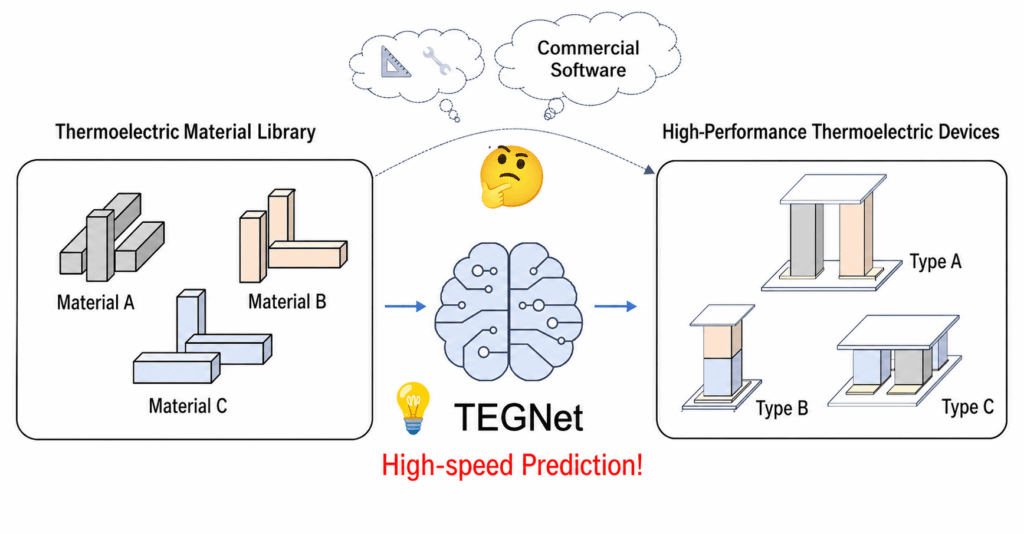
Researchers in Japan have built an AI tool that can design thermoelectric generators far faster than standard simulation methods, pointing to cheaper ways to turn waste heat into electricity.
TEGNet was developed by Takao Mori and colleagues at Japan’s National Institute for Materials Science (NIMS) and the University of Tsukuba.
In the newspaper published in Natureit predicted generator performance with greater than 99% accuracy while using only 0.01% of the computer time required by commercial finite element solvers.
The article continues below
Works as a fast emulator
Thermoelectric generators convert heat differences directly into electricity without turbines or moving parts.
They already power spacecraft, remote sensors and some isolated infrastructure, but cost and mediocre performance have kept them out of wider use in factories, refineries, vehicles and electronics.
Designing thermoelectric generators is slow because researchers must balance materials, geometry, temperature conditions, electrical resistance, and heat flow.
A conventional solver must solve coupled physics equations over and over again, which can take days or weeks for broad searches.
TEGNet learns from these simulations and then acts as a fast emulator. The paper says a typical material simulation took about 2,237 seconds in COMSOL, while TEGNet produced the same type of result in about 0.25 seconds.
The researchers used AI to improve two types of generators, one built from stacked layers of different materials and another made from paired semiconductor materials that work together to produce electricity.
Laboratory-built prototypes achieved conversion efficiencies of 9.3% and 8.7%, respectively, placing them among strong reported results for that temperature range.
That still doesn’t make thermoelectrics a cure. Heat-to-electricity conversion is limited by basic thermodynamics, and these devices need sufficient temperature difference to be useful.
The interesting part is the cost. Mori told IEEE spectrum that estimated costs suggest that an industrially competitive power generation cost could be possible “for the first time in thermoelectric history.”
TEGNet also identified designs that could use simpler manufacturing and in some cases avoid bismuth telluride, a common but expensive thermoelectric material.
It could help waste heat harvesters and high-performance heat pumps for the home become cheaper, although real-world production still needs to prove the numbers.
Follow TechRadar on Google News and add us as a preferred source to get our expert news, reviews and opinions in your feeds.


