
ISLAMABAD:
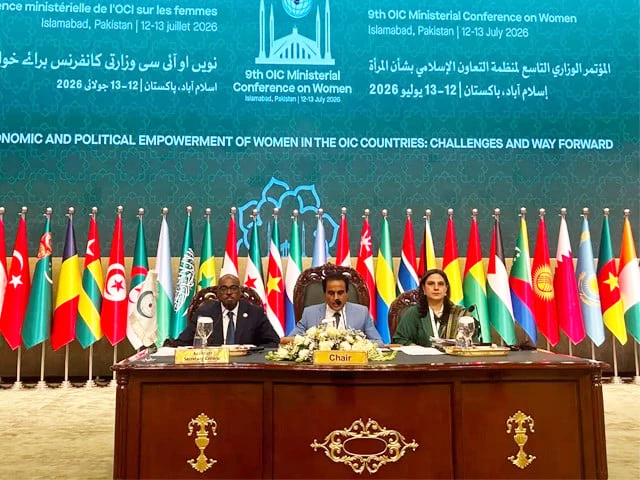
The Organization of Islamic Cooperation (OIC) 9th Ministerial Conference on Women kicked off in Islamabad on Sunday, bringing together delegates from across the Muslim world to discuss women’s socio-economic and political empowerment, even as international data highlights uneven progress across member states in education, employment and political representation.
Organized by the Ministry of Human Rights under the theme “Socio-Economic and Political Empowerment of Women in OIC Countries: Challenges and Way Forward”, the two-day conference is being hosted by Pakistan for the first time. Delegates discussed and finalized the agenda on the opening day, with around 190 representatives from the OIC’s 57 member states attending the event.
Around 190 delegates from the OIC’s 57 member states are attending the conference to discuss ways to expand women’s access to education, healthcare, employment, entrepreneurship, financial services, technology and digital opportunities, while strengthening cooperation among member states.
Union Minister for Law and Human Rights Azam Nazeer Tarar, who is chairing the conference on behalf of Pakistan, described it as an honor for the country.
The OIC, which includes 57 member countries on four continents, is the world’s second largest intergovernmental organization after the United Nations. Its Ministerial Conference on Women serves as the bloc’s main platform for discussing policies aimed at promoting women’s socio-economic and political empowerment, where member states are expected to share experiences and identify ways to improve women’s participation in education, the economy and public life.
In addition to the conference proceedings, a review of data from the World Economic Forum (WEF), Pakistan Bureau of Statistics and other international sources shows that while progress has varied across OIC member states, significant gaps remain in women’s education, economic participation and political representation.
Afghanistan represents the most serious example of the challenges facing women’s rights in the Muslim world. The country, where women remain largely excluded from secondary and higher education, many forms of employment and public life under Taliban rule, was not represented at the conference, according to the list of participating delegations.
Taliban authorities also did not publicly confirm their participation. They also did not attend a Pakistan-hosted conference on girls’ education last year. Afghanistan has not been included in the WEF’s Global Gender Gap Index since 2023 because comparable data have not been available following the Taliban’s return to power.
Across the Middle East and North Africa, home to most OIC member states, progress has also been uneven. According to the World Economic Forum’s 2025 Global Gender Gap Report, the region records the world’s lowest level of political empowerment for women, closing only 10.5% of the gender gap in that category.
Economic participation also remains limited in several countries, including Algeria, Egypt, Iran, Jordan and Sudan, where men’s labor force participation continues to far exceed women’s.
However, the picture is not uniform. The UAE leads the Middle East and North Africa (MENA) region in gender equality and women’s political empowerment, ranking 32nd globally in the WEF’s 2025 Global Gender Gap Report, while Jordan has a relatively high representation of women in leadership positions at 50%. Saudi Arabia, meanwhile, is among the economies that have made the fastest progress globally in narrowing the gender gap since 2006, according to the WEF.
Bangladesh offers another important regional comparison. The Muslim-majority South Asian country ranks 24th out of 148 economies in the WEF’s 2025 Global Gender Gap Report, making it the highest-ranked country in South Asia. Its achievements illustrate that progress on gender equality has varied considerably across OIC member states, with policy choices and implementation producing widely divergent results.
In relation to the wider regional picture, Pakistan’s own indicators highlight the scale of the challenges facing the conference host. Pakistan ranks 148th out of 148 countries in the WEF’s 2025 Global Gender Gap Report, placing it last among the seven South Asian countries included in the index and at the bottom among OIC member countries.
Perhaps the clearest illustration of these challenges is the disconnect between education and employment. Analysis of Pakistan Bureau of Statistics data by Gallup & Gilani Pakistan shows that female unemployment rises steadily with higher levels of education, from less than 5% among women with no formal education to nearly 24% among those with a Masters, MPhil or PhD.
The figures suggest that although more women are entering higher education, the economy has not created enough skilled employment opportunities to absorb them, reflecting wider structural barriers in the labor market, along with constraints such as mobility and skill mismatches.
The broader employment picture points to similar challenges. The Pakistan Bureau of Statistics (PBS) Labor Force Survey (LFS) reports that women’s labor force participation increased from 21.4% to 24.4% over the past four years, but remains significantly below that of men. Almost half of employed women work as unpaid family workers, while around six in ten are engaged in agriculture, highlighting the concentration of women in informal and low-paid work despite gradual improvements in participation.


