
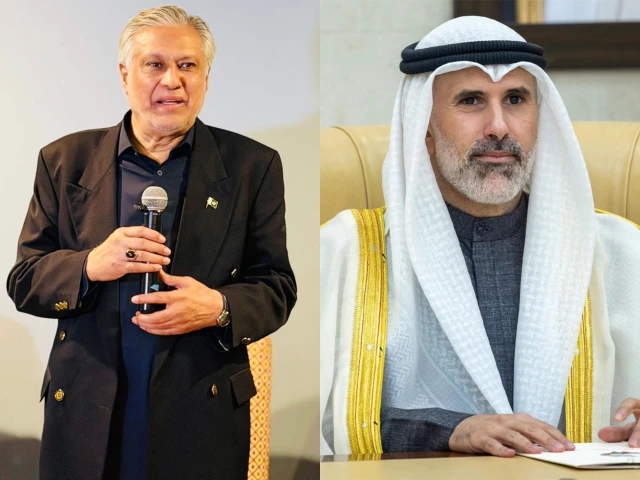
Dar, Kuwaiti FM calls for restraint, respect for sovereignty and implementation of Islamabad MoU amid tensions
A combination of footage with Kuwait’s Deputy Prime Minister and Minister of Foreign Affairs Senator Ishaq Dar and Kuwait’s Minister of Foreign Affairs Sheikh Jarrah Jaber Al-Ahmad Al-Sabah
Pakistan and Kuwait on Saturday stressed the urgent need for de-escalation in the Middle East amid the recent outbreak of fresh hostilities between the United States and Iran, while urging all sides to exercise restraint.
According to a statement issued by the Ministry of Foreign Affairs, Deputy Prime Minister and Minister of Foreign Affairs Ishaq Dar received a phone call from Kuwait’s FM Sheikh Jarrah Jaber Al-Ahmad Al-Sabah, where the two leaders discussed the latest developments in the region.
“Foreign Minister Sheikh Jarrah shared Kuwait’s serious concerns regarding the continued attacks on its territory,” the statement said, adding that he hoped restraint would be exercised by all sides and that the Islamabad MoU would be fully implemented.
Deputy Prime Minister/Foreign Minister Senator Mohammad Ishaq Dar @MIshaqDar50 today received a phone call from the Minister of Foreign Affairs of the State of Kuwait, HE Sheikh Jarrah Jaber Al-Ahmad Al-Sabah.
The two foreign ministers discussed the latest developments in the region… pic.twitter.com/ZxRFsczOoQ
— Ministry of Foreign Affairs – Pakistan (@ForeignOfficePk) July 18, 2026
He also appreciated Pakistan’s constructive and mediating role in promoting dialogue and regional stability.
During the conversation, Dar emphasized the urgent need for de-escalation, emphasized the importance of respecting the sovereignty and territorial integrity of all states and stressed that maintaining regional peace and security must remain a high priority.
He also stressed the importance of maintaining ceasefire commitments under the Islamabad MoU and avoiding any action that could further escalate tensions.
The two leaders agreed to remain in close contact on issues of mutual interest.
Read: Iran has suspended the implementation of Islamabad MoU: Deputy Minister Gharibabadi
The call came as Iran launched attacks on US military bases in Kuwait, Jordan and Bahrain, while an adviser to Supreme Leader Mojtaba Khamenei said the conflict would enter a more “aggressive” and “destructive” phase.
Kuwait Petroleum Corporation said that “one of the vital sites of the oil sector was subjected to repeated brutal Iranian attacks, resulting in a number of injuries and significant material losses”, according to Al Jazeera.
“The injured received medical attention and the site was evacuated while the response to the attack is handled in coordination with the relevant government authorities,” the statement said, according to the country’s KUNA news agency.
Separately, Kuwait Airways announced that takeoff and landing operations at Kuwait International Airport had been temporarily suspended, adding that most of its flights had been rescheduled due to the measure.
“Most flights have been rescheduled due to the temporary suspension of takeoffs and landings at Kuwait International Airport as a result of the Iranian aggression,” the airline said in a statement. KUNA.
Iran launched renewed attacks on the United States’ Gulf allies on Saturday after a seventh straight night of US strikes targeting Iranian military sites, including logistics infrastructure, escalating the conflict a week after a fragile ceasefire agreement collapsed.
Also read: Iran renews attacks on Gulf states after another night of US attacks
Both sides also targeted shipping traffic, with the United States saying it was enforcing a naval blockade while Iran said it was targeting vessels violating its rules on navigation through the Strait of Hormuz, a vital waterway for about a fifth of global oil supplies.
Oil prices rose more than 4% on Friday to their highest level in more than a month, increasing political pressure on US President Donald Trump as his Republican Party seeks to retain control in November’s congressional elections.
Washington and Tehran have continued to test the limits of escalation since the ceasefire deal collapsed last week, raising fears of a return to full-scale war.
Former IRGC commander Mohsen Rezaei stated early Saturday that “both diplomacy and negotiations as well as war are over.”
স্তিক্ত্য है নান্যান हौ জুগ তামা শ্দ; If America continues the war for the next 2-3 days, we will enter the attack phase and we will be in the attack phase. در صورة فيكلسازی ين ستراجی دیر به نمویبهمستل اكتفا نمویكتفا نموی صیاسیاد در مساعد فورگا عایران ایران سیاستیا در نامیک داشت.
— Mohsen رضایی (@ir_rezaee) July 17, 2026
“If America continues the war for the next 2-3 days, we will enter the stage of the enemy’s ‘full-scale invasion and annihilation,'” he said.
UN Secretary-General Antonio Guterres was also concerned about the escalation, particularly “attacks on civilian infrastructure in Iran and across the region”, his spokesman said.


