
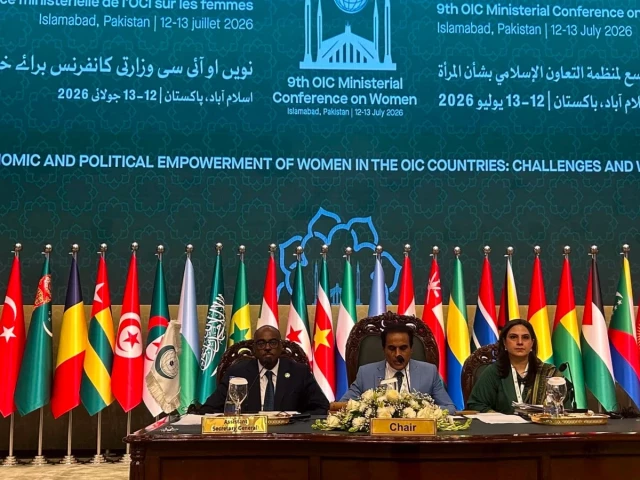
A panel from the 9th session of the Islamic Women’s Conference in Islamabad on Monday. — OIC
ISLAMABAD:
Senate Chairman Syed Yousaf Raza Gilani on Monday urged member states of the Organization of Islamic Cooperation (OIC) to go beyond declarations and translate their commitments into concrete action for women’s socio-economic empowerment as Pakistan assumed the chairmanship of the 9th OIC Ministerial Conference on Women.
The ninth session of the Ministerial Conference on Women ended with the adoption of an omnibus resolution and the adoption of the “Islamabad Declaration.” To view the text of the statement, please click on the following link: pic.twitter.com/sAxw2T4s0P
— OIC (@OIC_OCI) July 13, 2026
Addressing the opening session of the 9th OIC Ministerial Conference on Women, Gilani said as the chief guest that “empowering women is both an Islamic obligation and a prerequisite for sustainable development.”
He said Islam had guaranteed women the rights to education, property, inheritance, economic participation and dignity more than 1,400 years ago, while the teachings of the Holy Quran and the Holy Prophet Muhammad (peace be upon him) continued to provide a timeless framework to ensure women’s meaningful participation in society.
While welcoming ministers, parliamentarians and delegates from OIC member states, Gilani added that women constituted almost half of the population of OIC countries and no nation could achieve inclusive growth while excluding half of its human capital from economic and political participation.
Gilani hailed the contributions of Muslim women in education, governance, science, diplomacy, business and public service, describing Benazir Bhutto as the first female Prime Minister of Pakistan and the Muslim world, whose vision continued to inspire generations.
Highlighting Pakistan’s efforts, he referred to Benazir’s Income Support Program (BISP), Waseela-e-Taleem and other initiatives for women-led businesses, including for financial inclusion, digital literacy and e-commerce.
He also recalled the landmark legislation passed during his tenure as Prime Minister, including laws against workplace harassment, acid crime and anti-women practices, and called on OIC member states to adopt measurable targets for girls’ education, women’s leadership, entrepreneurship, economic inclusion and protection from gender-based violence.
9th OIC Ministerial Conference on Women, Islamabad 12-13 July 2026
Pakistan will host the 9th OIC Ministerial Conference on Women in Islamabad on 12-13 July, bringing together around 190 delegates from 57 OIC member countries. The purpose of the conference is to strengthen cooperation on… pic.twitter.com/kvgtczJv5S
— Ministry of Information & Broadcasting (@MoIB_Official) July 12, 2026
On this occasion, the OIC Assistant Secretary General for Humanitarian, Cultural and Social Affairs, Ambassador Dr. Tarig Ali Bakheet that the conference reflected the organization’s continued commitment to promoting women’s causes and maintaining efforts towards women’s empowerment.
He described empowering women as essential to the development, resilience and prosperity of the Islamic world and expressed the OIC’s appreciation to Pakistan and Egypt for hosting the Ministerial Conferences on Women.
Executive Director of the Women’s Development Organization (WDO) Sarah Al Shoura highlighted the organization’s efforts to strengthen cooperation among member countries and promote policies aimed at expanding women’s participation in education, economic development and leadership.
Ambassador Naela Gabr, Chair of the Women’s Consultative Council at the 8th OIC Ministerial Conference on Women, highlighted the progress made since the previous Ministerial Conference and stressed the importance of maintaining momentum through stronger cooperation among OIC member states.
She called for greater investment in women’s education, economic empowerment and leadership, saying women’s advancement was critical to inclusive development and long-term prosperity in the Islamic world.
Egypt’s National Women’s Council Amal Ammar said nations’ prosperity began with investment in people, especially women, adding that women’s empowerment had become a strategic imperative to achieve sustainable development and stability. She said Egypt had made women’s empowerment a national priority through constitutional, legislative and institutional reforms and the National Strategy for Egyptian Women 2030.
She highlighted Egypt’s flagship “Noura” program for girls, the “Noor” program for boys, the “Tahweesha” initiative for women’s economic inclusion, and the Equality Label awarded to 31 companies that promote gender-responsive workplaces.
She said women had made remarkable progress in leadership, with nearly 3,968 women serving as judges and prosecutors, and increased representation in parliament and senior public office.
Stressing that women’s empowerment was rooted in Islamic values, Amal called on OIC member states to deepen cooperation, share successful experiences and ensure equal opportunities in education, employment, finance, technology and management.
She also highlighted the plight of Palestinian women, urged member states to join the WDO to complete the accession process and congratulated Pakistan for assuming the chairmanship of the conference.
A documentary highlighting the contribution of women in various sectors was also screened during the opening session.


