
Says Pakistan views water security as ‘red line’ and will not allow violations of Indus Waters Treaty
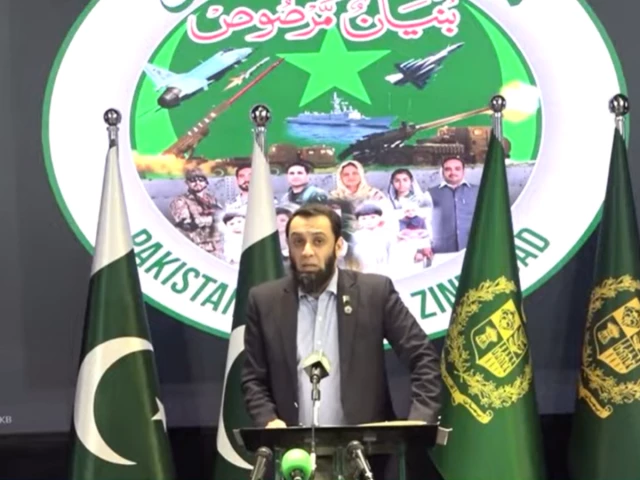
Information Minister Attaullah Tarar is speaking in a special address on the occasion of the first anniversary of Prime Minister Shehbaz Sharif’s speech at Pakistan Military Academy (PMA) Kakul. SCREEN GRAB
Information Minister Attaullah Tarar said on Sunday that Prime Minister Shehbaz Sharif’s speech in Kakul proved to be a “turning point” in Pakistan’s diplomatic stance as he had offered an independent probe into the Pahalgam incident but India did not respond.
“This strengthened Pakistan’s position internationally and proved that India’s accusations were baseless when an inquiry was offered,” Tarar said during a press briefing in Islamabad.
Tarar added that on April 26, 2025, the prime minister delivered a “historic speech” in Kakul, reacting to what he described as Pahalgam’s “false flag operation” and stressing that blame games and unverified allegations must come to an end.
Referring to the attack, he said Pakistan expressed sympathy for the victims and considered the incident a tragedy, adding that the prime minister had called for restraint in blaming and urged that allegations not be made without evidence.
فازیرِعزم Shahbaz Sharif کی برس برس Pakistan Military Academy مییگ کروفتور اور پهلکم regarding the False Flag Operation@TararAttaullah pic.twitter.com/9kRbyK8LR2
— PTV News (@PTVNewsOfficial) April 26, 2026
He contrasted Pakistan’s position with that of India, claiming that Islamabad had consistently condemned terrorism while suffering heavy losses in the fight against it, saying that Pakistan had lost over 90,000 lives and faced economic losses of over $600 billion due to terrorism.
The minister said Pakistan remained a frontline state against terrorism and continued to fight extremist networks alleging external links to groups like BLA and TTP.
Tarar said that on April 24, 2025, Pakistan’s National Security Committee held a meeting where the country gave a “comprehensive response” to Indian allegations.
He also referred to water-related concerns, saying that Pakistan considers water security a “red line” and would not allow violations of the Indus Waters Treaty. He added that the prime minister had warned that any attempt to limit Pakistan’s water rights would be met with a response warning India against using water as a weapon.
Read more: In India, the trial takes place by extended custody
Tarar said Pakistan’s armed forces remain fully capable of responding to any aggression, adding that the nation stood united behind its military leadership.
The minister added that Pakistan’s narrative on terrorism and regional security had gained international recognition over the past year, while what he called “baseless allegations” against Pakistan had not been accepted globally.
He further stated that Pakistan’s international image and the respect of overseas Pakistanis had improved, saying that the country continues to be regarded with “dignity and respect” by the international community.
He added that the Kakul speech would be remembered as an important milestone in Pakistan’s political articulation, strengthening the country’s stance on peace, security and sovereignty.
Pahalgam attack
Escalation between Pakistan and India began on 22 April 2025 when an attack in Pahalgam killed 26 people. India immediately blamed Pakistan for the incident. However, Pakistan categorically denied the Indian blame.
In response, India took a series of hostile actions the next day, on 23 April 2025, including suspending the 65-year-old Indus Waters Treaty (IWT), canceling visas for Pakistani nationals, closing the Wagah-Attari border crossing, ordering the closure of the Pakistan High Commission’s diplomatic staff in New Delhi, as well as other diplomatic embassies in Pakistan.
Tensions escalated further in the early hours of 7 May 2025 when missile attacks hit six towns in Punjab and Azad Jammu and Kashmir (AJK), destroying a mosque and killing dozens of civilians, including women, children and the elderly.
Read more: French intelligence confirms Pakistan downed Rafale
In a swift military response, Pakistan’s armed forces shot down Indian warplanes, including three Rafale jets. The confrontation intensified again in the early hours of 10 May 2025 when India targeted several Pakistani air bases with missile strikes. In retaliation, Pakistan launched Operation Bunyanum Marsoos, damaging Indian military installations, including missile storage sites, air bases and other strategic targets.
On 10 May 2025, US President Donald Trump announced that a ceasefire had been reached after intense diplomatic efforts overnight. Minutes later, the agreement was confirmed separately by Pakistan’s foreign minister Ishaq Dar and the Indian foreign minister.


