
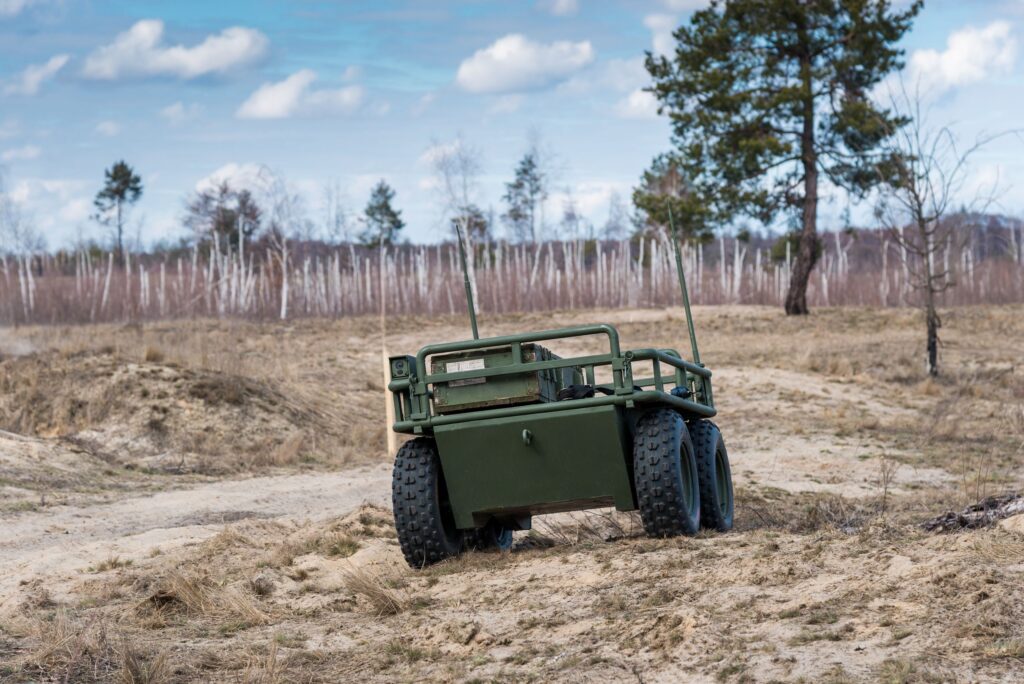
- China and Ukraine are testing new robot capabilities
- Robots are being deployed on the front lines of the war with Russia
- Protests in China may soon be monitored using swarms of robots and drones
Robots cannot surrender, do not suffer from morale problems, and will not refuse an order. That’s why military and law enforcement agencies see them as the future.
Ukraine already employs robots in multiple roles across its armed forces — from seaborne and airborne drones to CASEVAC and logistics vehicles — and now wants to deploy 25,000 more in frontline positions.
China is also flirting with the idea of equipping its armed police and riot units with squads made entirely of robots, controlled by a central AI, with external human input only to prevent the bots from getting too heavy-handed.
The article continues below
Ukraine will deploy 25,000 ground robots
To supplement its existing capabilities, the Ukrainian Defense Ministry has announced that it will seek to deploy an additional 25,000 robots in the first half of 2026. “Our goal – 100% of front-line logistics must be performed by robotic systems,” Defense Minister Mykhailo Fedorov said.
Since the Russian invasion, Ukraine’s robotics and drone industry has exploded with over 280 companies now actively producing systems and solutions to aid the war effort.
Ukraine has already claimed to have taken a trench system using a team made entirely of robots, in what could be a first-of-its-kind engagement. There are also new deployments of drones and robots with mounted weapons, including machine guns and rocket launchers.
The government is also setting up a center to help the armed forces, the general staff and robot manufacturers collaborate, ensuring seamless manufacturing and deployment.
China tests rebel robots
The People’s Armed Police Force (PAP) theorized a scenario where a protest is put down in an urban environment using a riot squad made entirely of robots.
The team, consisting of reconnaissance drones, armored vehicles and robotic dogs, would isolate and detain the instigators and remove the organizational backbone of the protest. The rest of the protest, cut off from the internet and lacking leadership, would then spread by itself.
Aerial drones would use pattern recognition to identify agitators before “watering” the protest with robotic barriers. Arrests are then made using nets and tasers to neutralize threats.
The system would require very little human input, instead using AI as its command center. Arrests would remain a human decision, albeit a distant one.
The scenario set in “New City” bears a striking resemblance to Taipei, the capital of Taiwan, which China has claimed as an inalienable part of the mainland since the Kuomintang-led Republic of China government lost the Chinese Civil War and fled to the island nation.
Follow TechRadar on Google News and add us as a preferred source to get our expert news, reviews and opinions in your feeds.


