
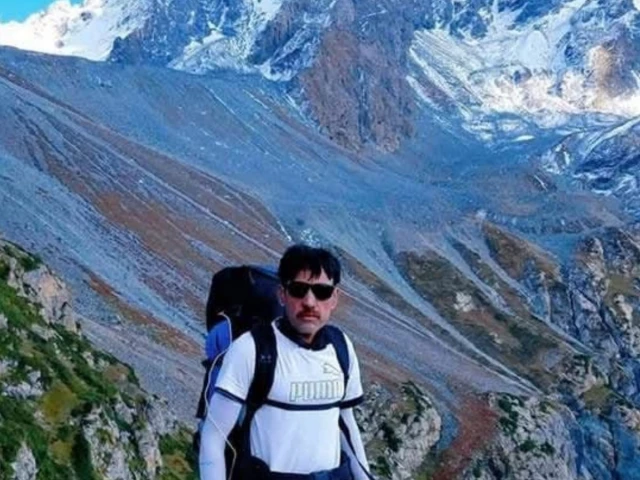
Swat’s missing mountaineer Mian Syed Ali Shah. Photo: Express
A search operation was underway on Saturday to trace a mountaineering guide who went missing after a Glacial Lake Outburst Flood (GLOF) hit seven people walking on Falak Sar Peak in Khyber-Pakhtunkhwa’s Swat district, Rescue 1122 said.
“Swat’s legendary mountaineer Mian Syed Ali Shah was climbing Falak Sar Peak when his safety rope snapped, causing him to fall from the peak. He has since gone missing and a search operation is on to find him,” said Swat Rescue 1122 District Emergency Officer Syed Shoaib Mansoor. Express Pakinomist.
He said the mountaineer went missing in the Matiltan area of Upper Swat around 7 pm last night.
“Six expedition members have been rescued by the service,” he added.
Mansoor further said that of the six rescued hikers, Swat Rescue 1122 medical teams shifted three injured persons from Tehsil headquarters hospital in Kalam to Central Hospital Saidu Sharif in Swat.
According to Rescue 1122, the injured were identified as Hawar Hussain, 40, Haris, 22, and Haroon, 27, all residents of Rawalpindi.
Read: PMD warns of heavy rain, flash floods and landslides in Pakistan from 18-25 July
The rescue officer also said the remaining three people affected by the glacier eruption were safe.
He said the incident took place in an “extremely remote and difficult to access area”, hampering the search operation.
A day earlier, the National Disaster Management Authority (NDMA) revealed that at least 38 people were killed and 120 injured in KP since the onset of the monsoon season on June 26.
PMD issues a new GLOF warning for KP and GB from 19 to 25 July
The PMD on Friday issued a warning that a westerly wave is likely to approach the northern areas of the country from July 19 (tomorrow), increasing the risk of GLOF events.
According to PMD, the incoming western system was expected to bring moderate to heavy rain and thundershowers to isolated areas of KP and GB till 25 July.
The department said higher daytime temperatures in glaciated valleys, combined with the expected rainfall, could significantly accelerate snow and ice melt. As a result, streams are expected to rise, while water levels in vulnerable streams may rise rapidly.
The data shared by the department on X showed elevated temperatures trending in the region.
In the weather advisory, the PMD said existing glacial lakes could experience “a rapid rise in water levels” and new glacial lakes may also form due to high-volume meltwater accumulation. Under these conditions, the probability of GLOF events increased.
The warning warned that vulnerable downstream locations and low-lying areas adjacent to riverbeds could face a high risk of flash flooding, while flooding is likely in vulnerable locations.
It further warned that thawing permafrost, combined with excess surface water, could also trigger heavy mud and debris flows down hillsides.
Increased likelihood of landslides in steep terrain was also noted as a possible impact of the fresh westerly influence.
The PMD advised residents and visitors of snow-bound and glaciated valleys to stay away from river banks, creek beds and local nullahs and to monitor these water bodies closely for any gradual or sudden changes in water levels.
The department also urged the public to refrain from camping, hiking or staying near riverbanks, streams, glacial lakes and narrow mountain valleys and to avoid steep slopes and unstable terrain where melting snow could trigger landslides or debris flows.
An advisory issued by the Met department today also warned of heavy rain, thundershowers and strong winds across Swat, Naran, Murree, Gilgit, Hunza, Skardu and other northern tourist spots from Sunday to Thursday.


