
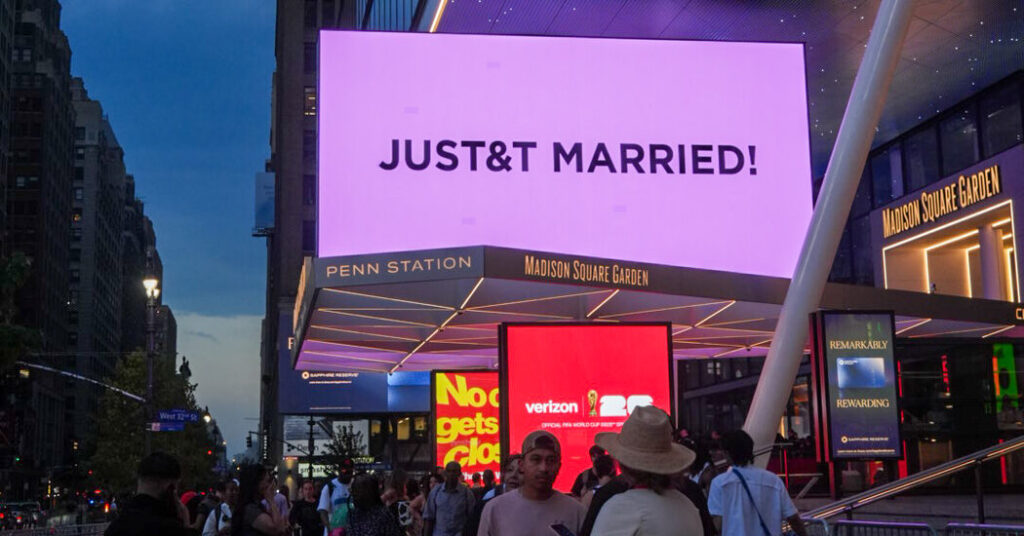
But Lovell cautioned brands against making connections to events that didn’t involve them.
“If your brand wasn’t part of the moment, don’t try to rewrite history with AI,” she said. “Consumers are increasingly smarter now. We can tell when a brand is producing relevance rather than earning it.”
Marielle Conlon, 39, the founder of Ocean Road Antiques in Pennsylvania, found her own way to participate in the wedding excitement. On Friday, she posted an AI-generated reel showing her colorful, bamboo-lacquered furniture being transported into Madison Square Garden by truck, as if she were one of the vendors working with Swift and Kelce’s production team.
“Because, like other small businesses, I don’t have a large advertising budget, I try to be creative with my marketing,” Conlon wrote in a text message. The tongue-in-cheek post, which garnered more than 10,000 views and 1,500 shares, sparked mixed reactions: Some viewers believed it and others appreciated the joke, though some questioned its authenticity.
“The goal was not to deceive anyone,” Conlon said, adding that the post had “poked fun at the internet’s obsession with celebrity weddings and the increasingly surreal nature of AI-generated content.”
Legal experts say that kind of blatant exaggeration is closer to a harmless marketing tactic than false advertising.
“If the image or statement merely conveys excitement or aspiration, it is more likely to be an exaggerated or boastful statement that no reasonable person would rely on as a factual representation,” wrote Andrew B. Jacobs, a partner and attorney at Winston Taylor LLP, a global law firm based in New York City, in a text message.
And despite the attention, Conlon said the wheel’s virality hadn’t translated into sales.
“This was not some wildly profitable marketing stunt,” she said.


