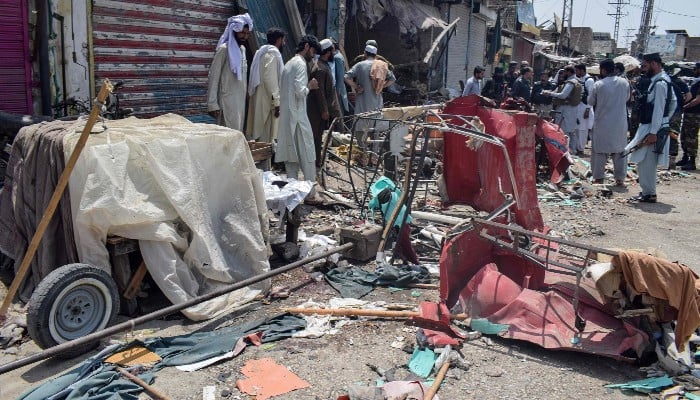
The history of terrorism in Pakistan was neither sudden nor accidental. It evolved gradually through decades of geopolitical conflicts and political expediency. Its roots lie in the 1980s Afghan-Soviet war, when Pakistan became a conduit for weapons, militant ideologies and battle-hardened fighters. Weapons like the Kalashnikov and the Uzi, once symbols of distant wars, became embedded in everyday life in Pakistan.
Over time, the line between ordinary crime and ideological militancy blurs. Criminal acts were often masked in militant rhetoric, while sectarian hatred presented itself as religious devotion. The state gradually confronted a deeply rooted culture of armed impunity that spread through society and changed the country’s social and political landscape.
With the end of the Cold War, militancy did not disappear. Its infrastructure survived below the surface, quietly recalibrating itself. Networks remained intact, training grounds endured, and extremist ideologies lingered. Thus the 1990s unfolded as a decade of deceptive calm.
The early 2000s marked a grim turning point as terrorism in Pakistan became more organized and ruthless. Suicide bombs hit cities and public spaces. These attacks were designed not only to kill but also to spread fear and destroy society.
The US invasion of Afghanistan after 9/11 accelerated this descent into militancy. Pakistan’s alliance with the United States and the collapse of the Afghan Taliban regime pushed foreign militants, including Al Qaeda operatives and Central Asian fighters, into the tribal areas. Over time, these groups redirected violence against Pakistan. The rise of the TTP unified the insurgency and expanded its reach.
The consequences were dire: thousands died, the economy suffered, and fear disrupted daily life. Still, military operations such as Zarb-e-Azb and Radd-ul-Fasaad weakened militant networks and restored state authority in many regions.
But terrorism adapts and reconfigures itself all the time. Following the return of the Afghan Taliban in 2021, the TTP found renewed sanctuaries across the border. Since 2022, militant activity has intensified amid domestic political turbulence. At the same time, long-standing tensions around the Durand Line and allegations within Pakistan’s security framework of support from hostile intelligence networks operating from India and Afghan soil have further complicated the security environment in Khyber Pakhtunkhwa and Balochistan.
In this volatile environment, Imran Khan’s policies assumed crucial importance. His government’s decision to open borders to Afghan militants and facilitate their settlement in Pakistan introduced a deeply contentious dimension. What might have been intended as housing risked reintroducing battle-hardened fighters to an already fragile environment.
At the same time, the insurgency in Balochistan has become sharper and more sophisticated. The Balochistan Liberation Army is believed to have benefited from external financial and logistical support. The influx of modern weapons has encouraged militant operations and transformed the insurgency into a more potent destabilizing force. Yet the steadfast resolve of the Pakistan Army stands up to this challenge.
Pakistan’s police forces deserve special recognition in this long struggle. They often form the first line of defense and have fought terrorism with remarkable courage and sacrifice. Their victims form one of the strongest pillars of Pakistan’s counter-terrorism framework.
A darker spillover of this long proliferation of sophisticated weaponry is now visible in the katcha areas of Sindh and Punjab, where heavily armed dacoit gangs have evolved into dangerous criminal syndicates. Armed with modern weaponry, they have expanded from remote river belts to urban centers where they engage in abduction, extortion and murder with appalling audacity. Police, despite their courage, often find themselves confronting criminals with superior firepower. Under such circumstances, a decisive and coordinated operation, supported by robust intelligence integration between civilian and military agencies and supported where necessary by air power, has become imperative.
Indeed, Pakistan’s journey against terrorism reflects hard-earned resilience and institutional maturity. Military operations dismantled entrenched sanctuaries; intelligence coordination is strengthened; and the calibrated use of air power signaled with unmistakable clarity that militant sanctuaries would no longer be tolerated. Yet terrorism remains inherently protean. It sheds old forms and assumes new guises. Sleeper cells, lone actors and digital radicalization now represent the new frontier of this threat.
Economically, terrorism limits investment and burdens the state; socially, it erodes trust and breaks cohesion; politically imposes the difficult and merciless choice. Above all, it challenges the very imagination of a peaceful and progressive society.
Ultimately, this is a contest of narratives. Militancy cannot be defeated by force alone; the ideas that sustain it must also be extinguished. Where despair once took root, hope, inclusion and lawful governance must emerge. Only then can the cycle of violence really be broken.
Terrorism in Pakistan is neither invincible nor eternal. With the army and the police, clarity of purpose and unity of will can really quell terror.
The author is a former Inspector General of Police and a former Ombudsman, Sindh.
Disclaimer: The views expressed in this piece are the author’s own and do not necessarily reflect Pakinomist.tv’s editorial policy.
Originally published in The News