
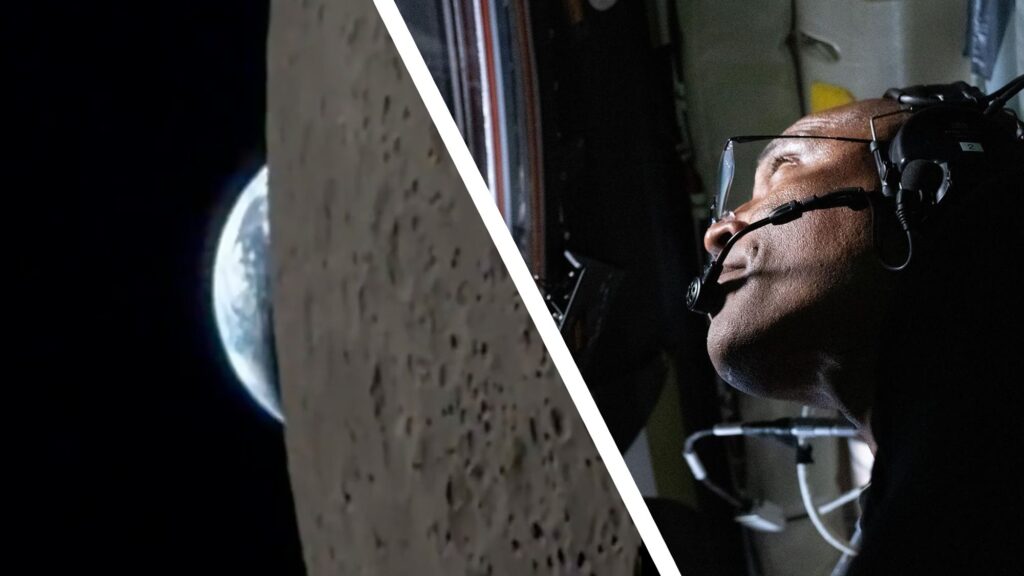
- NASA astronaut Reid Wiseman has filmed an ‘Earthset’ on an iPhone 17 Pro Max
- The footage shows the Earth ‘set down’ behind the moon
- This is the first time we’ve seen video of this, and it was taken with the 8x zoom lens
It’s not every day you see footage of the Earth behind the moon. But today, NASA astronaut Reid Wiseman released the first video taken of that event in human history — and it was shot on an iPhone 17 Pro Max.
Stationed at X, Wiseman shared a 53-second video shot through Integrity’s docking hatch window during the Artemis II mission that shows Earth slowly disappearing behind the moon.
It’s a great clip, and all the more impressive for being shot on an iPhone – in fact, it would make a great advert for Apple phones.
The article continues below
Only one chance in this lifetime…Like watching sunset on the beach from the most alien seat in the cosmos, I couldn’t resist a cell phone video of Earthset. You can hear the shutter on the Nikon as @Astro_Christina hammers away at 3-shot mounts and captures them… pic.twitter.com/8aWnaFJ69c19 April 2026
A scene once in a lifetime
Wiseman claims the footage is uncropped and uncropped with “8x zoom, which is quite comparable to the vision of the human eye.” We’re a little confused by that claim, as the 8x zoom on this phone should be around a 200mm equivalent focal length, whereas the human eye is normally considered to be between 40-50mm.
Still, this isn’t the time to get bogged down in technical details – Wiseman described the scene as something that is “only a once-in-a-lifetime opportunity” and “like watching the sunset on the beach from the most alien seat in the cosmos.” The astrophotographer Andrew McCarthy, meanwhile, said it was “possibly the most incredible video ever recorded by a phone. Bravo.”
While this is among the more impressive scenes to come from the Artemis II mission, we’ve also seen plenty of other photos and videos — including some iPhone shots.
Unfortunately, with the Artemis II mission now complete, there may not be too many more iPhone photos and videos to see from it, but that makes us even more excited for what’s to come on future NASA launches.
Follow TechRadar on Google News and add us as a preferred source to get our expert news, reviews and opinions in your feeds. Be sure to click the Follow button!
And of course you can too follow TechRadar on TikTok for news, reviews, video unboxings, and get regular updates from us on WhatsApp also.


