
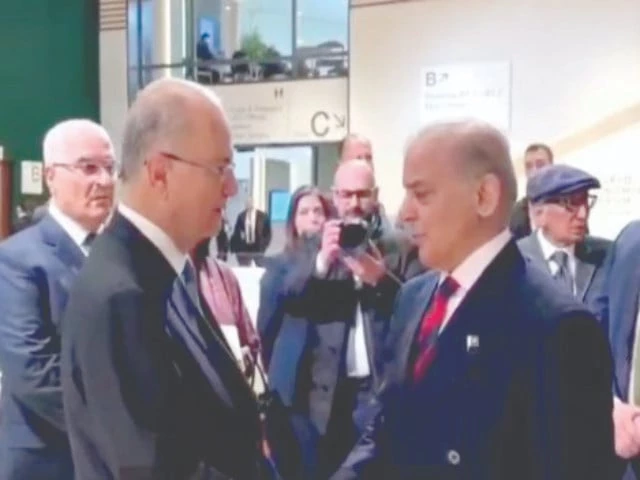
Prime Minister Shehbaz Sharif meets his Palestinian counterpart Mohammad Mustafa in Davos. Photo: APP
ISLAMABAD:
Prime Minister Shehbaz Sharif on Wednesday briefed International Monetary Fund (IMF) Managing Director Kristalina Georgieva of Pakistan’s improved macroeconomic indicators, stabilization efforts and progress on structural reforms.
He emphasized Pakistan’s commitment to fiscal discipline, revenue mobilization and sustainable growth.
The Prime Minister met the IMF MD in Davos, Switzerland, on the sidelines of the 56th annual meeting of the World Economic Forum, the PM Office Media Wing said in a press release.
The meeting was also attended by Deputy Prime Minister and Foreign Minister Ishaq Dar, Federal Minister for Economic Affairs Ahad Khan Cheema, Federal Minister for Finance and Revenue Muhammad Aurangzeb and Federal Minister for Information and Radio Attaullah Tarar.
The IMF Managing Director recognized and appreciated Pakistan’s reform efforts and emphasized the importance of maintaining reform momentum to ensure long-term economic resilience.
Both sides exchanged views on the global economic outlook, challenges facing emerging economies and the importance of multilateral support to ensure economic stability.
Pakistani breakfast
Prime Minister Shehbaz Sharif said on Wednesday that Pakistan will rise rapidly in agriculture, industry, mining, artificial intelligence and information technology.
He was speaking at the ‘Pakistan Breakfast’ in Davos on the sidelines of the World Economic Forum.
Highlighting the tireless efforts of the government, the Prime Minister said that macroeconomic indicators are quite reassuring, the inflation rate has come down from 30 percent to 5.5 percent, the policy rate has come down from a steep 22.5 percent to 10.5 percent, while IT exports are showing significant progress.
Emphasizing export-led growth, Shehbaz Sharif said the government brought structural reforms in the revenue collection system. He added that tax collection in relation to GDP is 10.5 percent today, which was nine percent a few years ago.
The Prime Minister said that agricultural exports are also increasing. He said that Pakistan has signed agreements with American and Chinese companies. He said the government has now decided to move forward with lightning speed in various fields including crypto, artificial intelligence and IT. He said the government is extending all possible relief to improve IT exports, including training and certification.
Sharif said Pakistan has strong economic ties with China and the United States. He expressed hope that there will be more cooperation in the fields of mines and minerals, counter-terrorism, information technology and artificial intelligence.
Sharif further said that the government is encouraging the private sector and it recently completed the privatization of Pakistan International Airlines in a transparent manner. He said the government will now outsource airports, privatize electricity distribution companies and transmission lines.
Macroeconomic indicators
Prime Minister Shehbaz Sharif said Pakistan’s economy was showing clear signs of recovery and the country was moving forward with renewed confidence as key economic indicators continued to strengthen.
Addressing an event at the Pakistan Pavilion on the sidelines of the World Economic Forum’s 56th annual meetings, the prime minister said Pakistan had achieved macroeconomic stability after difficult but necessary reforms and was now firmly focused on export-led growth and sustainable development.
“Our inflation has come down sharply from 30 percent to 5.5 percent, while the policy rate has been reduced from 22.5 percent to 10.5 percent,” he said, adding that the improvement reflected disciplined economic management. He noted that Pakistan’s IT exports had shown reassuring progress and now stood at around $3 billion annually through offshore channels.
The prime minister said Pakistan’s exports continued to face challenges, but the future path was unequivocal. “Pakistan needs to pursue export-led growth,” he said, emphasizing reforms in revenue collection as a key pillar of the strategy.
He said the government had introduced fundamental changes in the tax system which was fully digitized. As a result, the tax-to-GDP ratio had risen to 10.5 percent from 9 percent a few years ago, calling it a significant achievement.
Highlighting sectoral opportunities, Prime Minister Shehbaz said that agricultural exports had performed well in the previous year, while Pakistan was entering the mining and minerals sector.
He said agreements had been signed with American and Chinese companies to exploit the country’s vast untapped resources in Gilgit-Baltistan, Azad Jammu and Kashmir, Khyber-Pakhtunkhwa and Balochistan.
He said Pakistan was also moving rapidly in new fields such as information technology, artificial intelligence and crypto, citing the country’s large youth population as both a challenge and an opportunity.
The Prime Minister said the federal and provincial governments were jointly implementing programs to empower youth through vocational and technical education. He cited the role of the National Vocational and Technical Training Commission (NVTTC) and noted that its programs were subject to third-party audits and international certification, enabling Pakistani youth to secure productive employment in the Gulf countries and beyond.
On foreign relations, he said Pakistan enjoyed strong economic ties with China and was building cooperation with the US, particularly in mining, minerals, counter-terrorism and technology.
Prime Minister Shehbaz also highlighted transparent privatization efforts including Pakistan International Airlines and said further privatization and outsourcing was planned in airports, electricity distribution companies and transmission lines.
Referring to the IMF programme, he said Pakistan had complied with strict conditions in letter and spirit, adding that the fund was now citing Pakistan as a success story for developing countries.
On structural reforms, the prime minister said the government had taken tough decisions to close loss-making and inefficient state units. He said the Utility Stores Corporation, which had been a burden on the national treasury and offered substandard goods, had been closed to save public money. He added that Pakistan Agricultural Storage and Services Corporation (PASSCO) and Pakistan Public Works Department (PWD) had also been closed, resulting in savings of billions of rupees despite opposition from vested interests.
“We are at a point where Pakistan is gaining momentum,” he said, stressing unity, transparency and sustained reforms as essential to achieving long-term growth and prosperity.
Palestinian Prime Minister
Prime Minister Shehbaz Sharif on Wednesday met with Palestinian Prime Minister Mohammad Mustafa on the sidelines of the World Economic Forum (WEF) annual meeting in Davos.
The Palestinian Prime Minister met with the Prime Minister and introduced himself, the PM Office Media Wing said in a press release.
He expressed his gratitude to the Prime Minister for Pakistan’s consistent, principled and steadfast support to the Palestinian people.
He also thanked Pakistan for its role in global forums in support of Palestine and its cause.
(With addition from Radio Pakistan)


