
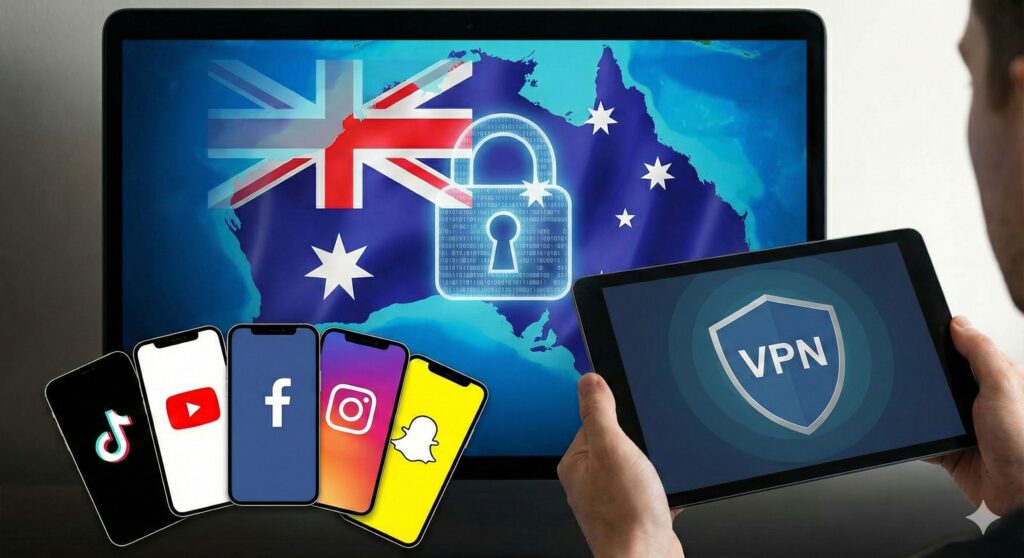
- Australians turn to VPNs amid new mandatory age verification rules
- Australia’s digital rights group claims VPN users could be the next target
- Restricting VPNs could jeopardize the country’s digital security, experts warn
Australian digital rights advocates have warned that VPNs could be next on the chopping block as the country begins the second phase of its age verification.
The warning comes as downloads for VPN services surged in local app stores on Monday as new age-restriction rules for adult-only content came into effect.
The spike shows Australians are searching for ways to protect their sensitive ID data in light of the risk of what the country’s longest-running digital rights organisation, Electronic Frontiers Australia, describes as a “Swiss cheese-style age verification” system.
The article continues below
However, the threats to the public’s privacy and security can only be the starting point.
Speaking to TechRadar, Electronic Frontiers Australia chairman John Pane argues “there’s a reasonably strong possibility” that VPNs could be banned or restricted as a result. Something that, he warns, would create “extraordinary privacy, security and online safety risks” for everyone.
VPN restrictions – what’s at stake?
Virtual Private Networks (VPNs) are tools used by individuals and businesses alike to secure their digital activities from an increasingly data-rich and hacking-ready online world.
VPNs encrypt internet traffic to make online surveillance more difficult. They also spoof a user’s real IP address by redirecting their connections through one of the VPN company’s servers – either in the same country or abroad.
The second feature is why Australian authorities may end up restricting their use.
Rather than security and privacy software, VPNs are increasingly viewed as mere circumvention tools that can allow minors to evade mandatory age checks. Still, Pane told TechRadar that a ban or restrictions on VPNs would be “a bright red line” not to cross.
He warns that online security is at stake for the entire nation, and outlines the unseen risks to both private citizens and commercial businesses should a VPN ban come into place.
For children, Pane explains, this can mean pushing them to use insecure free VPN apps. TechRadar recently revealed that over 75% of all free VPNs in the Android store have questionable personal data practices, easily exposing thousands of minors to malware and other malicious tracking.
The need to find different solutions can also push young people to even darker corners of the web, further jeopardizing their safety and privacy.
As for adults, the millions of people who enter their age verification information on adult content sites create a database of sensitive details that would lead to a large bounty for any identity thief. We already had a hint of this when Discord’s third party revealed the government-issued ID photos of approximately 70,000 users following a data breach.
Without a VPN to protect any of this information transfer, Pane argues, the problem will only get worse. This is a concern shared by over 400 scientists who recently called for a moratorium on mandatory age verification globally until a “scientific consensus” is reached on the benefits and technical feasibility of such laws.
How likely is Australia to restrict VPN use?
While Australia’s eSafety Commissioner, Julie Inman Grant, has yet to announce an outright ban or restrictions on VPNs, the possibility was previously mentioned when these tools began allowing teenagers to easily circumvent the country’s ban on under-16 social media.
Currently, the guidance from the eSafety Commission is clear – all service providers are expected to take “reasonable measures” to prevent solutions, which include detecting and restricting the use of VPNs.
Surfshark’s Senior Product Manager, Justas Pukys, told TechRadar that these expectations rest “on the false notion” that VPNs are merely ‘solutions’ to age restrictions.
“This misconception ignores the fact that VPNs are essential infrastructure for the security and privacy of millions of Australian citizens and businesses,” Pukys said, warning that “attempts to block them are a disproportionate response that treats a fundamental cyber security tool as a loophole, creating far-reaching security harms that policymakers have not adequately addressed.”
We test and review VPN services for legitimate recreational use. For example: 1. Accessing a Service from another country (subject to the terms and conditions of that Service). 2. Protecting your online security and enhancing your online privacy when you are abroad. We do not support or condone the use of a VPN service to break the law or carry out illegal activities. Consumption of paid-for pirated content is neither endorsed nor endorsed by Future Publishing.
Follow TechRadar on Google News and add us as a preferred source to get our expert news, reviews and opinions in your feeds. Be sure to click the Follow button!


