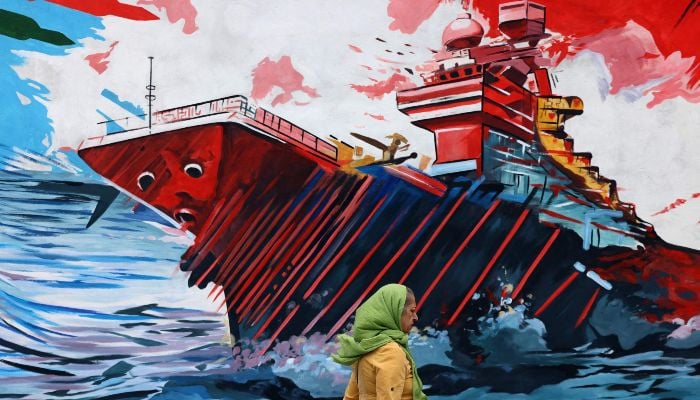
In some ways you can feel it in your bones. A significant wave of anxiety has swept over a world struggling to grapple with the impact and possible consequences of the unfinished Iran war. We are at a turning point in history, and no one knows how it will play out.
But there are certain messages that we can already decipher. In an allegorical sense, we have seen the impotence of power. And there is this example of how a violence-stricken country that has suffered great loss of life and property can find strength and influence with its strategic response to a mighty force.
It would be difficult for a creative writer to imagine this story. She might prefer to tell it in terms of magical realism. Or we would need a Homer to do this because the events of the last two months or so have hints of Greek mythology. And the great challenge in any fictional presentation of the Iran war would be to draw the character played in reality by US President Donald Trump.
I may be excused for this fanciful digression. It is largely due to my inability to gather the different perspectives and correctly interpret developments across several fronts. There are so many surprises and wonders that this war has created. And more twists and turns remain embedded in a story rooted in the very nature of the Iran-US relationship, with Israel pulling the strings behind the curtain.
Although the ceasefire was extended indefinitely by President Trump just hours before the initial two-week ceasefire was due to expire, a war-like situation has continued due to the blockade of the Strait of Hormuz. This affects the entire world and amplifies the energy and economic crises that were completely unanticipated when the US and Israel began their essentially senseless war.
We in Pakistan need to understand our very complex and intimate relationship with this war. There is no doubt that we are in a very good place in that regard. Our diplomatic triumph in becoming a mediator is a remarkable achievement that allows ordinary citizens to be proud of their country.
But we also have to pay the costs of this conflict, and I don’t see much attention being paid to this issue on an intellectual level. A massive disruption to the affairs of the countries of the Gulf region, especially the UAE, will soon have a major impact on our economic and social sectors.
There is so much that is passionately discussed in our casual conversations. I’m kind of amazed at the passion people I know invest in these discussions. They are also confused about some results of this ongoing war. This widely accepted view of Iran’s astonishing resistance to American aggression creates great excitement. So what upheavals will mark the birth of a new order? Where does China fit into this equation?
As I said, things are not easy to understand. Overall, it’s a bleak situation that highlights distinct problems across countries. At the time of writing, a glimmer of hope has emerged with the prospect of a second round of talks between America and Iran in Islamabad, the city that has been under a security lockdown for more than a week. How this excessive security has affected the lives of citizens and even created food and fuel shortages is another story.
In any case, Iranian Foreign Minister Abbas Araghchi’s visit coincided with a senior White House official in Washington, DC that Steve Witkoff, the US special envoy, and Jared Kushner, President Trump’s son-in-law, were returning to Islamabad to resume talks with Iranian officials.
This means that the second round of talks will be held at a lower level, in the absence of Vice President JD Vance and the Speaker of the Iranian Parliament, Mohammad Bagher Ghalibaf. They are expected to participate in the negotiations if an agreement is seen as possible. Since Iran has become more influential after the 38-day war, it would certainly like to make a hard bargain.
In the meantime, I’d like to highlight two reports I’ve seen this week that explain some of the unbearable costs of the Iran war. One is a warning from the United Nations that this war will push more than 30 million people back into poverty and increase food insecurity in the coming months. The second is about the incredible cost of the war to the United States in the form of high-value military equipment.
Alexander De Croo, administrator of the United Nations Development Program (UNDP) said on Thursday: “Even if the war would stop tomorrow, you already have these effects and they will push more than 30 million people back into poverty”. He warned of other consequences of the war, including energy shortages and declining remittances.
He said disruption of fuel and fertilizer supplies due to the blockade of cargo ships through the Strait of Hormuz has already lowered agricultural productivity and will hit early harvests later this year.
A report in New York Timesciting administration and congressional officials, said the Iran war has drained US supplies of critical, expensive weapons. The Pentagon’s rush to rearm its Middle Eastern forces has left it less ready to confront potential adversaries, such as China and Russia.
Although White House officials have so far refused to estimate the cost of the conflict, two independent groups say the cost is staggering: between $28 billion and $35 billion, just under $1 billion a day. In the first two days alone, the military spent $5.6 billion in ammunition.
Let me close with what Senator Jack Reed, the top Democrat on the Armed Services Committee, said this week: “At current production rates, it could take years to reconstruct what we’ve used”.
And yet America has not achieved any of its goals.
The author is a senior journalist. He can be found at: [email protected]
Disclaimer: The views expressed in this piece are the author’s own and do not necessarily reflect Pakinomist.tv’s editorial policy.
Originally published in The News