Why this matters
- The third largest Ebola outbreak ever recorded.
- Most new infections come from unknown transmission chains.
- Virus has spread beyond the original outbreak area.
- Early detection and global support are essential.
Speaking to reporters in Geneva after returning from Bunia in eastern DRC’s Ituri province, at the heart of the outbreak, Dr. Chikwe Ihekweazu, Executive Director of WHO’s Health Emergencies Programme, that with close to 2,000 confirmed cases and more than 700 deaths in five provinces, the outbreak is the third ever on July 11.
“We’ve seen the fastest growth in a single month since the outbreak started and of all the Ebola outbreaks that we’ve managed,” he said.
“Over the past few days, we’ve seen some of the highest numbers of new infections in a single day,” added Dr. Ihekweazu, including over 80 cases confirmed in 24 hours.
Known unknowns
Many of the newly reported deaths are people who died in their communities without ever reaching a health facility or receiving care – which is what the WHO official described as “the most alarming finding”.
Despite advances in diagnostics and high contact follow-up rates, “80 percent of new cases are outside our contact lists and therefore come to us from unknown chains of transmission,” warned Dr. Ihekweazu.
The current outbreak was declared two months ago almost today, and WHO modeling indicates that its scale could be “at least two to four times” the number of reported cases.
“You have to imagine this is a fire,” said Dr. Ihekweazu. “There’s something fueling the fire in its heart, and it’s also expanding at the same time.”
While up to 95 percent of all new Ebola cases come from Ituri province, where the outbreak started, the virus has very recently spread to two new provinces, Haut-Uele and Tshopo.
The WHO official outlined a two-pronged strategy for the response: continue to push to the heart of the outbreak in Ituri while “understanding the routes of travel … and really mapping where the risk is of new cases emerging”.
The WHO official urged the international community not to be “disheartened” by the disease’s rapid spread, insisting that the work was paying off.
“Now is not the time to drop the ball,” he warned.
Therapeutic trials underway
Several therapies are undergoing clinical trials, but there is no approved treatment yet for patients with the Bundibugyo strain of Ebola. Still, the chances of survival increase significantly with early supportive treatment.
“We need to find the cases earlier, get them into care as quickly as possible” to reduce infection in the community and avoid falling behind the curve, said Dr. Ihekweazu.
Asked about recent attacks on healthcare workers and facilities, he explained that the solution lies in “being open and transparent” about the care provided.
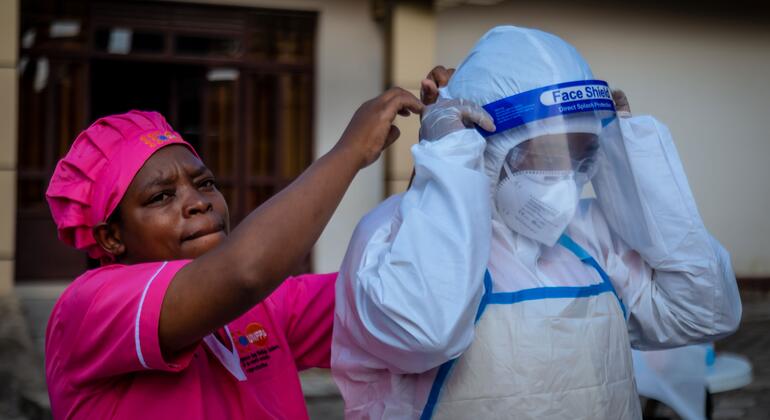
“Before a new center opens, we invite community leaders to see what’s being done” and to talk to the health care providers who have left their homes to support the response, he said.
Preventing attacks on healthcare depends on building community trust in the new facilities and showing people that “they will not be left alone – they will not only be treated, they will be offered food, they will have access to their families”.
As the fight continues to stop the spread of Ebola in the DRC, Dr Ihekweazu spoke of “dissonance between the threats we face and the efforts we are making to respond.”
“We need the world to come together, not just out of charity or out of support for the DRC, but in our own enlightened interest. The more we do now, the better off we will be in the future,” he stressed.
The WHO official mentioned that at the WHO headquarters in Geneva, member states are negotiating the key part of the WHO pandemic agreement, the Pathogen Access and Benefit Sharing (PABS) annex, which aims to ensure that genetic information on dangerous pathogens with pandemic potential is quickly shared and vaccines and treatments are made available to developing countries.