
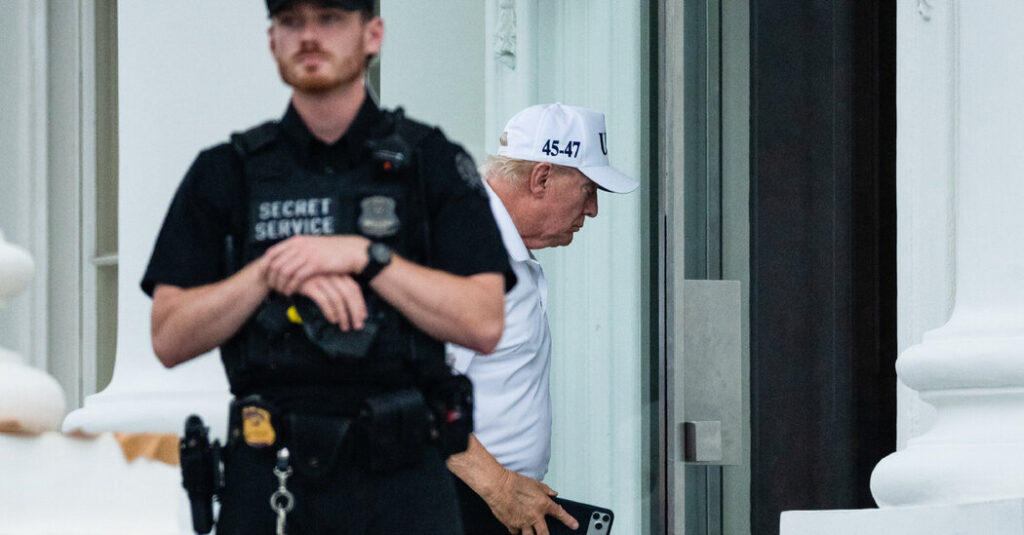
President Trump reaped an astonishing windfall in his first year back in the White House, including about $1.4 billion from his family’s cryptocurrency businesses, a new filing shows.
This figure does not include money he brought in from other parts of his large holdings, including stocks, bonds and real estate.
One of his biggest moves in 2025 came when an investment firm linked to the United Arab Emirates bought nearly half of the Trump family’s main crypto business, World Liberty Financial, a transaction that blurred the line between foreign policy and private business.
Mr. Trump also raised hundreds of millions of dollars from the sale of his $TRUMP memecoin and World Liberty’s sale of its own digital tokens.
The findings, detailed in Mr Trump’s 2025 mandatory financial disclosure report and released on Tuesday, pulled back the curtain on the president’s business operations. His crypto ventures, the report shows, are now some of his most lucrative businesses, a remarkable turnaround for a man who once slammed crypto as a haven for drug dealers and fraudsters.
The return, which had been something of a mystery, highlights a conflict in the president’s crypto business: Not only is Mr. Trump a major crypto industry operator, but he is also its top policy maker.
That’s hardly the only problem that arises from having a businessman serve as president. The president’s family business, the Trump Organization, has also taken advantage of Mr. Trump’s popularity in certain parts of the world, and licensed the Trump name to properties in countries crucial to US foreign policy interests, including Saudi Arabia and Qatar.
The White House did not immediately respond to a request for comment, although Mr. Trump has previously noted that he is exempt from federal conflict-of-interest laws.
Anna Kelly, a White House spokeswoman, said in a recent statement that Mr. Trump “acts only in the best interest of the American public” and that “there are no conflicts of interest.”
Although the report, released Tuesday, offered revenue figures for Mr. Trump’s crypto and real estate ventures, it did not disclose whether all the companies had profits or losses, which is consistent with his previous filings.
What is clear from the report, however, is that Mr. Trump’s crypto operation was a top money maker.
Once an outspoken skeptic of crypto, Mr. Trump industry on the campaign trail in 2024 and started a series of ventures that have reaped huge sums.
Along with his three sons, he co-founded World Liberty, a crypto company that sells a digital currency called $WLFI.
Last year, World Liberty marketed its coin to investors around the world, with 75 percent of each sale allocated to a Trump business entity, after deducting certain expenses, guaranteeing that the president would make money even if the value of the token fell.
World Liberty also enriched the Trump family in other ways. In January 2025, days before Mr. Trump’s inauguration, an investment firm linked to the UAE government bought a 49 percent stake in World Liberty for $500 million, raising a number of ethical concerns. Soon, the Emiratis struck a deal with the Trump administration — over the objections of some national security officials — to export valuable computer chips that power artificial intelligence.
The filing, made public on Tuesday, did not explicitly refer to the deal, but it did mention unnamed investments that generated more than $200 million for Mr. Trump.
The other major source of Mr. Trump’s crypto wealth was his memecoin, a novelty currency known as $TRUMP, which he began selling days before his inauguration. He made more than $600 million from the sale of the coin, according to the filing.
The coin’s price rose briefly before falling, with its price now hovering at $1.67, down 80 percent from a year ago.


