
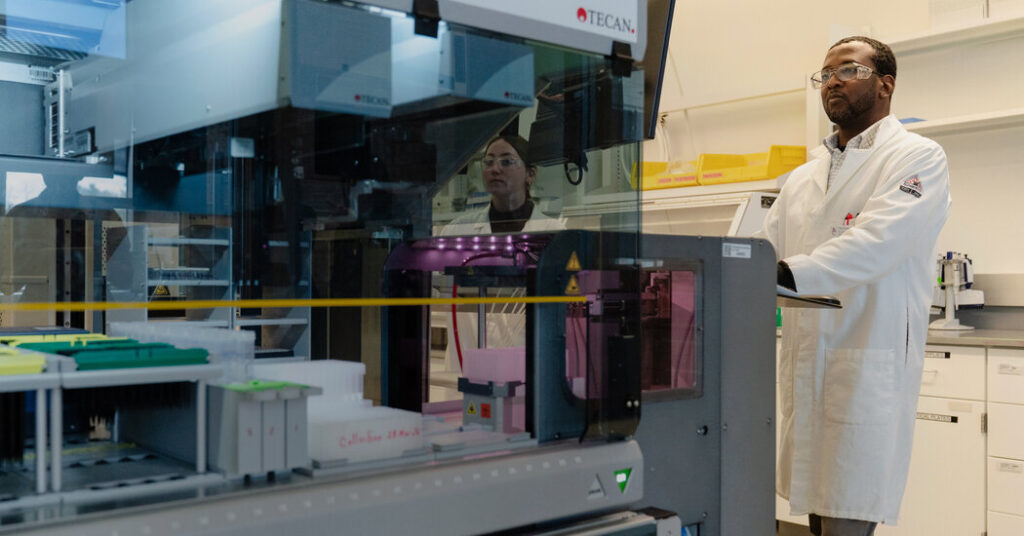
In a sterile Bristol Myers Squibb lab about an hour north of Boston, researchers in scrubs and hairnets transfer living cells into a 2,000-liter stainless steel bioreactor, growing them for weeks. The goal is to produce proteins that are genetically engineered to attack cells that cause disease.
Small variations in heat, light or pH levels can stop cells from growing, causing drug shortages that put patients at risk. Typically, scientists would wait to see what went wrong during the fragile process, but now artificial intelligence is being used to carefully monitor key variables – such as temperature and oxygen levels – and alert technicians if there are problems.
Every year, the World Economic Forum and McKinsey recognize manufacturers who are at the forefront of technology, including artificial intelligence. This year, the Bristol Myers Squibb plant in Devens, Mass., was the only U.S. manufacturer to make the list of 23.
While American companies typically lead in AI research and capital investment, American manufacturers often struggle to translate these breakthroughs into productivity gains on the factory floor.
Of the 223 factories that have made the World Economic Forum’s Global Lighthouse Network list since 2018, 14 have been in the United States, while 99 are in China. Of the American ones, four are in the pharmaceutical and life sciences sector.
“China is scaling faster,” said Rahul Shahani, a partner at McKinsey who is working with the World Economic Forum on the initiative. He added: “They have technologists in the factories – hundreds of them – while in the US we are competing for the same talent with Silicon Valley.”
Big US pharmaceutical companies have been a rare bright spot in the use of artificial intelligence Many drugmakers, including Pfizer and Eli Lilly, are investing billions in artificial intelligence and related technologies to speed up drug discovery and streamline production. The trend coincides with President Trump’s demand that drugmakers produce more drugs on American soil.
Researchers at the Devens facility are using artificial intelligence to discover molecules that can target cancer and other diseases with greater precision. AI can comb data sets from past experiments to identify possibilities that a human might not have considered. Researchers then test these molecules in the virtual world—a process called “in silico.” Only the most promising are tested in a physical laboratory. The company can run several “in silico” experiments at a time.
“Drug discovery and bio-manufacturing are definitely areas where artificial intelligence can have the biggest impact,” said Kyle Chan, a fellow at the Brookings Institution’s John L. Thornton China Center. “These are areas where AI has some of the biggest advantages over previous approaches, given the need to process and synthesize large, complex data sets.”
However, there is no guarantee that technological benefits will immediately translate into benefits for patients. The history of drug development is littered with mistakes, and it is unknown whether molecules identified by AI will pass patterns in clinical trials.
The Bristol Myers Squibb facility is located on an 89-acre campus where buildings are decorated with portraits of cancer survivors.
Previously, scientists and engineers were never sure why some batches of cells produced a large amount of proteins while others failed completely. But now AI uses information from previous batches to identify which variables need to be changed. For example, if the oxygen level is lower than previous batches, the system will suggest adding oxygen. If the pH levels are higher than previous batches, it will recommend a solution. It also suggests the best time to harvest the cells.
These innovations have increased the amount of drugs produced for clinical trials and commercial use at the facility by about 40 percent, according to a company spokeswoman.
“We are now able to intervene in the batches during the manufacturing process and not have to wait until we get to the end,” said Karin Shanahan, executive vice president, chief supply chain and operations officer for the company.
These innovations have helped stabilize the production of Orencia, a drug that treats autoimmune conditions such as rheumatoid arthritis using cells that are extremely difficult to grow. By 2024, production challenges resulted in shortages in some parts of the world.
The company has just begun using artificial intelligence in its manufacturing process for another drug, Breyanzi, which turns a cancer patient’s own white blood cells into a personalized treatment. Currently, the Devens facility is approved by the Food and Drug Administration to produce treatments for only 12 patients at a time.
Mrs. Shanahan said she hoped artificial intelligence would eventually increase production of the treatment, often seen as a last resort for people with blood cancers such as leukemia.
Bristol Myers Squibb has embarked on a series of cost-cutting measures as the key patent for its cancer drug Opdivo expires in 2028. The drug, which uses proteins that have been genetically engineered to target cancer cells, generated more than $10 billion of the company’s $48 billion in revenue last year.
The company is trimming $2 billion in costs by the end of 2027 on top of $1.5 billion in cuts announced in 2024. More than 1,000 positions are being eliminated, many of them at a research facility in Lawrenceville, NJ, adding to fears of AI’s elimination of jobs in the sector.
At the Semafor World Economy Summit last month, Bristol Myers Squibb CEO Chris Boerner said the company had a responsibility to use AI to advance its mission, but acknowledged it could negatively impact some employees.
“We engage with these employees to make them more marketable around this technology — with the company or elsewhere,” he said.
The Devens facility, which was completed in 2009 at a cost of $750 million, was not designed with artificial intelligence in mind. As recently as 2020, employees were using Excel spreadsheets for some tasks. Batch records documenting each step of production were completed by hand. But in recent years, the company has prioritized digitizing and automating its processes.
“We had to make sure that we could formulate our products faster, that we could commercially scale them faster,” Shanahan said. “And that’s really what forced us to start going down that path.”
Overall, the company aims to reduce the time it takes to bring a drug to market to about six years, from nine, she said.
Other factories that received recognition from the World Economic Forum this year include Yueda Textile in Yancheng, China, which collects sensor data to detect machine maintenance problems before they occur, reducing costs; and Midea, a microwave and air conditioner manufacturer in Thailand that uses artificial intelligence to investigate customer complaints and generate recommendations for corrective actions that reduce resolution time from months to days.
Some of the factories in China that received the award in previous years belong to American companies, including Johnson & Johnson and Agilent, a California supplier of advanced laboratory equipment. But Chinese drugmakers are also expanding their use of artificial intelligence.
“This is not just a trend among American pharmaceutical companies,” said Mr. Chan, Brookings Institution Fellow. “China’s biotech industry has moved quickly to harness AI to accelerate progress.”


