
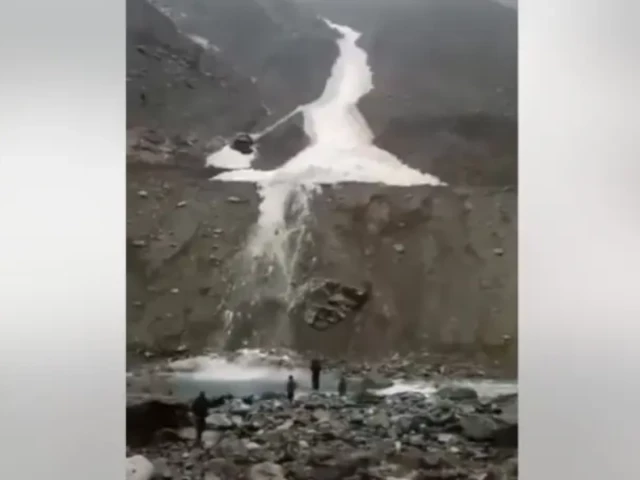
Video shows an avalanche blocking a road in GB as people can be heard screaming in panic in the background
Pakistan is experiencing an intense heat wave this year, with the mercury crossing 50°C in some parts of the country. In his weather forecasts for 26.-31. In May, the National Disaster Management Authority warned that rising temperatures, heat wave conditions, flash floods and landslides could affect several parts of the country, especially the northern and southern regions.
It added that there was also a risk of glacial lake outburst (GLOF) across Gilgit-Baltistan, Khyber-Pakhtunkhwa and Azad Jammu and Kashmir.
Earlier, the NDMA also issued a warning of an increase in potential GLOF events from March to September 2026 due to an expected increase in temperatures, changing weather patterns and possible early heatwave conditions in northern Pakistan.
Since Tuesday, a video has been circulating on X showing an avalanche blocking a road in Gilgit-Baltistan, while in the background people can be heard screaming in panic, some even chanting ‘Allahu Akbar‘.
Many social media users shared the video, claiming the visuals were recent and raising alarm over Pakistan’s weakened glaciers. Some also used the clip to warn tourists heading north on holiday.
The video was also shared by local digital news outlets on YouTube and Instagram, as seen here, here, here and here.
It should be noted that none of these posts mentioned when the incident occurred.
A keyword search carried out to confirm whether any national or local media had reported on recent avalanches in GB returned no results.
Conducting a reverse image search on Google yielded a Facebook video shared by the state media Pakistan TVdated March 13, with the caption: “An avalanche blocked a river in the mountains of Gilgit-Baltistan in northern Pakistan amid snowfall ahead of the spring season.”
The caption ended with the hashtags #GilgitBaltistan #AvalancheAlert #NorthernPakistan #SnowfallImpact.
The video was also shared by Bol Hunzaa regional media network and a page covering news in the GB region on their Instagram account. It was dated March 13. According to the caption of the post, the incident took place in Upper Hunza.
The same video was also shared by multiple users on X and Facebook at various times during April and May.
Jamil Nagri, Dawn correspondent in GB, also confirmed to iVerify Pakistan that no such event had taken place in the region recently and that the video dated back to March.
During an avalanche, a mass of snow, rock, ice, soil and other material slides quickly down a mountainside.
In a report released in March, the NDMA said the incidence of avalanches is highest in Pakistan from February to April, when heavy snowfall events are followed by temperature fluctuations, strong winds and additional snow loads.
It further stated that infrastructure expansion, including the Karakoram Highway, hydropower installations and settlements located in narrow valleys, increases exposure to avalanche hazards. Districts such as Chitral, Upper Dir, Ghizer, Hunza, Skardu, Neelum and Haveli remain particularly vulnerable.
Research shows that the frequency of avalanches in the Himalayan mountains has increased in recent years in what is called an “expected consequence” of climate change.
Conclusion
The claim that a viral video shows a recent avalanche in GB is misleading.
The video is from March 2026. Also, according to NDMA, the highest occurrence of avalanches in Pakistan is from February to April.
This fact check was originally published by iVerify Pakistan – a project of CEJ-IBA and UNDP.


