
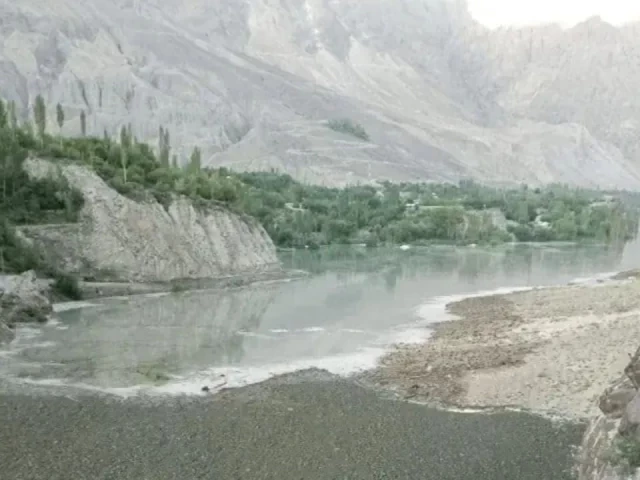
Pakistan’s northern areas experienced unusual summer snowfall; rain and snow disrupted life in KP, GB and AJK in March–April
Haider Raza, the director of North/Nature-Based Solutions at WWF-Pakistan, told iVerify that rain and snow after March 21 in northern areas was not unusual. Screen grab from video
On Monday, the National Disaster Management Authority (NDMA) issued a high-level heatwave warning, warning that large parts of southern and central Pakistan are likely to experience dangerously high temperatures from May 19 to May 26. Especially in the southern areas of the country, temperatures have risen well above seasonal norms throughout April and May, often crossing 44-46 degrees Celsius.
According to NDMA’s latest release, temperatures were expected to remain unusually high for three to five consecutive days in several districts of Punjab, Sindh and Balochistan. It added that rising humidity in lower Sindh and dry interior conditions in Punjab and Balochistan may further intensify thermal stress.
On the other hand, Pakistan Meteorological Department (PMD) issued Glacial Lake Outburst (Glof) warning for northern areas. According to the weather advisory, a moderate westerly wave had penetrated the upper regions of the country and was currently affecting parts of Khyber-Pakhtunkhwa and Gilgit-Baltistan. Intermittent rain-wind/thunderstorms with isolated heavy falls would likely occur over vulnerable mountainous catchments during the ongoing weather period.
Over the past few days, social media has been abuzz with videos showing snowfall in Pakistan’s mountainous north, including parts of GB and KP. The rocks left many users surprised and questioning whether snowfall at this time of year was unusual. “Is there snow in GB even this season?” one user asked, while another wondered, “Does it still snow there?”
Sharing a video from Mansehra, an X user called the snowfall in May a “miracle”.
What we found
Looking at the weather pattern, the northern areas of Pakistan have experienced snowfall during the summer. Rain and snowfall disrupted daily life in parts of KP, GB and Azad Jammu and Kashmir during the months of March and April, according to media reports Aaj News and Dawn.
In GB, avalanches near the Khunjerab Pass blocked the Karakoram Highway, stranding tourists. Rain-triggered landslides also blocked access roads and damaged infrastructure in several other areas and disrupted water supply channels, power transmission, internet and mobile services.
Mohammad Hasan, a resident of Skardu, said that snowfall over mountain peaks occurred intermittently. “I visited Deosai Plains two days ago. There was at least three inches of snow there,” he added. Jamil Nagri, Dawn‘s GB correspondent, also confirmed the same.
Meanwhile, Abbottabad and surrounding areas experienced intermittent rain and snow, with temperatures falling below freezing. A couple who visited the northern areas in early May confirmed the same. Asad Mehmood Lodhi, the Additional Deputy Commissioner (Relief) of Mansehra, told iVerify Pakistan that the area received heavier snowfall this year during April.
These temperatures were already predicted by PMD. According to a Dawn report dated May 2, the Met Office had predicted widespread rain, thundershowers and isolated heavy falls across GB and KP due to a westerly wave.
Research showed that snowfall in the northern areas of Pakistan traditionally occurred from late November to February, with January generally seeing the heaviest and most consistent snowfall. But in recent years, heavy snow has been reported well into March, April and now May.
Last year, sudden snowfall and rain was also reported in GB during March.
According to a report by GB-centric news outlet Pamir Timeswas this temperature cycle part of a wider climate shift. “Global warming is disrupting seasonal cycles, sometimes resulting in milder winters and harsher spring cold spells,” it said. The report also cited the Intergovernmental Panel on Climate Change (IPCC), noting that it had identified the Himalayas and Karakoram as particularly vulnerable to such anomalies due to their fragile ecosystems and rapid glacial changes.
Haider Raza, the director of North/Nature-Based Solutions at WWF-Pakistan, told iVerify that rain and snow after March 21 in northern areas was not unusual. “However, their intensity has increased in the last few years, probably due to the effects of climate change and other anthropogenic activities,” he added.
Fatima Yamin, a climate change expert, said that climate change had caused massive transformation or change in Pakistan’s seasonal weather patterns.
“Rainfall patterns are also changing in frequency and amount. This is why northern areas will experience longer summers with above-normal rainfall, while some areas will also experience below-normal rainfall,” she added.
Conclusion
Yes, the northern areas of Pakistan actually experienced snowfall in summer.
The weather had been predicted by the Met Office. In recent years, heavy snow has been reported well into March and April in the north due to the effects of climate change.
This fact check was originally published by iVerify Pakistan — a project of CEJ-IBA and UNDP.


