
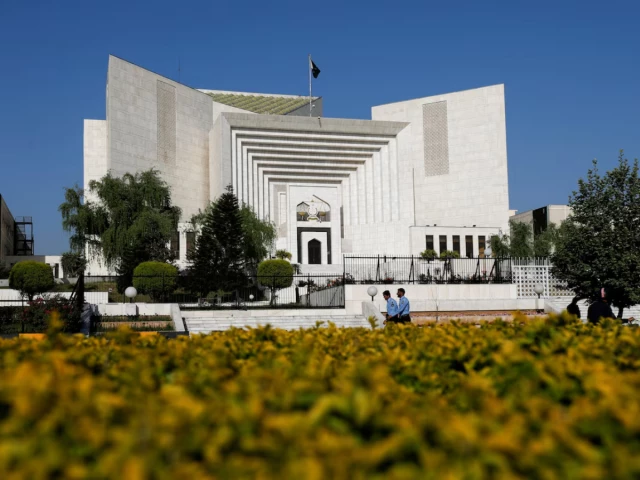
Police officers walk past the Supreme Court of Pakistan building in Islamabad, Pakistan April 6, 2022. REUTERS
ISLAMABAD:
The Supreme Court has established a definitive legal basis on the tenancy, which states that after the death of a property owner, legal heirs automatically become the rightful owners and no new tenancy agreement is required.
The court further held that the deposit of rent in the name of a deceased landlord does not constitute a valid legal payment.
Upholding the Sindh High Court’s decision, the apex court upheld the eviction order against the tenants and directed them to vacate the shops and hand over the possession to the legal heirs within 60 days.
The case was heard by a two-member bench comprising Chief Justice Yahya Afridi and Justice Shakeel Ahmed. Justice Shakeel Ahmed authored the four-page written judgment, which has been approved for official reporting.
According to the detailed judgment, after the death of the original owner, his son as legal heir has given notice to the tenants demanding payment of rent and outstanding dues.
The court noted that the tenants acknowledged both the death of the owner and their attendance at his funeral, yet failed to pay rent to the rightful heirs.
In the judgment, it appeared that, despite the opening letter, the tenants continued to pay rent into court under the deceased owner’s name, which the court declared invalid.
The Supreme Court clarified that when legal heirs notify the tenants, rent must be paid to them and payments made in the deceased’s name do not satisfy legal obligations.
The court ruled that failure to pay rent to the legal heirs, combined with willful deposit of rent under the deceased landlord’s name, constitutes willful default. Such conduct, the court believes, makes tenants liable for eviction.
Rejecting the tenants’ argument that depositing rent in court protects them from eviction, the Supreme Court ruled that willful defaulters cannot claim legal protection.


