
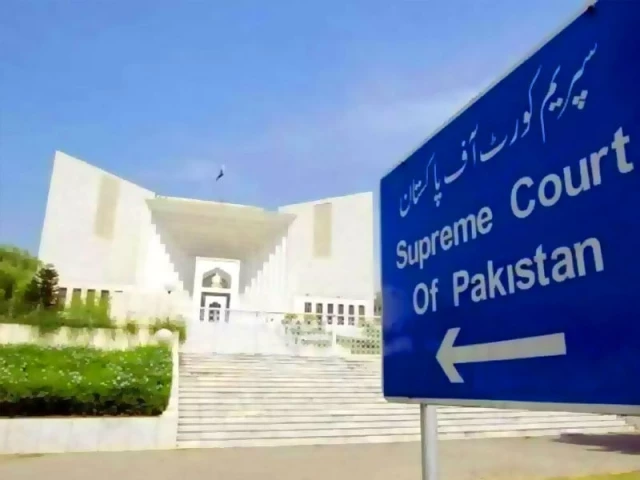
The judgment notes that the law neither condones manipulation nor allows its fruits to persist
ISLAMABAD:
The Supreme Court has taken strong exception to returning officers (ROs) altering election results, holding that an administrative officer cannot substitute his arithmetic for the sovereign will of the electorate.
“An administrative officer cannot be allowed to substitute his arithmetic for the sovereign will of the electorate. Where the true tally of votes appears from uncontroversial Forms-45, duly recognized by the ECP, no shadow can be cast on their authenticity. This court is not powerless; where the evidence, legally, the appellant does not conclusively prove that it is a majority, re-poll, but to declare the appellant duly elected,” said a 10-page detailed judgment authored by Justice Shakeel Ahmed.
Justice Ahmed was a member of the three-judge bench that overturned the decision of the Balochistan Election Tribunal on 24 November 2025 and had ordered the Election Commission of Pakistan (ECP) to notify Pakhtunkhwa National Awami Party (PNAP) Khushal Khan Kakar as the returned candidate from NA-Zhobilla-cum (Sheranib-cum (Sheranib-cum) Saifullah) for the 8 February 2024 general election.
The case was heard by a three-judge bench headed by Justice Shahid Waheed.
The judgment observed that the law neither condones manipulation nor allows its fruits to persist. “Manipulation at the consolidation stage by the RO is even more dangerous than irregularities at the polling station, for it takes place at the last stage of democratic determination. It turns an administrative official into a legal arbiter of political destiny, usurping the sovereign will of the electorate.”
It further stated that any manipulation at the time of vote consolidation erodes democratic legitimacy and shakes the foundation of the people’s mandate.
The court said that Article 218(3) of the Constitution imposes the solemn and inalienable duty on the ECP to organize and conduct elections honestly, fairly and equitably and to vigilantly guard against corrupt practices.
“This constitutional command is not directory but mandatory.”
“We deem it necessary to observe that election officials are trustees of the mandate of the people and guardians of the integrity of the electoral process. Any deviation from neutrality or deviation from the statutory framework endangers not only the outcome of a particular election, but the democratic order itself.
“The performance of electoral duties requires scrupulous adherence to the law, transparency in action, and an unwavering commitment to impartiality, for it is through these principles that public confidence in the electoral process is maintained and the sovereign will of the electorate preserved.”
The judgment noted that when examined from this perspective, the position expressed in the record admits of serious ambiguity.
“Firstly, the primary record viz. Forms-45 consistently reflects that the appellant secured the majority of votes in the relevant polling stations. Secondly, the copies of Form-45 available on the official portal of the ECP confirm the same figures. Thirdly, it is only in the consolidated statement viz. Form-48 prepared by the result of the RO and amended in all circumstances, the conclusion becomes inescapable that the amendment was not clerical in nature but substantially in effect, for it changed the electoral mandate.”
The court observed that a vote is not a mere mechanical entry in a ledger but the sovereign expression of the people, adding that any change at the consolidation stage is not a trivial irregularity but an interference with the will of the electorate.
It further said that under the Elections Act, 2017, read with Rule 81 of the Election Rules, 2017, the result of counting at each polling station shall be recorded in Form-45, prepared and signed by the Presiding Officer (PO) immediately after the counting, with copies supplied to the eligible voters of the candidate.
“Rule 84 of the Election Rules, 2017 provides that on receipt of the count from all POs in the constituency, the RO shall prepare the provisional consolidated statement of results for the constituency as required under Section 92, in Form-47 and thereafter announce the provisional result as per the said section, immediately after the provisional announcement of the provisional consolidated results. under Section 95 of the Act in Form-48 read with Rules 84-C and 85 of the Election Rules, 2017.”
The court said that the purpose of Section 95 of the Act is to ensure a transparent, accurate and official final tally of votes after polling, adding that it governs the consolidation of the results of the RO.
The executive order said section 95 of the law ensures that all polling station results are carefully combined into a single, verified and publicly declared result, making it the decisive administrative step in determining the winner, while still allowing for legal challenge afterwards.
“It is not disputed that Forms-45 were prepared and signed at the polling stations immediately after the counting of votes and that copies thereof were supplied to the Polling Agents of the contesting candidates. However, Form-45 prepared by the appellant as well as those available on the ECP official portal and the result of the recount conducted by every other TW are consistent with the other figures. Form-48 prepared by the RO differs significantly from the vote count recorded in Forms-45 in respect of the polling stations detailed above Significantly, the margin of victory declared in Form-48 does not correspond to the count from Forms-45.
The judgment held that the RO is bound by strict statutory duties, including neutral and transparent conduct of the election.
“He shall act as an impartial officer responsible for maintaining the integrity of the election process. He shall merely compile the result from Forms-45 to Form-48. He shall not modify or alter the votes unless a recount is ordered or an obvious clerical or arithmetical error is discovered and corrected transparently in accordance with the law.”
“He must also ensure that the record accurately reflects the polled votes. If the RO deducts votes from one candidate and adds them to another without legal authority, as happened in the present case, the act constitutes manipulation of election results, abuse of statutory process and violation of electoral law. Such conduct has significantly affected the election result and undermined the democratic process, in the democratic process and 4. Form-48 are significantly different from each other;
“The appellant had a clear lead of 1863 votes as per Forms-45 and after amendment in Form-48 his rival/respondent was declared as the returned candidate. This deliberate alteration with election results incurs criminal liability on the concerned employees and officers under the election laws.”
The court observed that “the discrepancy between Form-45 and Form-48 in the instant case indicates a serious irregularity. By reducing the votes of the appellant and adding them to his rival/respondent, the RO appears to have exceeded his statutory powers and possibly acted with mala fide intention, thus completely altering the result of the election and undermining the integrity of the election process.”
The judgment stated that “the controversy brought before this court strikes at the very heart of constitutional democracy and the sanctity of the vote. In a constitutional order based on representative governance, the legitimacy of public institutions ultimately rests on the integrity, transparency and credibility of the electoral process. Where doubts arise in the minds of the electorate, as expressed by the will of the electorate, faithfully carried out through the statutory consolidation process, the case assumes significance beyond the individual fortunes of candidates.”
It further noted that “the law also distinguishes between corrupt and illegal practices. While illegal practices are prohibited regardless of human rea, corrupt practices such as bribery and treatment require proof of a corrupt inducement to voters to vote or abstain. Such human rea may be inferred from the surrounding circumstances of the case.”
“In such cases, the court must be aware that ordering a new election is a last resort, given the significant costs, delays and disruption to representation it entails.
“On perusal of the record, we have no hesitation in concluding that the RO acted beyond lawful authority by changing the arithmetical basis of consolidation. Such change materially affected the outcome of the election. Therefore, the judgment of the trial court is set aside. The election petition filed by the appellant is accepted. The impugned notification cannot be approved by the impugned notification. upheld, is set aside on the basis of verified Forms-45 forming part of the record, the appellant, after securing the majority of valid votes, as the returned candidate from Constituency NA-251, Sherani-cum-Zhob-cum-Killa Saifullah. 1152/2025 filed by the respondent is partially allowed to the extent of setting aside the judgment dated 24.11.2025 of the Election Tribunal-III, Balochistan, Quetta.”


