
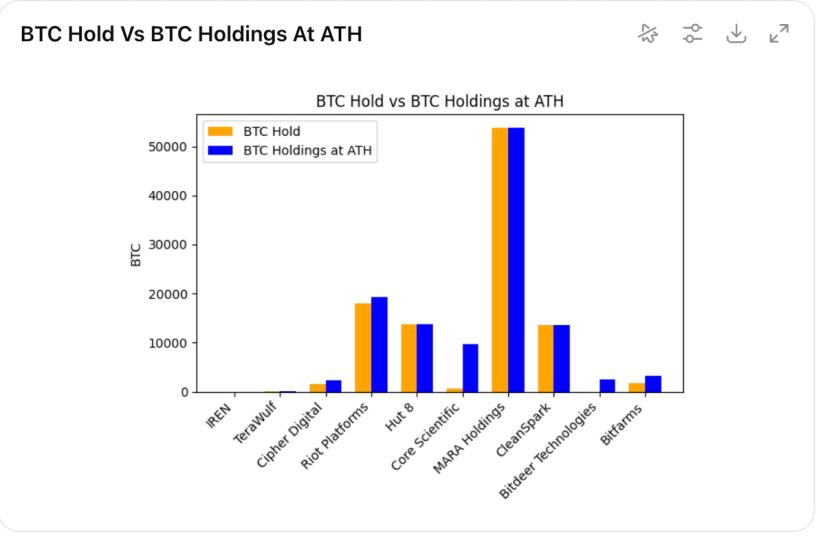
Bitcoin miners are increasingly moving away from keeping bitcoin on their balance sheets by selling more BTC to fund new identities as players in artificial intelligence (AI) infrastructure.
What started as holding on to bitcoin at all costs, or HODLing, is becoming a thing of the past for most publicly traded miners as they move into the capital-intensive but more attractive business of AI infrastructure. With tougher competition, higher energy costs and compressed prices, bitcoin mining profit margins, which reached as high as 90% during the 2021 bull run, have disappeared, leaving miners who relied solely on the company struggling. Given that miners already have data centers ready to host AI computers, most have shifted their business away from bitcoin to become “AI infrastructure” companies.
This momentum is gaining traction as prices hover around $66,000, down nearly 50% from October’s all-time high. Many of the top 10 public miners are selling or discussing open sales to fund these AI expansions.
Here are some miners who are either moving away from the bitcoin business by selling more BTC or have switched to AI entirely:
IREN (IREN) has never taken an ideological stance on holding bitcoin, focusing instead on infrastructure scale and operational execution as it leans into high-performance computing. The company currently has 0 BTC, which highlights its lack of a financial strategy.
TeraWulf (WULF) has maintained a pragmatic stance, avoiding a hard financial approach while maintaining balance sheet flexibility for AI-enabled growth. It has 15 BTC, in line with its all-time high, reflecting minimal emphasis on accumulation.
Cipher Digital (CIFR), formerly Cipher Mining, has made its repositioning explicit, calling 2025 a transformative year as it pivots toward HPC infrastructure. The company divested its 49% stake in three mining joint ventures for about $40 million in stock. Cipher now has 1,500 BTC, down from an all-time high of 2,284 BTC, highlighting a gradual reduction alongside its structural shift.
Riot Platforms (RIOT) has treated bitcoin as a financing tool rather than a passive reserve, selling all monthly production and liquidating balance sheet holdings, including nearly 1,100 BTC to fund the Rockdale acquisition. Riot sold $200 million worth of bitcoin in the last two months of 2025. It currently has 18,005 BTC against peak holdings of 19,368 coins.
Hut 8 (HUT) said bitcoin is no longer a long-term strategic focus in its fourth-quarter earnings call, with exposure expected to decrease over time in favor of its stake in American Bitcoin (ABTC), which holds 6,039 BTC. Hut 8’s own balance stands at 13,696 BTC, unchanged from its peak.
Core Scientific (CORZ) sold $175 million in bitcoin as its AI pivot accelerated. After holding 2,537 BTC at year-end 2025, its balance has fallen to around 630 BTC, well below its 9,618 BTC high-water mark.
MARA Holdings (MARA) has softened its strict HODL identity, selling newly mined bitcoin and signaling it may buy or sell opportunistically, with about 28% of holdings lent or pledged. It still has 53,822 BTC, matching its record high, despite the more flexible policy.
CleanSpark (CLSK) is treating its more than 13,000 BTC as productive capital, monetizing output, layering covered calls and exploring bitcoin-backed credit lines as non-dilutive financing. Its current 13,513 BTC balance is in line with its all-time high.
Bitdeer Technologies ( BTDR ) reduced holdings to zero to fund AI data center expansion. It marks a massive drop from its previous peak of 2,470 BTC.
Bitfarms (BITF) has been forthright about its repositioning, with CEO Ben Gagnon stating, “We are no longer a Bitcoin company.” The miner now has 1,827 BTC, down from a peak of 3,301 BTC, as it doubles on AI infrastructure.


