
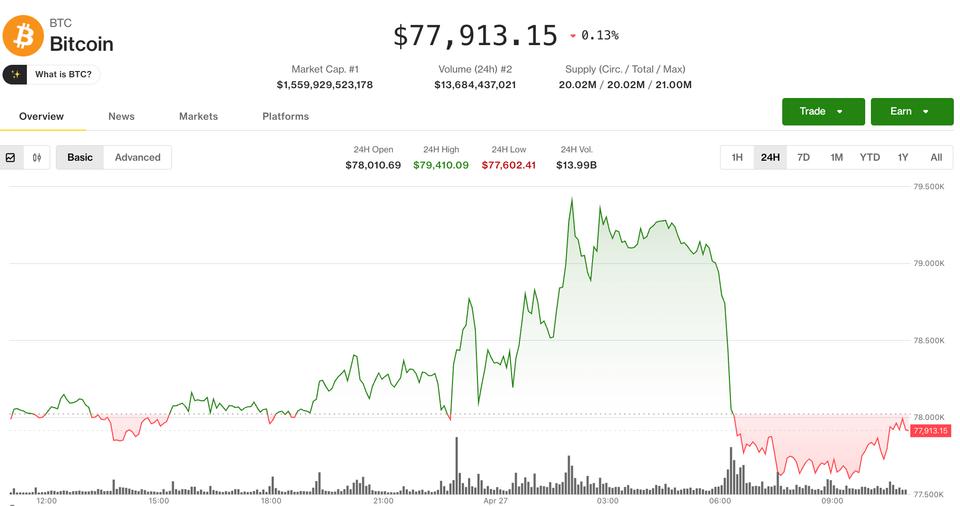
Volatility returned to the crypto markets on Monday as bitcoin rose up to $79,480 before quickly returning to $77,800.
The move began around 23:00 UTC with the opening of US stocks and CME bitcoin futures, a period that often sees increased volatility.
At 05:30 UTC, the price started falling after failing to break above the $80,000 level, falling 2% in an hour.
The drop came as oil reached its highest level since the cease-fire between the US and Iran began. Brent crude traded at $107 a barrel after US President Donald Trump canceled plans to send US officials for talks in Pakistan on Saturday.
Ether (ETH) recently traded around $2,320 after losing 2.2% since midnight UTC, underperforming bitcoin, which is down 1.1% but not as steeply as several altcoins.
Derivatives positioning
- Nearly $300 million in crypto futures bets have been liquidated in the last 24 hours. Most of these have been bearish short plays, which likely faced the bulk of the cryptocurrency’s brief rally to near $79,500.
- Open interest (OI) in XRP futures increased by nearly 2.5% in 24 hours. It is the biggest increase among major tokens including bitcoin, ether and solana (SOL). OI hit a one-week high of 1.82 billion XRP alongside negative perpetual futures funding rates and OI-adjusted cumulative volume delta. This combination paints a bearish picture consistent with the bitcoin and ether markets.
- However, analysts said persistent negative funding rates in BTC are mainly due to institutions hedging their bullish exposure in related markets and do not represent outright bearish action in the market.
- HBAR, CC, XLM and HYPE are other outstanding OI winners from the last 24 hours.
- SUI registers the most negative CVD, suggesting continued aggressive selling through market orders. A Sui-based DeFi protocol called Scallop was hacked early today, and the perpetrators walked away with approximately 150,000 SUI tokens worth just over $140,000.
- Bitcoin and ether’s 30-day implied volatility index extended declines, painting a picture of market calm that supports continued price gains in the two assets. This is in line with the recent decline in Wall Street’s VIX index, a gauge of the S&P 500 index, and record highs in other key measures, including the Nasdaq.
- On Deribit, bitcoin and ether options continue to show a bias for puts across all timeframes. Ether options expiring in December and next March are significantly less bearish than their bitcoin counterparts.
- Bitcoin’s $80,000 strike call option is the most popular on Deribit and boasts a theoretical open interest of over $1.5 billion. The trader’s gamma here is positive, implying that traders (market makers) could sell on a potential breakout above this level and similarly buy the dip, stopping price volatility.
- Speaking of flows, Laser Digital said investors prefer risk reversals to outright puts. This means that traders prefer options strategies that take advantage of price fluctuations and differences in how options are priced at different strike levels.
Token talk
- While the broader market was volatile on Monday, the altcoin sector was hit the hardest during the 05:30 UTC sell-off.
- Liquid restaking token Lido (LDO) led losses, giving back all of Sunday’s gains for a drop of around 17%.
- The bitcoin-heavy CoinDesk 20 (CD20) Index is down 1.5% since midnight UTC, while the DeFi Select Index (DFX) has lost 2.3%, with only the Smart Contract Platform Select Index (SCPX) underperforming, down 2.5%.
- A handful of tokens managed to avoid the selloff, most notably PENGU, JUP, and CHZ, which rose 9.1%, 4%, and 3.1%, respectively.
- CoinMarketCap’s “Altcoin Season” indicator sits at a neutral 39/100, unchanged from last week and well below last month’s high of 51/100.


