
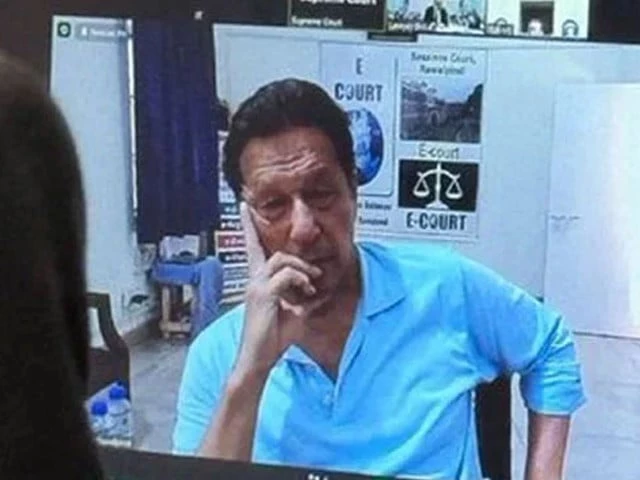
Safdar argued that prolonged solitary confinement was not part of the court’s sentence
ISLAMABAD:
The Islamabad High Court was informed on Thursday that Pakistan Tehreek-e-Insaf (PTI) founder Imran Khan and his wife Bushra Bibi faced deteriorating eyesight and prolonged solitary confinement in prison, with their counsel raising concerns about medical treatment and prison conditions.
Barrister Salman Safdar, representing the PTI founder and Bibi, told the division bench headed by Chief Justice Sardar Muhammad Sarfraz Dogar and Justice Muhammad Asif that both were suffering from health complications, adding that adequate treatment was not possible in the Adiala jail.
During the hearing of appeals in the £190 million case, the lawyer questioned the prison environment, asking what “infection” affected the right eye of both prisoners and stating that necessary surgical procedures necessitated hospital access, which he said was not possible within the prison premises.
Safdar argued that extended solitary confinement was not part of the court’s sentence and was “torture” if continued for longer periods. He further claimed that Bushra Bibi had previously been placed in solitary confinement despite previous judicial observations against such treatment.
The lawyer told the court that during a recent jail meeting, the PTI founder had reported significant deterioration of vision, claiming that only 15% remained, while 85% had been lost, and that doctors had indicated that the damage was irreversible.
He also claimed that the PTI founder was kept in 22-hour solitary confinement, not even responding to greetings, while Bushra Bibi was kept in 24-hour solitary confinement.
Safdar further referred to an alleged emergency call from Adiala prison on April 16 regarding Bushra Bibi’s condition, saying the family was asked to call immediately, and urged the court to summon senior prison officials, including the Inspector General of Prisons, to explain the conditions of confinement.
He said Bushra Bibi’s bail plea had been pending for more than a year and questioned whether the courts had historically been reluctant to grant relief to women.
Chief Justice Dogar questioned why arguments on the main appeal were not made, saying the court was ready to hear the matter and dispose of it expeditiously. He added that complaints were taken up on a daily basis and resolved without delay.
In response, Safdar said there was no objection to hearing the appeal, but he was instructed to first argue for the suspension of sentence applications. He also indicated that senior advocate Latif Khosa may appear to argue the appeal.
The chief justice noted that once an appeal is set for hearing, appeals for suspension of sentence generally become ineffective and directed counsel to prepare within 10 days for scheduling.
During the hearing, lawyers also referred to other pending cases, including the Toshakhana appeal, and exchanged arguments on the priority of cases before the court. At the end of the proceedings, the bench commented on frequent objections by the Khyber Pakhtunkhwa Chief Minister before retiring to chambers.


