
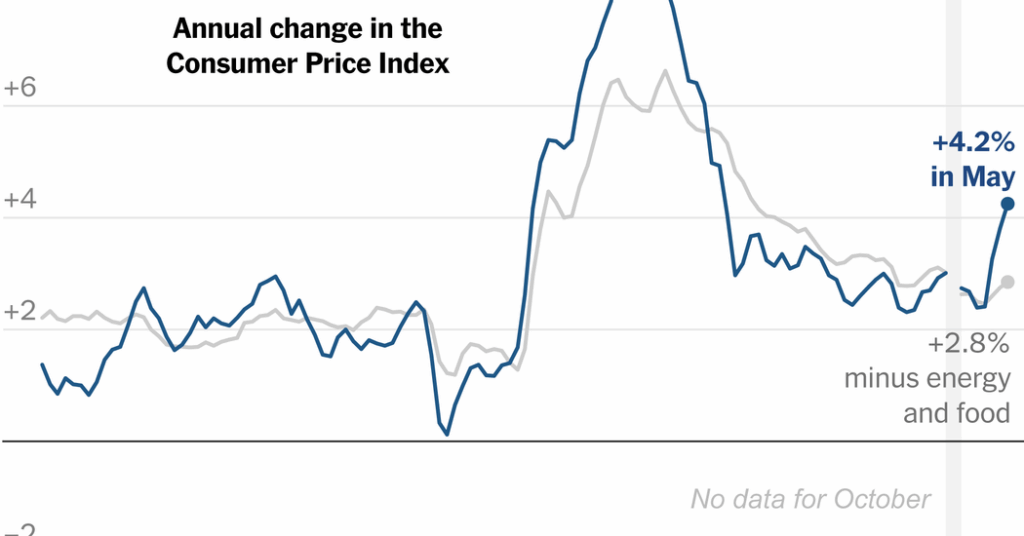
Inflation accelerated for a third straight month in May amid an impasse in talks to end a war with Iran that has pushed up energy prices and increased the burden on already strained consumers.
The consumer price index rose 4.2 percent in May from a year earlier, the Bureau of Labor Statistics reported Wednesday, a sharp increase from the 2.4 percent annual increase before the conflict started in February and the fastest pace since April 2023. Over the month, overall prices rose 0.5 percent.
The increase is almost entirely driven by energy prices, which are up 23.5 percent from this time a year ago. Americans have felt that effect most acutely while filling up their vehicles: A gallon of gas costs an average of $4.24, according to AAA, more than a dollar more than a year ago.
Faster price increases have, on average, wiped out the wage increases Americans have received over the past year. Adjusted for inflation, hourly earnings have fallen 0.7 percent over the past year and are exactly where they were when President Trump returned to office. Tax refunds that came in the spring have been used up, and cuts to the federal Supplemental Nutrition Assistance Program are now cutting into food budgets.
“It’s a pretty negative situation,” said Stephen Brown, North American chief economist for Capital Economics. “Low-income consumers don’t have much room to maneuver at this point.”
This dynamic was visible across major retailer earnings reports in recent weeks. Dollar General told investors that its customers had pulled back on food purchases and sought to shop closer to home because of high gas prices. However, even people making more than $100,000 a year still came in for cheaper necessities.
The inflation report contained some reassuring news for the Federal Reserve, which meets next week to decide whether to change interest rates. Monetary policymakers are most interested in the “core” interest rate, which strips out volatile food and energy prices and is believed to be a better measure of underlying inflation. This index rose 2.9 percent year-on-year and 0.2 percent for the month, a slower pace than April’s monthly rate.
Price increases on durable goods were also quite tame, an indication that the tariffs Mr. Trump introduced last year, has largely worked its way into prices. Household furniture has been falling for the past few months and has only increased by 2.4 percent over the year. Leisure goods fell during the month and new vehicles have fallen in price to be just 0.2 per cent more expensive than this time last year.
Prices in some categories are still normalizing from pandemic-era booms, like autos and health insurance, which are down 2 percent and 6.4 percent, respectively, over the year.
The White House seized on some of these price drops as a sign that Mr. Trump’s economic agenda delivered “meaningful results for the American people,” Kush Desai, an administration spokesman, said in a statement.
“The numbers were amazing,” said Mr. Trump to reporters at a bill signed Wednesday.
But according to a long-running study from the University of Michigan, the growing disparity between earnings and prices has put consumers in a bad mood, posing a danger to Republicans in November’s midterm elections.
The muted core increase may reassure monetary policy makers that they can avoid raising interest rates for the time being, even if the labor market appears to be strengthening. But it’s also potentially a sign that companies are doing their best to absorb higher energy costs, aware that shoppers are experiencing slower wage increases and are jaded by high prices.
OpenBrand, a consumer data company, recorded larger-than-usual discounts through the Memorial Day weekend, said Ralph McLaughlin, its chief economist.
“There is no substantial evidence that rising energy prices are really spreading yet to the rest of the economy,” said Mr. McLaughlin. “It shows that at least manufacturers and retailers may recognize that consumers are very price sensitive.”
Energy bills have spilled over into some categories where they make up a large part of the ultimate price tag, including airfares, which rose 2.7 percent in May and 26.7 percent from this time last year. The International Air Transport Association said Sunday that higher jet fuel prices would cost the industry $100 billion this year.
Hotel prices also rose 0.5 percent last month, in a possible indication of effects from the World Cup, although the hotel industry has been disappointed by demand for rooms. Access to sporting events, a volatile category, rose 2.8 percent in May. That kind of discretionary and luxury spending has been driven by high-income consumers whose stock portfolios have gotten fat this year.
But grocery prices rose just 0.1 percent over the month, down from 0.7 percent in April, as meat and dairy prices fell after a big rise in beef prices. Manufacturers, distributors and retailers have tried to keep prices as stable as possible in hopes that the energy price hike will pass, said Andy Harig, vice president at FMI, a trade association for the food industry.
“You want to have some certainty of where we’re going before you see where prices are going at the consumer level because you don’t want to have periods where you go up and down,” Mr. Hairy. “So I think that slowed price transmission up to this point.”
That could change in the coming months and years, however, as U.S. farmers face a persistent drought that has lowered yields and increases in fertilizer prices that could force them to plant less next season. For food that is harvested, the supply chain for materials used in food packaging remains limited.
Campbell’s Soup, for example, told investors it would charge five to six percent more in the coming fiscal year because of underlying inflation and the higher costs of energy and materials coming through the Strait of Hormuz.
“Oil obviously goes into products, whether it’s packaging, whether it’s logistics,” Todd Cunfer, Campbell’s chief financial officer, said on the company’s earnings call this week. “And then we see some aluminum coming out of that region is very, very elevated.”
America’s artificial intelligence boom is also pushing up inflation.
Although electricity in the U.S. is mostly generated by abundant natural gas and renewable energy sources rather than oil, massive new data centers are adding so much demand for power that prices are up nearly six percent from last year. These computing complexes also need the same memory chips that go into almost all consumer electronics. As a consequence, computer equipment is becoming more expensive after becoming cheaper for decades.
“The long period of low inflation from 2000 to 2020 was driven by technology,” said David Doyle, chief economist at Macquarie Group. “It feels like we’re on the other side of that, and potentially that means we’re in a structurally higher inflation regime.”
In the longer term, artificial intelligence can push down inflation by lowering the cost of services. Right now, it only adds to the more immediate energy price shock, which could get worse as countries around the world run down their reserves — or better, if lasting peace in the Middle East is achieved.
“If the conflict ends, and it’s a big if, we think that would probably be a peak,” Atsi Sheth, chief credit officer at Moody’s Ratings, said of May’s inflation reading. “If it doesn’t, it doesn’t.”


