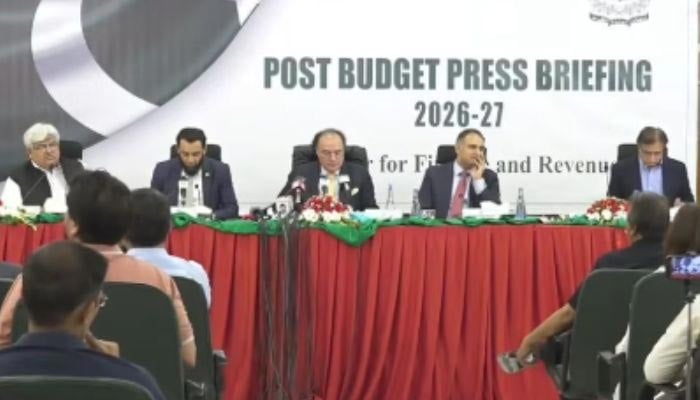
Finance Minister Muhammad Aurangzeb said on Saturday that Pakistan’s economy was moving from stabilization to growth as he extended the federal budget proposed yesterday (Friday) for the coming fiscal year 2026-27.
“The economy is moving in the right direction […] we will now move from economic stability to growth,” Aurangzeb said while addressing a post-Budget press conference flanked by Finance and Revenue Minister Bilal Azhar Kayani, Information Minister Attaullah Tarar and Revenue Board Chairman Rashid Mahmood Langrial.
The finance minister said the government had worked to strengthen both the tax and export framework in the budget, adding that there had been significant economic progress in the outgoing financial year. He said that the available fiscal space had been utilized to the best of its ability.
Aurangzeb announced that Rs70 billion in additional subsidies had been allocated to allow exporters access to finance at a reduced rate of 4.5%, a measure aimed at increasing export competitiveness and improving sector liquidity.
He confirmed that the super tax had been abolished for companies earning more than Rs.500 million and described it as a meaningful step.
He added that when the budget was presented to Prime Minister Shehbaz Sharif and the federal cabinet, a specific directive was issued to abolish the super tax for all exporters – a measure he said he would include in his closing speech at the end of the budget session.
The advance tax has also been abolished as part of efforts to create an enabling environment for export-led growth, he said.
Agriculture
On the agricultural front, Aurangzeb said that customs duty, additional duty and statutory duty on import of agricultural machinery had all been reduced to zero to facilitate modernization of the sector.
Agricultural credit had grown by 15% and the total volume now crossed Rs.2 trillion, he added.
He said that the Zarkhez-e-Asaan scheme was developing in a better and more efficient manner. He gave a firm assurance that small farmers would not be asked to mortgage their homes to access agricultural subsidies or financing.
The Prime Minister’s Youth Program has been allocated Rs 262 billion, of which Rs 125 billion has been specifically earmarked for agriculture.
Wage earner class and construction
Aurangzeb said the government had prioritized relief to lower income earners. The 5% tax slab has been reduced to 1%, while the 15% slab has been reduced to 13%. He said positive feedback had been received on measures related to higher pay levels and allowance adjustments.
Taxes in the construction sector have been reduced to encourage activity and investment, he added.
The Final Tax Regime (FTR) for the IT industry and freelancers has been retained, which ensures continuity and stability in the sector’s fiscal framework.
Energy and provinces
The Minister of Finance acknowledged that pressure on the energy infrastructure remained a challenge.
He said the oil import bill had initially increased by $1 billion but had since been capped at about $500 million. He added that some pressure on the energy infrastructure would also continue in the next financial year.
Aurangzeb expressed gratitude to the provinces for their support to the federal government and noted their cooperation in the budget process. This facility, he noted, would continue for the next three financial years.
He said that a new, modern automated tax system was being introduced and that the tax net would be expanded in the coming period.
‘The budget belongs to the public’
On his part, Minister of State for Finance and Revenue Bilal Azhar Kayani described the budget as one that belongs to the public, industrialists and those who want to build their homes. “This is a budget that reduces the financial burden on the people,” he said.
Kayani said the government’s first priority had been to reduce the burden on the salaried class, adding that measures had been taken in consultation with the business community to ease the overall tax burden.
He said the demands of the export industry had been kept at the fore while the budget’s incentive framework was framed.
He outlined the revised tax structure for wage earners: those earning up to Rs 600,000 annually pay zero tax; those earning between Rs600,000 and Rs1.2 million annually pay 1%; and those earning between Rs1.2 million and Rs2.2 million annually had their tax reduced by 11% last year.
He added that a person earning Rs 100,000 a month now pays only Rs 500 in monthly tax, while a person earning Rs 200,000 a month pays Rs 13,500.
“This is a budget for the salaried class, industrialists, exporters and the construction sector,” Kayani added.
This is a developing story and will be updated with additional details