
Letter warns Chenab projects aim to divert water, threaten Pakistan’s water, food and economic security
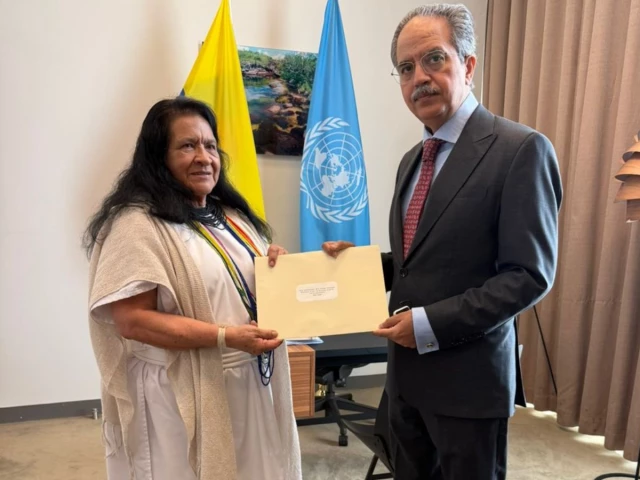
Ambassador Asim Iftikhar hands over a letter from Deputy Prime Minister Ishaq Dar to the President of the UN Security Council in June 2026 and Permanent Representative of Colombia to UN Ambassador Leonor Zalabata Torres regarding India’s continued illegal actions and violations of the Indus Waters Treaty (IWT). PHOTO: X
Pakistan on Friday asked the United Nations Security Council (UNSC) to take notice of India’s attempts to alter the flow of rivers governed by the Indus Waters Treaty (IWT), with Deputy Prime Minister and Foreign Minister Ishaq Dar warning in a letter that two Indian infrastructure projects on the Chenab river system are aimed at diverting water and could threaten food, Pakistan’s water security and economic security.
Last April, following a deadly attack on tourists in Indian illegally occupied Jammu and Kashmir (IIOJK), India unilaterally suspended the IWT after accusing Pakistan of supporting the attackers – a charge Islamabad categorically denied. The treaty has since remained at the center of renewed tensions between the two neighbors over the sharing of transboundary water resources.
Pakistan’s Permanent Representative to the UN, Ambassador Asim Iftikhar Ahmad, said in a statement on X that he had handed over a letter from Dar to the President of the UN Security Council and Colombia’s Permanent Representative to the UN, Ambassador Leonor Zalabata Torres, expressing concern over India’s continued violations of 19 IWT.
I have just handed over a letter addressed by DPM/FM @MIshaqDar50 to Ambassador Leonor Zalabata Torres, President of the UN Security Council in June 2026 and Colombia’s Permanent Representative to the UN regarding India’s continued illegal acts and violations of the industry… pic.twitter.com/4mhFjhOURp
— Asim Iftikhar Ahmad, Pakistan PR to the UN (@PakistanPR_UN) June 18, 2026
According to the envoy, the letter concerns “India’s continued illegal acts and violations of the 1960 IWT”. It seeks to draw the attention of the Council to the developments relating to the Chenab river system.
“The letter draws the Security Council’s attention to two illegal Indian infrastructure projects linked to the Chenab river system aimed at water diversion,” he said.
He added that the projects “reveal India’s intention to illegally alter the treaty-regulated flow and use of the western rivers, weaponizing waters with dangerous consequences for Pakistan’s water, food and economic security, as well as regional stability and international peace and security”.
The Pakistani envoy said the UN Security Council had been urged to “take note of this fragile and deteriorating situation and hold India accountable for its brazen violations”.
Read: FM Dar warns India’s water projects aim to establish ‘hydro-hegemony’
Iftikhar further said he briefed the Security Council President on “the overall situation in South Asia” and raised concerns over “India’s continued non-compliance with its obligations under UN Security Council resolutions on the Jammu and Kashmir dispute”.
A day earlier, Dar spoke at the Brussels conference on “Transboundary Water Resources: An Armed Global Common”warned that India was pursuing a strategy of “hydro-hegemony”, with at least 17 projects, including reservoir and river diversion schemes, designed to drastically alter the Indus river system.
“It is a shared resource, a shared responsibility and ultimately a prerequisite for human dignity and sustainable development. The future of transboundary water management must therefore be rooted in cooperation and respect for international law,” Dar said.
Meanwhile, India has launched a concerted campaign to undermine the Brussels seminar amid growing global scrutiny over New Delhi’s unilateral suspension of the Indus Waters Treaty (IWT), diplomatic sources said on Thursday.
According to diplomatic sources, the Indian side has been alarmed by Pakistan’s efforts to internationalize the issue of transboundary water management and expose the dangers posed by the weaponization of shared water resources.
IWT and why it matters
The 1960 IWT stands as one of the most carefully negotiated and legally robust transboundary water agreements in modern international law. Signed between Pakistan and India with the good offices of the World Bank, the treaty was designed to remove water from the volatility of politics and conflict and anchor it firmly in law, engineering discipline and neutral dispute resolution. It is a binding international instrument governed by the fundamental principle of pacta sunt servanda – that treaties must be observed in good faith.
Read more: Pakistan accuses India of violating the Indus Waters Treaty
At the heart of the IWT is a permanent and unqualified allocation of rivers. Article II assigns the eastern rivers – Ravi, Beas and Sutlej – exclusively to India, while Article III gives Pakistan exclusive rights over the western rivers – Indus, Jhelum and Chenab. This award was the basic agreement of the treaty.
India’s access to the western rivers is permitted only within the narrow limits of Article III, para. 2, of the Indus Waters Treaty, read with Annexes D and E, which allows limited, non-consumptive uses such as hydroelectric power plants in the river. These permits are subject to strict design and operational restrictions, including restrictions on water bodies, a ban on storage for flow regulation, and a ban on technical features that enable control of water flows to Pakistan.
These safeguards aimed to protect Pakistan as the lower river bank and prevent water from becoming a strategic tool. Pakistan’s objections to projects such as Kishanganga and Ratle stem from concerns over excessive water bodies, fenced drains and mechanisms that Pakistan says violate treaty provisions and can affect downstream flows, especially during lean seasons.
The dispute entered a more worrying phase in April 2025 when, following a terrorist incident in Pahalgam, India announced that it was putting the Indus Waters Treaty “on pause”.
Earlier this year, India unilaterally approved the Dulhasti Stage-II hydropower project on the Chenab River, an act that violates the provisions of the Western Rivers Treaty and violates Pakistan’s legally protected rights under the binding international agreement.
The unilateral suspension and expedited approval of upstream projects, including the withholding of hydrological data, diversion of river flows and alteration of natural regimes, constitutes deliberate water weaponry that endangers Pakistan’s agriculture, food security, hydropower generation and ecological stability. Under the IWT, customary international law and Article 51 of the UN Charter, Pakistan has clear legal options to respond.
International law expressly prohibits the use of water as a weapon against downstream populations, making strict enforcement of the IWT essential not only for bilateral stability but also for the integrity of global water management norms.


