
The committee agrees to withdraw the fuel subsidy after the benefit has already been passed on to consumers
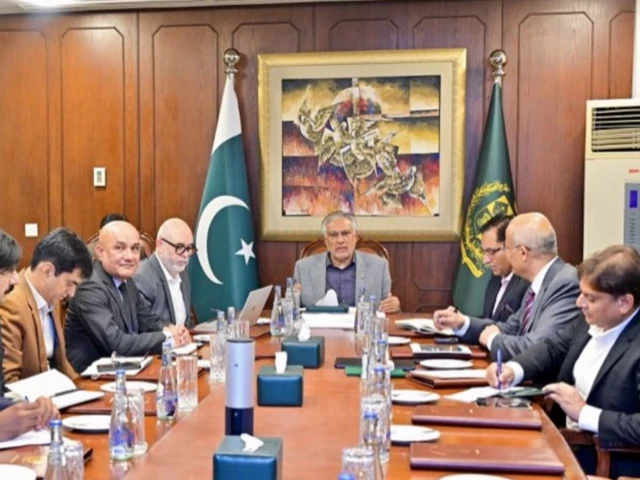
Deputy Prime Minister and Foreign Minister Ishaq Dar is chairing the 7th meeting of the National Steering Committee on Fuel Subsidy on Monday. Photo: X
Due to a sharp drop in global fuel prices, the government on Monday decided to end fuel subsidies for motorcyclists, small farmers and public transport.
The development comes after recent reductions in oil prices, where petrol was cut by Rs 74 per liter and diesel by Rs 67 per litre, bringing them down to Rs 299 per liter and Rs 311 per liter respectively, following a fall in the international market after the US and Iran agreed to end a conflict that had lasted over three months.
The decision was taken during the seventh meeting of the National Fuel Subsidy Steering Committee chaired by Deputy Prime Minister and Foreign Minister Ishaq Dar.
Deputy Prime Minister and Foreign Minister Senator Mohammad Ishaq Dar @MIshaqDar50 chaired the 7th meeting of the National Fuel Subsidy Steering Committee.
The committee reviewed the rollout of fuel subsidies for motorcyclists, small farmers, public transport and freight transport in… pic.twitter.com/I4X55tPKNV
— Ishaq Dar (@MIshaqDar50) June 22, 2026
The committee reviewed the rollout of fuel subsidy for motorcyclists, small farmers, public transport and goods transport across all provinces, Gilgit-Baltistan and Azad Jammu and Kashmir.
On the basis of the sharp fall in global fuel prices and the fact that the benefit had already been passed on to consumers, the committee agreed to discontinue the subsidy with the Prime Minister’s approval.
While appreciating the committee’s work characterized by sustained inter-provincial coordination, the Deputy Prime Minister directed that the lessons learned from the exercise be documented and gaps in data and delivery addressed to strengthen future initiatives aimed at improving the delivery of public services.
Also read: Government pays out Rs38b in fuel subsidy
The meeting was attended by SAPM Tariq Bajwa, Federal Secretaries for Petroleum and IT, the Governor of State Bank of Pakistan and senior representatives from all provinces, Gilgit-Baltistan and Azad Jammu and Kashmir.
Following the rise in oil prices in the global market following the US-Iran conflict, the government significantly raised the prices of petroleum products after initially deciding to absorb the burden.
At one point, petrol prices had touched Rs 458 per liter in April this year. But days later, the Prime Minister announced an immediate reduction of Rs80 per liter in oil tax to provide relief to the public.
While announcing the relief, the prime minister also unveiled a fuel subsidy package aimed at protecting the public from rising fuel costs triggered by tensions in the Gulf region.
Under that initiative, motorcyclists were to receive a subsidy of Rs 100 per liter while goods transport, public transport and goods wagons were also given subsidy for a month.
Under the same relief measures, small trucks got Rs 70,000 per month, big trucks Rs 80,000 and public transport buses Rs 100,000 as monthly subsidies.
The initiative also included support to small farmers who were given Rs1,500 per hectares in aid.


