
Law minister urges OIC states to ensure women lead digital future, warns AI must not widen inequality
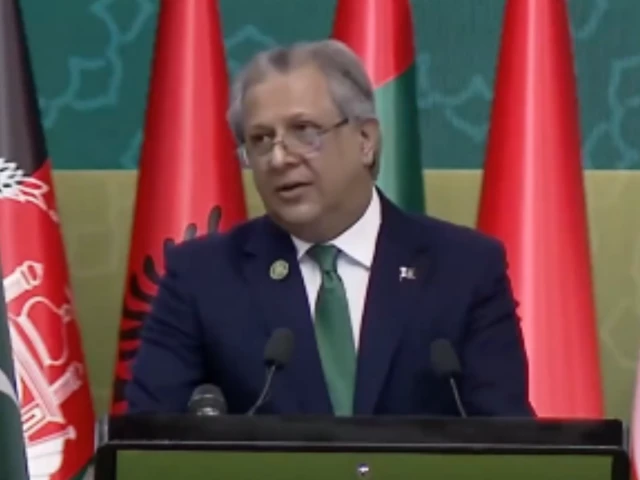
Law Minister Azam Nazeer Tarar speaks on the second day of the 9th OIC Ministerial Conference on Women in Islamabad. SCREEN GRAB
Law Minister Azam Nazeer Tarar on Monday urged Organization of Islamic Cooperation (OIC) member states to ensure equal access to new technologies for women and girls, warning that artificial intelligence and digital innovation could either bridge inequality or deepen it.
Addressing the second day of the 9th OIC Ministerial Conference on Women in Islamabad, Tarar said every woman and girl must have equal opportunities to learn, innovate and lead so that the digital future becomes “a bridge to inclusion” rather than “a barrier to equality”.
“Artificial intelligence and digital innovation are transforming our society at an unprecedented pace,” he said. “If managed wisely, these technologies can expand access to employment, healthcare, entrepreneurship and financial inclusion. If ignored, they risk creating new forms of inequality, discrimination and exclusion.”
Tarar said women across the Muslim world were transforming economies, promoting scientific progress, running businesses, serving in public office and contributing to peace and humanitarian efforts.
Despite these achievements, he said, millions of women and girls continued to face barriers that limited their opportunities and prevented them from fully contributing to national development.
“Our responsibility is not just to recognize these realities; it is to change them,” he said, describing the conference’s theme of the socio-economic and political empowerment of women in OIC member states as timely and forward-looking.
Calling women’s empowerment an economic necessity as well as a social imperative, Tarar said no nation could realize its full potential while half of its population lacked equal opportunities to learn, work, innovate and lead.
He said Muslim women had historically served as scholars, educators, entrepreneurs, lawyers and community leaders and continued to break new ground in science, technology, academia, business and public service.
“Our responsibility is not to define their potential, it is to remove the barriers that prevent it from being realized,” he said.
The minister further said that the principles behind these efforts were deeply rooted in Islam, which recognized the dignity, rights and legal identity of women more than 14 centuries ago.
Read: OIC Women’s Forum highlights empowerment
Highlighting the role of the OIC, Tarar said the organization’s Action Plan for the Advancement of Women and the Organization for the Development of Women had established a strong framework for cooperation among member states.
Sharing best practices and strengthening institutional partnerships, he said, would help accelerate progress while respecting different legal systems, cultures and national priorities.
Tarar also said Pakistan viewed its chairmanship of the conference “not as a position of prestige but as a responsibility” to build consensus and translate shared aspirations into practical action.
Regarding Pakistan’s domestic agenda, the minister stated that women’s empowerment was a national priority enshrined in the constitution and supported by legal, political and institutional reforms under Prime Minister Shehbaz Sharif’s government.
He said the government implemented the National Gender Policy Framework 2025 and the Prime Minister’s Women Empowerment Package to expand women’s leadership, promote economic inclusion and entrepreneurship, bridge the digital divide, strengthen access to justice and create safer, more inclusive workplaces.
Read more: Company rules still block women out
“Today, women in Pakistan are serving with distinction as parliamentarians, judges, civil servants, diplomats, entrepreneurs, academics, scientists and members of our armed forces,” he said. “Their growing leadership across public and private institutions reflects our belief that when women are empowered to lead and succeed, families flourish, communities become more resilient and nations flourish.”
Tarar further said that sustainable progress required the active participation of men and boys as partners in promoting equality, respect and shared responsibility, adding that building an inclusive society was a collective endeavor that required the commitment of every institution and every citizen.
He added that women’s empowerment extends beyond legal protection to ensure equal access to education, innovation, finance, decision-making and economic participation.
He also highlighted the plight of women living in the midst of conflict, occupation and humanitarian crises, and paid tribute to women and girls in Palestine, especially Gaza, for their resilience. He also referred to the plight of women in Afghanistan and Indian illegally occupied Jammu and Kashmir, saying that empowerment was not only about opportunity but also about protection, dignity, justice and hope.
Concluding his address, Tarar said that Pakistan would use its chairmanship of the conference to strengthen dialogue and cooperation among OIC member states, urging delegates to translate commitments into tangible progress for nearly 940 million women across the Islamic world. “The next generation of Muslim women must not only participate in the digital economy, they must help lead it,” he argued.


