
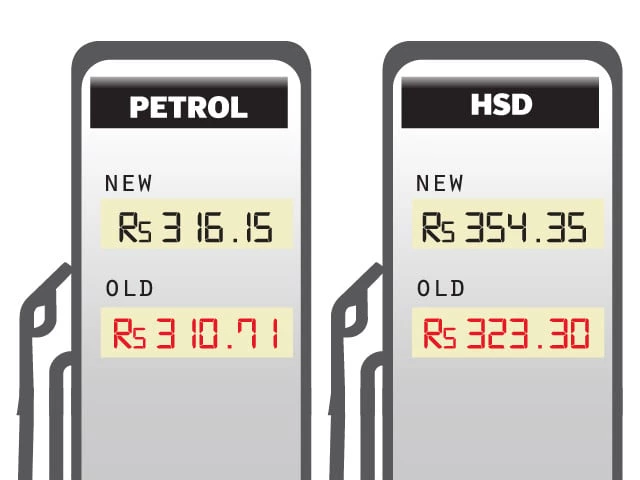
Ministers say the move aims to increase transparency Diesel up by Rs 31.05. per litre, petrol Rs 5.44 Owner
ISLAMABAD:
The federal government announced Friday that oil product prices will now be reviewed and announced on a daily basis, replacing the weekly pricing mechanism, as renewed tensions between the United States and Iran continue to drive volatility in global oil markets and raise concerns about fuel supplies.
Under the new pricing mechanism, the government raised the ex-depot price of high-speed diesel (HSD) by Rs 31.05. per litre, from Rs 323.30. to Rs.354.35, while the price of petrol was raised by Rs.5.44 per litre. 2026.
Officials said the daily review system would allow domestic fuel prices to reflect changes in international oil markets more quickly while reducing the risk of supply disruptions and speculative hoarding.
The decision comes after the government had already switched from fortnightly to weekly fuel price revisions following the first phase of the US-Iran conflict.
With tensions escalating again after a fresh exchange of strikes and growing concern over disruptions to oil supplies through the Strait of Hormuz, authorities have opted for daily price adjustments to ensure uninterrupted fuel availability and greater transparency in the pricing mechanism.
Addressing a press conference along with Information Minister Ataullah Tarar, Petroleum Minister Ali Pervaiz Malik said the decision had been taken at a federal cabinet meeting chaired by Prime Minister Shehbaz Sharif.
Malik said the move was aimed at increasing transparency in oil prices without exposing the state to financial risks.
“The Federal Cabinet and the Prime Minister decided that without exposing the state to any risk, the responsibility would be transferred to Ogra to determine oil prices daily in accordance with international market trends. Ogra will not only publish on its website the Platts benchmark rates, which are used globally to determine oil prices, but will also reveal the components that make up the final consumer price of petroleum at the final consumer price that makes up the final consumer price. all these details so that people know why these prices are inevitable,” he said.
Malik said it was unfortunate that despite Pakistan’s leadership making “tremendous efforts” to steer the region towards reconciliation and a lasting ceasefire, tensions had once again begun to escalate.
“It is unfortunate that despite the sincere efforts made by our leadership, especially Prime Minister Shehbaz Sharif, Chief of Defense Forces and Chief of Army Staff Field Marshal Asim Munir, to move the region towards reconciliation and a permanent ceasefire, tensions are rising again,” he said.
The minister said oil prices, which had already witnessed sharp swings during previous bouts of regional tensions, were on the rise again.
He said diesel prices had risen significantly over the past few days, adding that Platt’s benchmark for diesel had risen from $110 a barrel. barrel at $140 per barrel from Friday.
Referring to gasoline prices, Malik said Platt’s benchmark had risen from about $89 a gallon. barrel at almost $100 per barrel, which pushed energy prices higher on international markets.
The minister thanked the public for their patience despite the hardships and said people had shared the burden with the government despite a subsidy of Rs 130 billion. and a targeted grant program that was implemented in coordination with the provincial governments.
“Today’s decision is aimed at bringing greater transparency to the entire system so that people can understand for themselves why increases in oil prices become inevitable,” he said.
Malik added that if the government had adopted the same approach as a previous administration in 2022, the public would have continued to pay the price for years through higher inflation.
He acknowledged that the latest decision would be difficult for consumers, but said it was necessary to strengthen the state.
Rejecting the perception that the government had increased the burden on consumers through higher taxes or had failed to pass on the benefits of lower international oil prices, Malik said:
“The government remains committed to its promise. Just as the price of diesel has come down from Rs520 per liter to below Rs300 per litre, people have also witnessed a significant reduction of Rs70 to Rs80 in petrol prices.”
He added that the drop in international oil prices had been fully passed on to consumers.
Clarifying the issue of the petroleum tax, Malik said that under international agreements, Pakistan was required to maintain such taxes to support the budget.
He said the combined kerosene tax and carbon subsidy tax on petrol remained lower than before the conflict began and no additional burdens had been imposed on the public beyond Pakistan’s international obligations.
The minister said the daily oil prices would be determined on the basis of the average Platts benchmark over the previous seven working days.
“It will be ensured that when prices rise, they rise accordingly and when they fall, they fall automatically without requiring the approval of the Prime Minister, Ata sahab, or me, and the relief will be passed on to the public immediately on a daily basis,” he said, describing the move as another step towards deregulation.
Malik also said that the prime minister had directed the Federal Investigation Agency (FIA), Intelligence Bureau (IB) and all law enforcement agencies to take strict action against anyone involved in profiteering in the oil sector.
Addressing the press conference, Information Minister Ataullah Tarar said the new pricing mechanism would ensure that changes in international oil prices are immediately reflected in domestic fuel prices.
“When oil prices are set daily, the criticism that changes in international prices are not transmitted immediately will no longer hold. Whatever increase or decrease takes place will be passed on without delay,” he said, adding that the move would bring greater transparency in the pricing system.
Tarar also rejected the notion that the government had significantly increased the oil tax.
“There is a misconception that the tax has increased significantly, but the tax is still lower than it was before the war. Since there has been no increase in the tax now, the whole mechanism of determining oil prices will become more transparent,” he said.
Highlighting the need to shift towards cleaner transport, Tarar said Pakistan would eventually have to adopt electric vehicles.
“If our import bill continues to rise and the public continues to bear the impact of fluctuations in international oil prices, the best solution is for us to gradually move towards electric vehicles and electric motorcycles,” he said.
Gasoline, diesel prices revised
Under the new daily pricing mechanism, the Ministry of Energy (Petroleum Division) revised ex-deposit oil prices for July 18, 2026, increasing petrol and diesel prices by up to Rs 31 per liter in line with international market trends.
The price of High-Speed Diesel (HSD) was increased by Rs 31.05 per litre, from Rs 323.30. at Rs 354.35 per litre.
Meanwhile, petrol price was hiked by Rs 5.44 per litre, from Rs 310.71 to Rs 316.15 per litre.
The government currently levies an oil tax of Rs70.82 per liter on retail sales of HSD and Rs79.46 per liter on direct sales along with a Rs5 carbon support levy (CSL).
On petrol, Rs 80 per liter is charged as oil tax and Rs 5 per liter as CSL at retail outlets.
The government also levies a petroleum tax of Rs105 per liter on HOBC (97 RON) and MS (95 RON), while the tax on Superior Kerosene Oil and Light Diesel Oil stands at Rs20.36 and Rs15.84 per liter respectively without carbon subsidy tax.
For heating oil, the oil levy is Rs 77 per liter (Rs 82,077 per metric tonne) for both retail and direct sales, in addition to a Rs 5 per liter (Rs 5,330 per metric tonne) carbon subsidy levy.
The petroleum division said the revised prices would remain effective only on July 18, 2026.
Officials said the move to daily prices would also deter oil traders who are allegedly involved in hoarding fuel products in anticipation of price increases.
Last week, under the weekly review mechanism, the government had increased petrol and diesel prices by up to Rs13.80 per litre.
Officials said international oil prices had risen again following the renewed conflict between Iran and the United States and concerns over the closure of the Strait of Hormuz, which threatens global oil supplies, including those to Pakistan.
Domestic fuel prices had initially fallen following the Iran-US peace deal, but began to rise again after fresh hostilities resumed.
The renewed conflict has also raised concerns about potential fuel shortages in the country.
High-speed diesel is widely used in the transport and agricultural sectors, while petrol is primarily consumed by motorcycles and cars. Officials said demand for petrol has increased following restrictions on the use of indigenous gas in Punjab.
Petroleum oil continues to be used in remote areas, particularly in the country’s northern regions where LPG is not readily available for cooking, while the Pakistan Army remains one of its main users. Light diesel oil is primarily used by industry.
Petrol pump owners reject politics
Meanwhile, the All Pakistan Petrol Pump Owners Association rejected the government’s policy of oil price deregulation and warned that it would consider launching protests and a nationwide strike next week if the decision was not withdrawn.
In a video statement, the association’s chairman, Nauman Ali Butt, called on the government to review the policy, saying petrol pump owners should not bear the burden of the new system.
He demanded that all stakeholders be taken into confidence before Oil Marketing Companies (OMCs) finalize fuel prices under the proposed mechanism.
Butt said nearly 15,000 petrol pump owners across the country had expressed serious reservations about the policy.
He warned that the new mechanism would affect oil tankers, transport and the overall fuel pricing system.
The association’s chairman also called on the government to consult petrol pump owners instead of making unilateral decisions.


