
- A rare decay reveals cracks in physics that defy easy explanation
- The standard model shows load during one of its toughest tests
- Four-sigma anomaly suggests that something subtle may be missing in physics
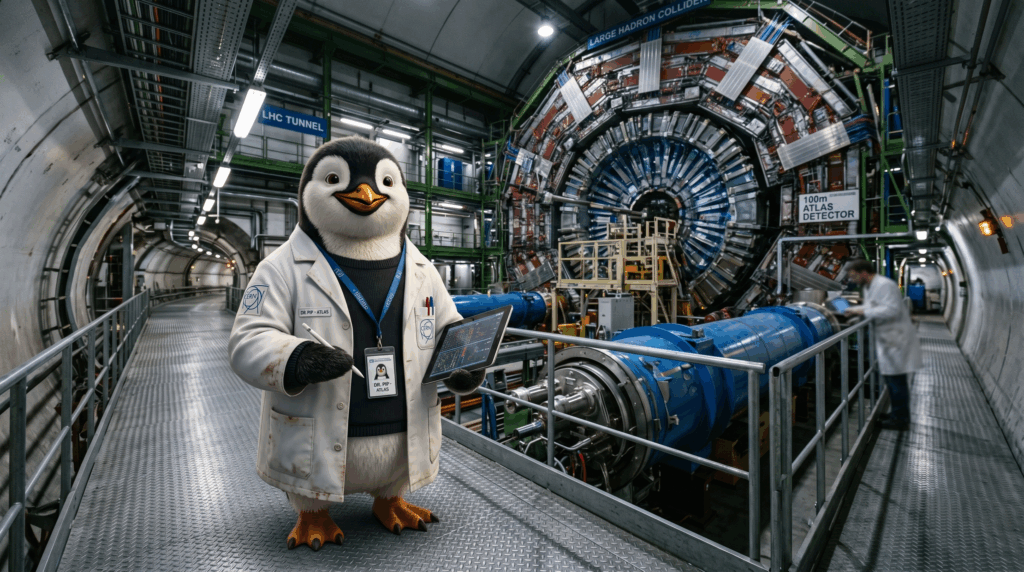
Scientists at the Large Hadron Collider (LHC) have found something strange inside a particle decay process called electroweak penguin decay that could signal a major problem for modern physics.
The LHC is a 27-kilometer-long circular tunnel buried under the French-Swiss border, where proton beams smash together at nearly the speed of light, recreating conditions similar to those just after the Big Bang.
Experiments like the LHCb analyze the collision debris to look for cracks in the Standard Model, the rulebook of particle physics that has passed every test for over 50 years despite being known to be incomplete.
The article continues below
How scientists discovered the flaw in a million-to-one event
In their experiment, the researchers observed a B meson, a short-lived particle, that broke apart into three other particles.
This transformation is extremely rare, occurring only once in every million B meson collisions.
That rarity makes it a powerful tool for spotting hidden influences from unknown particles.
Think of it like hearing a faint whisper in a noisy stadium. The whisper might be nothing, or it might be the most important message you’ve ever heard.
The researchers measured two things: the angles at which the particles fly apart and how often the decay occurs.
Both measurements disagreed with what the Standard Model of Physics predicts, which sounds impressive, but physicists require much higher certainty for a formal discovery.
The odds of this disagreement being a fluke are about 1 in 16,000, since the current finding is at four sigma.
The gold standard for a discovery is five sigma, which is a 1 in 1.7 million chance of being wrong.
Imagine rolling a die and getting the same number six times in a row. It is unusual, but not impossible.
Now imagine rolling the same number 20 times in a row. It would make you question the fairness of the dice. It is the difference between four sigma and five sigma.
There are several possible explanations if this anomaly turns out to be real.
One idea involves particles called leptoquarks, which would unite two different types of matter: leptons and quarks.
Another possibility is the existence of heavier versions of particles we already know about, extending the Standard Model rather than replacing it.
This kind of indirect evidence has happened before in physics. Radioactivity was discovered 80 years before scientists found the particles responsible for it.
This proves that you can detect the effects of something long before you can see it directly.
The current anomaly may be a similar early warning. The LHCb experiment analyzed about 650 billion B meson decays between 2011 and 2018 to find this penguin process.
Since then, the team has already collected three times more data that will help confirm or rule out the anomaly.
Future upgrades in the 2030s will increase the data set by a factor of 15, giving physicists the statistical power needed to reach a definitive conclusion.
The main complication comes from something called “charming penguins.” These are Standard Model processes involving charm quarks, which are very difficult to calculate precisely.
Recent estimates suggest that these effects are not large enough to explain the anomaly. But the calculations are so difficult that physicists cannot be completely sure yet.
Think of it like trying to measure the thickness of a hair with a ruler. The ruler is simply not accurate enough for the task.
The current available data is like that ruler. It points in an interesting direction, but we need a sharper tool to be sure.
The four-sigma excitement is really exciting, but particle physics has seen promising anomalies disappear before.
More data and better calculations could still bring the results back in line with the standard model.
Last year, an independent LHC experiment known as CMS published results consistent with the current study, albeit with less precision.
Taken together, both studies provide the strongest combined argument to date that something truly new can work at the most fundamental level of reality, but both share similar uncertainties.
For now, the standard model remains standing, but for the first time in decades it appears to be faltering.
Whether that wobble is the beginning of a collapse or just a statistical mirage will be determined by the next few years of data.
Either outcome will teach us something profound about how science progresses when history’s most successful theory meets its first real test.
Via Phys.org
Follow TechRadar on Google News and add us as a preferred source to get our expert news, reviews and opinions in your feeds.


