
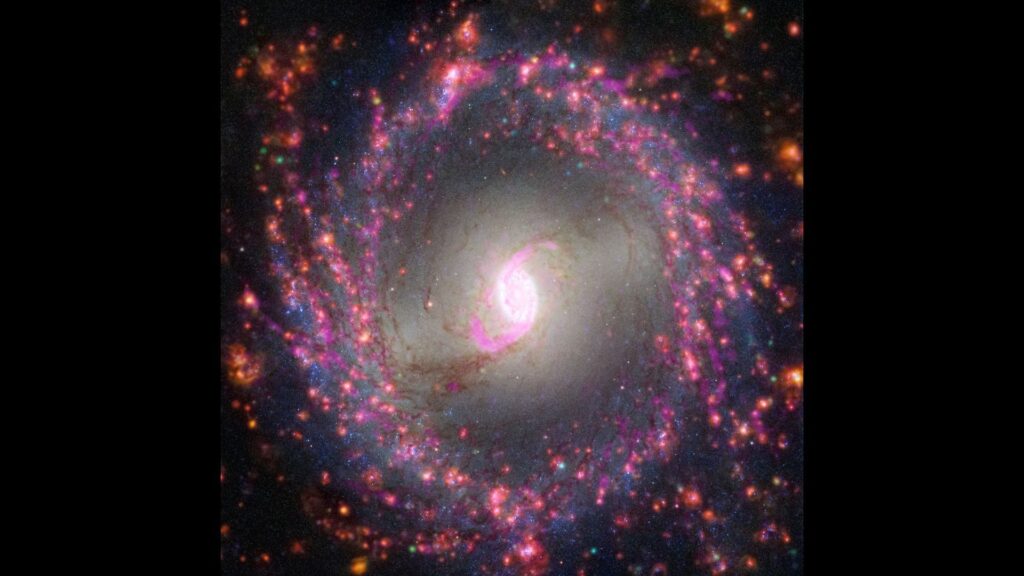
- Scientists fear that AI addiction could slowly weaken independent astrophysical reasoning and mathematical intuition
- Trained researchers are increasingly relying on AI systems for difficult coding and analytical scientific work
- Astronomy journals are struggling with increasing volumes of machine-assisted scientific paper submissions
AI systems are rapidly transforming astrophysical research, leaving many scientists wondering whether human researchers will remain central to future discoveries.
Across major astronomy institutions, researchers increasingly rely on large language models for coding, mathematical analysis, proposal writing, and interpretation of huge telescope data sets.
Several astrophysicists have now warned that AI systems could eventually change scientific practice so dramatically that traditional human research skills will gradually disappear entirely.

Scientists fear that human reasoning may gradually disappear
There has been growing institutional pressure encouraging astronomers to integrate advanced machine learning systems into daily scientific work and professional scientific publishing.
At Harvard’s Center for Astrophysics, researchers demonstrated AI systems capable of generating mathematical models, software code and apparently publishable research papers.
One researcher explained that ChatGPT solved a long-standing problem of galaxy motion analysis within minutes after frustrating scientific teams for several years in the past.
With such deep AI integration, it becomes difficult to determine where scientific assistance ends and intellectual dependence begins.
“A lot of people think it’s too late to intervene—we’re done,” says David Hogg, a computational astrophysicist at New York University (NYU).
Several scientists argued that junior astrophysicists could face the biggest disruption because AI is increasingly performing tasks traditionally done during scientific training periods.
“We’ve all come to the realization that these tools are taking over,” said Rodrigo Córdova Rosado, a postdoctoral fellow.
He warned that over-reliance on automated systems could ultimately create researchers who lack essential mathematical reasoning and coding skills.
Younger researchers now lack critical thinking, which is necessary for difficult technical work and provides the intellectual foundation necessary for meaningful scientific discoveries.
“Every hour you spend confused is an hour you spend building the infrastructure inside your own head,” said Cosmology researcher Minas Karamanis.
Unfortunately, no one wants to be confused anymore because there is artificial intelligence to the rescue.
“LLMs force us to face the fact that as a field we are not good at assessing ourselves and our peers,” Natalie Hogg, a cosmologist at the University of Cambridge, wrote in a blog post in February.
Journal editors report increasing pressure to publish
Editors at major astronomy journals are already reporting large increases in scientific submissions since AI tools became mainstream academic research tools internationally.
The American Astronomical Society (AAS), for example, is now struggling to find reviewers for submitted papers due to the widespread use of AI tools.
“The amount of low-quality stuff can choke the system … and the only solution to that is to do pretty much arbitrary gatekeeping,” said Ethan Vishniac, editor-in-chief of AAS.
Despite growing anxiety, several scientists acknowledge that advanced language models still struggle with sophisticated theoretical physics problems involving original mathematical interpretation and reasoning.
According to Harvard astrophysicist Cecilia Garraffo, artificial intelligence systems “failed miserably” to solve difficult gravitational equations.
Some researchers nevertheless fear that rapid technological advances could eventually overwhelm existing scientific safeguards.
Via Science

Follow TechRadar on Google News and add us as a preferred source to get our expert news, reviews and opinions in your feeds.


