
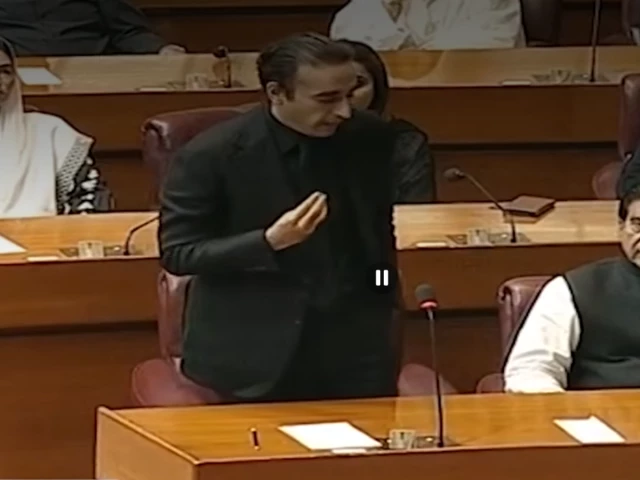
Questioning why he remained in the cabinet, some cabinet members are accusing him of creating political problems for the prime minister
PPP Chairman Bilawal Bhutto Zardari on Wednesday criticized Defense Minister Khawaja Asif over remarks on Azad Jammu and Kashmir (AJK), questioned why he remained in the cabinet and accused some cabinet members of creating political problems for Prime Minister Shehbaz Sharif.
In a televised interview, Asif said that Rawalakot – which has seen protests led by the Joint Awami Action Committee (JAAC) – was “not Kashmir” and that he did not consider its residents Kashmiris.
He later sought to clarify the remarks at X, saying that “Kashmiriat is defined by the sacrifices and struggles waged over nearly eight decades” by Pakistanis, Kashmiris and others, “not by birth certificates”.
“There are certain ministers whose politics I don’t understand. Instead of helping the prime minister, they are creating problems for him,” Bilawal said while addressing the National Assembly (NA) during debate on the federal budget.
The PPP chairman went on to say that every coalition partner, every member of the opposition and every citizen of Pakistan should ask “why such a minister is still in the cabinet,” he said, adding, “How is it possible for us to accept that a federal minister can say that the Kashmiris of Rawalakot are not Kashmiris?”
For the past few years, the local administration and the JAAC have been at loggerheads over the abolition of 12 reserved seats in the AJK Assembly reserved for refugees from Indian-occupied Kashmir who settled in Pakistan after 1947.
In a post on X on Tuesday, Asif said: “The people of AJK, who live here in peace and tranquility for many decades guarded by soldiers from all over Pakistan, and surely also brave hearts from AJK, need to acknowledge the sacrifices of Kashmiris of IIOJK and Muhajirs of 1947 and later years.
The defense minister had further added that in his opinion Kashmiri identity was defined by “sacrifices and struggles waged over nearly eight decades by Pakistanis, including Kashmiris and all others, not by birth certificates”.
Bilawal said in today’s NA session that Pakistan’s political parties needed to work together at a time of significant regional and international change. “Where Pakistan stands today, and given everything that is happening geopolitically, if all political parties unite and decide that we will jointly confront Pakistan’s challenges, then we can ensure the political, economic and strategic dividends that these opportunities bring,” he said.
The PPP chairman said Prime Minister Shehbaz wanted to move the country forward in consultation with coalition partners and the opposition, arguing that many national problems could only be resolved through dialogue. “Problems can only be resolved through negotiations and dialogue,” he said.
Bilawal said criticism of statements made at rallies or protests was legitimate, but argued that the comments of a serving federal minister carried a different weight. “If he is not prepared to apologise, what justification do we have for sitting with that minister?” he asked.
While expressing respect for Prime Minister Shehbaz, Prime Minister’s Adviser on Political Affairs Rana Sanaullah and former Prime Minister Nawaz Sharif’s long-standing association with the Kashmir issue, Bilawal said a minister’s remarks had aggravated an already sensitive situation.
“Instead of putting out the fire, it was like pouring oil on it,” he said.
Bilawal also referred to remarks allegedly made by a minister regarding AJK elections and said such statements had given political room for unrest. “If a minister says we are pocketing 12 seats, how can we object when people react to such statements?” he said.
Calling for a political solution to the dispute, Bilawal suggested, “As your coalition partner, we must give Maulana Fazlur Rehman space to engage with the federal government, the AJK government and the protesters so that this process reaches a conclusion and the people of Kashmir do not have to protest again and again.”
Read: AJK government asks JAAC leaders to surrender, ensures legal process
He said all stakeholders should follow “a political path” that would help protect the Kashmir issue while reducing tensions.
The PPP chairman then turned his attention to local government issues, particularly in Karachi, accusing some members of the federal coalition, specifically the Muttahida Qaumi Movement Pakistan (MQM-P), of misleading their allies and directing criticism at the PPP instead of addressing grievances within the federal government.
“Your problem is not with the PPP,” he said, addressing lawmakers from Karachi. “The people who create problems for you are your own cabinet colleagues.”
He alleged coalition partners were being offered “lollipops” instead of meaningful solutions and called on them to hold federal ministers accountable for unfulfilled commitments.
“How long will you continue to survive on lollipops?” he asked.
Bilawal defended the PPP government’s track record with local government, arguing that Sindh was currently the only province where a functioning local government system was in place. “Where PPP is in government, there is a local government system. Where PML-N is in government, they are afraid to hold a union council election themselves,” he said.
He challenged political opponents to implement in Lahore the same local government model that existed in Karachi, and called for local government elections to be held in Punjab and Islamabad before any constitutional changes were considered.
The PPP chairman also promised that local government elections would be held in Gilgit-Baltistan within 90 days if a new government was formed there with PPP participation.
Concluding his speech, Bilawal urged the lawmakers to pass the budget before Ashura and avoid unnecessary political confrontation. “I also want the prime minister to succeed because if the prime minister succeeds, then Pakistan succeeds,” he said.
“In my personal view, this is not the time to focus on our political differences. This is the time for us to unite and find solutions to Pakistan’s problems.”
Maulana Fazlur Rehman
Jamiat Ulema-e-Islam-F chief Fazlur Rehman also addressed the House, criticizing the government’s handling of the situation in Azad Jammu and Kashmir (AJK), questioning statements made by Defense Minister Khawaja Asif and warning against what he described as the political involvement of state institutions.
Fazl said he had replied to a letter of the Joint Awami Action Committee (JAAC) through a video message and had also informed the government about his stand. “I welcome the decision of the Awami Action Committee to postpone tomorrow’s march towards Muzaffarabad,” he said, referring to planned protests in AJK.
Questioning the state’s response to the recent development, the JUI-F chief asked, “How can action taken on the basis of speeches be considered an appropriate response?” “Until yesterday we were talking about human rights in occupied Kashmir. What are we doing today?” he added.
“The things Khawaja Asif has said should not have been said by a defense minister,” he told lawmakers. In an apparent reference to the government’s approach to the crisis, he remarked: “You have entrusted the conflict to Khawaja Asif and the reconciliation to Ishaq Dar.”
While acknowledging the government’s diplomatic efforts abroad, Fazl argued that, “At the international level, the government is earning goodwill through efforts for global peace, but Pakistan is losing goodwill at home,” he said.
The JUI-F chief also criticized the use of security forces in internal affairs, saying, “Pakistan’s army should be on the borders; instead, it is being used inside the country.”
He warned that statements such as those made by the defense minister would only inflame tensions. “Comments like those of Khawaja Asif will increase the provocation,” he said, urging the government not to force the opposition into confrontation.
Fazl also pointed to his party’s recent public gathering in Charsadda, claiming it had attracted hundreds of thousands of people.
On the role of institutions in politics, the JUI-F chief said his party respected the military, the establishment and all state institutions, “But if they change the election results, then we will react.”
“If they engage in politics, we will answer them in politics,” he added. Fazl rejected calls for silence on such issues, saying: “We are not mute. We will not become silent devils.”
He further argued that if institutions used taxpayers’ money for political purposes, elected officials had a duty to raise the issue in parliament. “If institutions use tax money and then use it for political purposes, we will respond here in Parliament,” he said.
In a pointed reference to the ruling party’s past opposition policies, Fazl questioned: “The prime minister should tell us if when they stood on containers they did not mention the army chief and the army,” he said. “Weren’t there speeches from the stage that described the military as the ‘Ministry of Agriculture’?”
Background
The latest unrest and deadly clashes erupted in areas including Rawalakot where the JAAC had held a sit-in outside the Combined Military Hospital Rawalakot. AJK police claim that armed JAAC members opened fire on deployed law enforcers in a planned attack, leaving four people dead and around 20 injured. JAAC, however, disputes this account and claims that security forces used tear gas and fired grenades at the hospital.
According to the AJK police, three people associated with JAAC and four policemen were killed during the protests. However, JAAC said in a statement on the X that seven people were killed and dozens were injured when street shelling was carried out in the dark after power was reportedly cut.
The clash came as the AJK government and JAAC witnessed a face-off when the election date for AJK was announced on July 27.
Read more: Certain elements seeking to destabilize AJK despite repeated offers of dialogue: Rana Sanaullah
AJK’s 53-member legislature includes 12 seats reserved for Kashmiri refugees – people who fled Indian-controlled Kashmir in 1947 and 1965 and are now spread across Pakistan. Six seats represent refugees from the Jammu division (~434,000 people) and six from the Kashmir Valley (~30,000 people) – an already lopsided arrangement that many see as unfair.
The region experienced one of its most turbulent periods last October, when protests led by JAAC broke out over demands for constitutional and government reforms. At least nine people, including three policemen, were killed during the unrest.
JAAC, which organized the protests and strike, had presented a comprehensive charter of demands, including an end to the privileges enjoyed by the ruling elite, the abolition of 12 assembly spaces reserved for refugees and the abolition of the quota system.
Two days after the violence, the government and JAAC reached an agreement covering 12 core points and 13 additional points. Under the agreement, both sides agreed to set up a high-level committee to look into the issue of refugee seats in the AJK Legislative Assembly


