
Saying that no one has the right to offend, requests all those responsible to apologize to these families for violating dignity
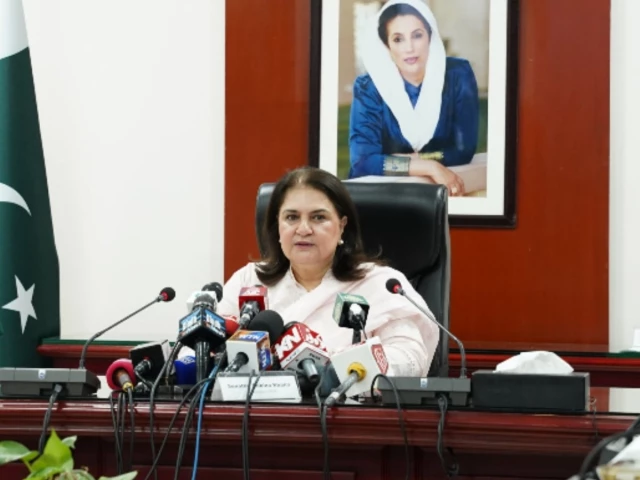
Senator Rubina Khalid, Chairperson of the Benazir Income Support Programme. Photo: Rubina Khalid
Chairperson of the Benazir Income Support Program (BISP), Senator Rubina Khalid, on Monday stressed that any humiliation or disrespect towards the poor and hardworking citizens was unacceptable and called on those who had undermined the dignity of the beneficiary families to apologise.
The statement came after Prime Minister’s Adviser on Political Affairs Rana Sanaullah said in a private television program that BISP served no other purpose than turning people into beggars.
Addressing a press conference at the BISP headquarters in Islamabad, Rubina said the program was constantly improving, but it did not justify the use of abusive language for those who benefit from it. “When you use such words, use them with evidence. No one has the right to offend. I ask all these people to apologize to these families for hurting their dignity,” she added.
The senator stated that misinformation was being spread about the program at the national level for political purposes, adding that it was the world’s largest poverty alleviation program.
“I am not able to understand why such things are said in our country. There are a lot of problems and problems in many institutions,” she said.
She added that several countries and international organizations were studying and learning from the BISP model, and that both the President and the Prime Minister had full confidence in the program. As proof of this confidence, she said that the Prime Minister’s Ramazan relief package had been successfully delivered through BISP’s digital payment mechanism for the past two years.
Rubina said another misconception was that BISP was turning people into beggars, calling it a “very wrong” perception. “It is very easy for you to become a beggar. Now I tell you, if any one of us gets up and stands on a street, he can easily collect Rs 8,000 to 10,000 in the evening,” she said.
She added that BISP supported low-income families and helped balance their expenses and income.
“It is the duty of the state not to hurt the self-respect of these people. They do not have to stretch their hands in front of anyone. So BISP does not make you a beggar but prevents you from becoming one,” she added.
The chairperson of the Income Support Program, Senator روبینه خالد نْ اج بی ؾی ایی ایی هدکوارترز, speaking at the press conference held in the headquarters, gave a detailed briefing to the media representatives. The main purpose of the press conference is to pay back the deserving families to the press conference transparency,… pic.twitter.com/yPilq9m7YW
— Benazir Income Support Program (@bisp_pakistan) June 8, 2026
Lamenting the spread of misinformation about the program, Rubina described BISP as a globally recognized model of financial inclusion and social protection that supported more than 10 million deserving families across Pakistan.
The conductor further said that if anyone had suggestions or thought the program should be improved, they were welcome to get involved.
“You come and tell us. We’re doing our best to make this program better,” she said.
Announcing that all BISP payments would be made through digital wallets from July, she said the initiative would increase transparency, eliminate unauthorized deductions and enhance economic empowerment of women beneficiaries.
Read more: Spouses of government personnel allegedly misusing BISP
Highlighting that BISP continued to introduce reforms aimed at enhancing transparency and empowering women beneficiaries, Senator Rubina said the digital wallet initiative had been launched to provide greater financial autonomy to women and improve the efficiency of payments.
“More than 8 million free Benazir SIMs have already been distributed among women beneficiaries and digital wallets are being opened in their names to eliminate unauthorized deductions and unnecessary difficulties in accessing payments,” she said.
Rubina further informed that BISP had put in place an interoperability system that enables beneficiaries to withdraw their payments through multiple banking channels at their convenience.
She announced that from July 2026 onwards, all BISP payments would be made exclusively through digital wallets. Women who face problems with biometric verification or those whose fingerprints cannot be verified will also be able to access their money through bank accounts.
The Chairman stated that BISP had introduced a recertification mechanism to further enhance transparency. Under this system, beneficiary households were reassessed every three years to ensure that only families truly deserving of aid continued to receive aid, while households whose financial conditions had improved could be replaced by new eligible families.
Rubina said the BISP’s National Socio-Economic Register was considered a credible and reliable database across the country. Provincial governments used this data for various welfare schemes, grant programs and social assistance initiatives aimed at supporting vulnerable populations.
Talking about the Benazir Nashonuma program, Rubina said that more than 2.2 million pregnant and lactating women and their children were currently registered under the program.
She stated that efforts continued to improve maternal and child health and nutrition, adding that the program had contributed to a 22% reduction in the number of disabled people in Pakistan.
Rubina further stated that under the Benazir Hunarmand programme, young people were given technical and vocational training. More than 1,000 young people had already received certificates, while another 5,000 were currently undergoing training in various fields.
Read also: PHC stops BISP salary recovery
The Chairman also highlighted the achievements of the Benazir Taleemi Wazaif programme, where more than 12 million children are currently receiving educational support.
She said 503 students benefiting from the program achieved A+ grades in matriculation exams, reflecting the positive impact of BISP’s investment in education.
Rubina stated that BISP provided services to beneficiary families through its network of 647 centers across the country.
She reaffirmed the programme’s commitment to become more transparent, efficient and citizen-centric, while continuing to work for the welfare and socio-economic upliftment of poor and vulnerable sections of society.


