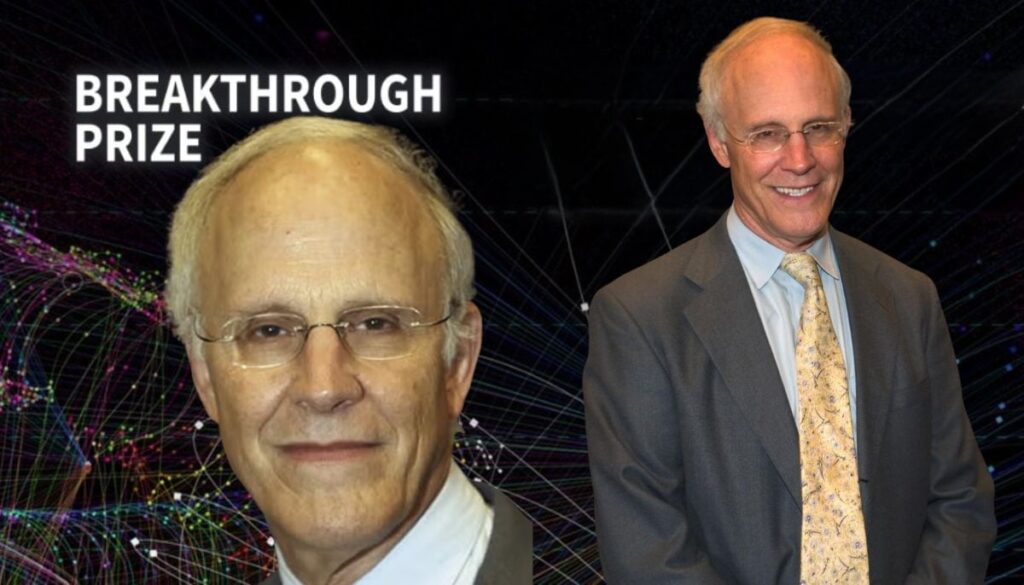
David Gross has won the Special Breakthrough Prize for Fundamental Physics with a whopping $3 million prize, as announced by the Breakthrough Prize Foundation on April 18, 2026.
The award honors scientists whose discoveries have contributed significantly to the development of human knowledge.
The Breakthrough Awards – commonly known as the ‘Science Oscars’ – were established in 2012 to celebrate the wonders of the 21st century scientific age.
David Gross, a Nobel laureate in physics (2004), served as director of the Kavli Institute of Theoretical Physics at the University of California, Santa Barbara for three decades.
What made Gross win the Breakthrough Prize in Fundamental Physics?
In the early 1970s, there was a big gap in quantum field theory, as it could not define the strong nuclear force that holds the nucleus of the atom together.
But in 1973, Gross and his graduate student Frank Wilczek cracked the mystery.
They discovered that the strong force works the opposite way of well-known forces like gravity: it becomes weaker when particles approach each other, but stronger when they move apart.
This discovery led to the development of quantum chromodynamics.
After taking home the breakthrough prize in fundamental physics, he drops a shocking prediction for humanity in an interview with Live Science.
Gross, when asked if humanity will ever get to a place where we get rid of nuclear weapons.
Gross predicted: “We don’t recommend it. It’s idealistic, but still I hope so. Because if you don’t, there’s always some risk of an AI in 100 years, but the chances of (humanity) living, by this estimate, 100 years, is very small, and living 200 years is infinitesimally small.”
Gross became one of this year’s six awardees for his contributions to theoretical physics, earning the special breakthrough prize in fundamental physics.
David Gross has been an authority on fundamental physics for six decades.