
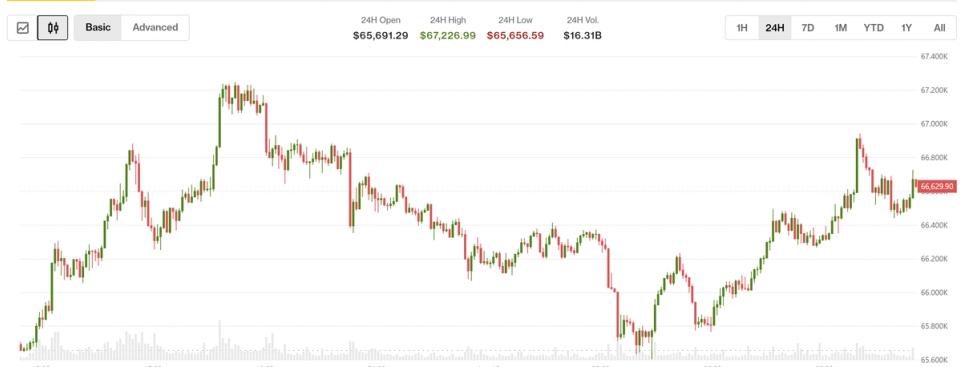
Bitcoin rose after the Bank of Japan raised interest rates to a 31-year high, pushing the price from around $65,600 in Asian trade to more than $66,500 in European hours.
The largest cryptocurrency has added 1.5% over the past 24 hours, continuing its recovery from a June 5 low below $60,000. Several altcoins showed even stronger gains.
Stellar’s XLM, Injective’s INJ and Uniswap’s UNI rose between 13% and 16%, ranking among the best in the top 100 cryptocurrencies by market capitalization. UNI’s gain comes after Standard Chartered initiated coverage of Uniswap and set a long-term price target for the token of $100 by 2030.
Memecoin SIREN extended its decline, dropping another 21% in 24 hours. The token has now lost a staggering 77% month to date. Blockchain data trackers on X pointed to a large holder or whale that unloaded coins representing 92% of the token’s supply as the main driver behind the collapse.
Derivative positioning
- Crypto markets show renewed risk appetite. Total 24-hour trading volume jumped 51% to $207 billion, open interest rose 2.4% to $113.41 billion and liquidations are up 64% to $561 million, with shorts accounting for the bulk of the forced exits.
- Gearing is also coming back. BTC futures open interest (OI) has risen to 747,000 BTC, a third consecutive daily increase and the highest since June 4. The steady increase suggests that investors are willing to take on risk again, a message reinforced by annual perpetual funding rates holding close to zero and a positive 24-hour OI cumulative volume adjusted (CVD). Both point to a balanced market in recovery rather than speculative excess.
- Ether futures OI rose up to 14.20 million ETH from a recent low of 13.64 million, a modest but directionally encouraging move.
- Among the major cryptocurrencies, is prominent. Its OI has increased 6.6% to 6.86 million tokens in 24 hours. While impressive in relative terms, the absolute level tells a more cautious story. That’s still only a one-week high and remains well below January’s peak of 9.29 million tokens. Overall positioning therefore remains easy.
- On the losing side, TON, BCH and HBAR all saw OI fall over the past 24 hours, signaling capital outflows. TON is the most notable; its rebranding to GRAM has done nothing for trader sentiment, and the 24-hour CVD is the most negative among the majors, a sign that the market is driven by sellers bidding the market rather than passive limit orders.
- The volatility picture gives bulls some comfort. Both BVIV and EVIV – the 30-day implied volatility indices for BTC and ETH respectively – have almost fully reversed the gains seen in the first week of the month. The fear that drove this rise has subsided and the implied retreat of volatility supports the case for a continued recovery.
- On Deribit, BTC strikes between $58,000 and $64,000 are among the most active in the last 24 hours. Block streams contained put condors, a non-directional strategy designed to benefit from a specific range of volatility rather than a directional bet.
Token talk
- Avalanche was the most discussed token on Monday as the crypto spread, although in AVAX’s case the conversation turned sharply negative. The ratio of positive to negative comments has fallen to around 0.85, according to Santiment, meaning bearish posts now outnumber bullish ones, down from one of the most bullish readings back in January.
- The negative talk is about mindshare. It centers on whether Avalanche can keep pace with faster-growing rivals, with developer activity and user growth seen shifting toward Solana and Sui, Santiment said.
- Price supports the mood. AVAX is trading around $6.88, near the low end of its recent range and well below the near $10 level it held a month ago.
- However, there is an opposite turning point. Santiment notes that extreme negative sentiment has often marked opportunities rather than peaks. Markets can reverse when volume becomes overwhelmingly bearish. It did the same case on XRP days earlier.
- The fundamentals have not disappeared. Avalanche still has institutional partnerships, government-related projects, and its subnet design, which lets teams launch custom app-specific blockchains. The Bear case is about momentum, not a business falling apart.


