
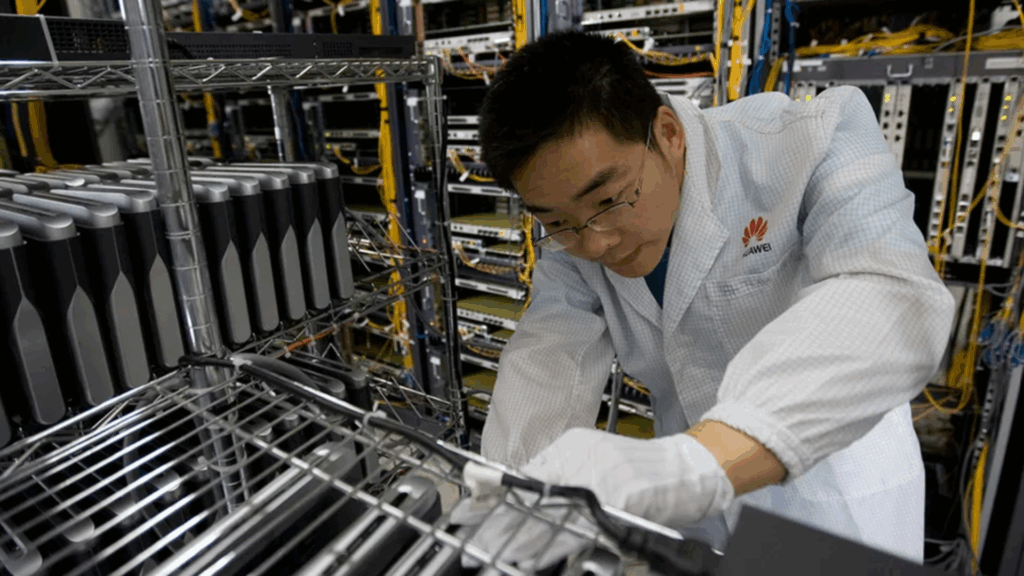
The International Supercomputer Conference in Hamburg was the perfect platform for Lineshine (or Língshèng 灵晟) to, well, shine as it took the crown of the world’s most powerful computer ever built.
It smashed the previous TOP500 record held by El Capitan, the US supercomputer built in 2024 by HPE for the National Nuclear Security Administration (NNSA) at Lawrence Livermore National Laboratory (LLNL).
Unlike the latter, Lineshine uses only CPU power instead of APU or GPUs, a remarkable achievement considering the prevalence of these technologies. Only one other supercomputer in the top 10, the arm-driven Fugaku supercomputer, falls into that category.

Details shared by Lu Yutong, the chief designer of Lineshine, show that it is powered by more than 13.7 million ARMv9 cores spread over 90 racks and 45,360 CPUs.
Yes, you got it, there are 304 cores per socket divided into two chiplets and eight NUMA domains each with 38 cores and 4GB of HBM memory. There are apparently eight CPU slots left per rack.
Each slot has access to 256GB of DDR5 memory, meaning the entire system has 128TB of off-package RAM and 16TB of HBM. The entire supercomputer has 11.6 PB of traditional DDR5 memory and almost 1.5 PB of HBM.
Compared to El Capitan’s pure HBM3 approach, Lineshine opted for a layered memory pool similar to traditional computers (using RAM and SSD). The system is also connected to 200PB of direct storage.
Breathtaking performance
Combined, Lineshine reached 2,198 exaflops, 21% faster than the 1,809 exaflops figure achieved by El Capitan.
However, the numbers do not tell the whole story; China’s new top dog uses far more power than the El Capitan, making it far less efficient. It only reached 52 Gigaflops/Watt compared to 60.95 Gigaflops for El Capitan and 73.28 for Kairos, the greenest supercomputer in operation.
What is more interesting is the fact that each core, even at 1.5 GHz, reached about 200 Gigaflops of FP64. Significantly more than any supercomputing CPU Core (eg AMD Zen 4 or Nvidia Grace), which ironically highlights Chinese weakness when it comes to GPU ie. they went the CPU route because they had no other option but to go brute-force.
And that’s despite the slew of launches from Huawei over the past few years with the Ascend 910D, Ascend 910C and Ascend 920.
Lineshine used its own version of Nvidia’s Nvlink connector called LinQi, one that can scale over 100,000 nodes or more than 60 million cores, 4x the current number of cores. So there is plenty of room to grow if Lineshine wants to keep its rank.
It is not the first time that China is at the top of the TOP500 ranking. The last time it achieved that was with the Sunway TaihuLight supercomputer back in 2017. And while the winner gets bragging rights, it’s only really useful for HPC (high performance computing) applications like CFD, earthquake simulation, materials, energy, drug design, neuroscience and scientific AI and others.
Hyperscalers such as Google or Microsoft can muster even more powerful computing power, by at least an order of magnitude if necessary, but this is not accounted for by the TOP500 for various reasons.

Follow TechRadar on Google News and add us as a preferred source to get our expert news, reviews and opinions in your feeds.


