
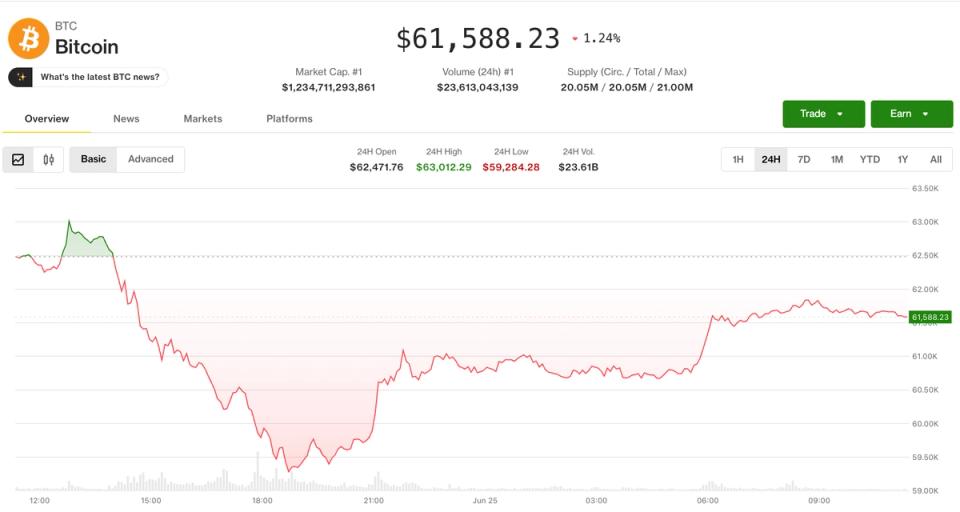
The crypto market showed signs of resilience on Thursday with bitcoin added 1.1% since midnight UTC after falling below $60,000 on Wednesday to its lowest since October 2024.
The largest cryptocurrency remains at a critical level in terms of broader market structure. A potential break lower in price could trigger a drop to around $52,000. For now, it seems to have weathered the storm.
Ether (ETH) rose 1.5% on Thursday and recently traded at $1,644 after briefly falling to $1,550 around 17:00 UTC Wednesday.
Thursday’s increases may be linked to a recovery in US stocks. S&P 500 and Nasdaq 100 futures are 0.7% and 2.2% higher, respectively.
Derivatives positioning
- BTC revisited lows near $59,000 on Wednesday and has since rebounded to above $61,000.
- The two-way volatility has proven costly for leveraged futures bets across the market. Centralized exchanges liquidated nearly $1 billion in crypto futures positions within 24 hours, with longs accounting for the largest share.
- Still, bitcoin futures open interest (OI) rose to 763K BTC, the most since June 4, ending a stretch of stability around 730K BTC. In other words, the price drop has triggered an influx of money, but not necessarily on the bullish side. In fact, annual funding rates have turned negative, a sign that traders are paying a premium for downside exposure.
- The Ether futures market has seen no significant increase in OI and funding rates remain weakly positive.
- SOL’s OI is still close to Wednesday’s record high, along with broadly neutral funding rates that point to a balanced positioning in the market. The same goes for XRP, whose OI is hovering at its highest level since October.
- The OI-normalized 24-hour cumulative volume delta for most coins, including BTC, is negative for a third day in a row. It is a sign that bears are leading the price action by shorting to market prices rather than using passive limit orders.
- BVIV, which measures the 30-day implied volatility in BTC, has pulled back to 46%, a high of 51%. This drop in the so-called “fear gauge,” which represents the demand for options, underpins the cryptocurrency’s overnight recovery. The same applies to ether’s implied volatility index, EVIV.
- Still, ether is seen as more volatile than BTC, with implied volatilities richer by 10 points or more compared to bitcoins across all timeframes.
- Options biases for the two largest cryptocurrencies indicate downside concerns that are both persistent and strengthening. For example, BTC’s one-week bias shows a nearly 25-point volatility premium for puts. This also means that upside bets are currently cheap and could draw strong demand if Thursday’s US Core PCE for May reveals a slowdown in inflation.
Token talk
- The altcoin market showed an exaggerated bounce on Thursday after losses on Wednesday, a reflection of a low liquidity environment.
- Jupiter ( JUP ) fell more than 12% in six hours Wednesday before jumping more than 18%, liquidating futures traders in both directions.
- Coinglass data shows that $1 billion in futures positions were liquidated in the last 24 hours, with $585 million attributed to altcoin trading pairs.
- Decentralized finance (DeFi) tokens AAVE and ETHFI also performed well on Thursday, rising 2.5% and 4.7% respectively since midnight.
- AI tokens, meanwhile, struggled to recover. RENDER and NEAR posted losses of between 0.8% and 1.9% despite a bounce across other crypto sectors.
- Layer-1 network token solana (SOL) fell to $64 on Wednesday to complete a 75% slide since September. A break below the June 6 low of $60 would mark its lowest point since December 2023.


