
He is trying to secure the return of 20 Iranian seafarers also aboard ships near Singapore waters
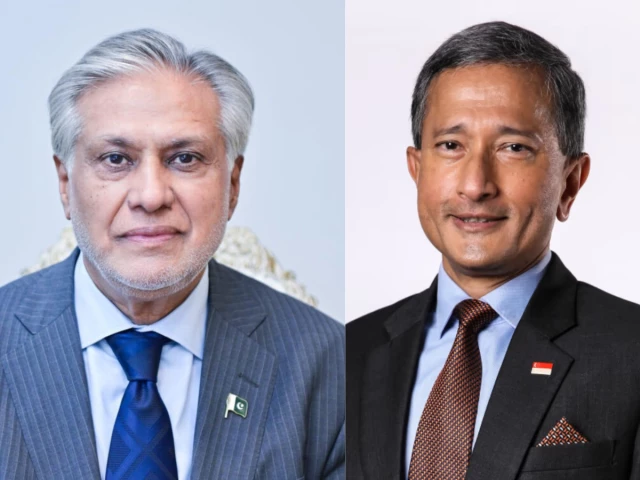
Foreign Minister Ishaq Dar (L), Singapore Foreign Minister Vivian Balakrishnan (R)
Deputy Prime Minister and Foreign Affairs Minister Ishaq Dar said on Friday that he has requested Singapore’s assistance in facilitating the welfare and repatriation of detained seafarers.
In a post on X, Dar said he spoke with Singapore’s Foreign Minister Vivian Balakrishnan about 11 Pakistani and 20 Iranian sailors aboard ships seized by US authorities and currently near Singapore waters.
Spoke to Singapore’s Minister for Foreign Affairs HE Vivian Balakrishnan @VivianBala and requested Singapore’s support in facilitating the welfare and repatriation of 11 Pakistani and 20 Iranian seafarers aboard ships seized by the US authorities and currently near Singapore waters…
— Ishaq Dar (@MIshaqDar50) 8 May 2026
“I asked for Singapore’s support in facilitating the welfare and repatriation of 11 Pakistani and 20 Iranian seafarers,” he said.
Dar also said he had spoken to Iranian Foreign Minister Abbas Araghchi, adding that Pakistan remains in close coordination with Iran on the matter. “Pakistan is also ready to facilitate safe repatriation of Iranian nationals to Iran via Pakistan,” he added.
Expressing appreciation for Singapore’s cooperation and support, he said the Ministry of Foreign Affairs and relevant authorities are coordinating with US officials and others to ensure the safety, welfare and early return of the nationals involved.
Read: 22 Iranian crew repatriated via Pakistan
On Monday, Pakistan facilitated the transfer of 22 Iranian crew members on board the container ship MV Touskaseized by the United States. In a statement released on X Monday, the ministry said the individuals were flown to Pakistan “last night and will be handed over to the Iranian authorities today.”
“As a confidence-building measure by the United States, twenty-two crew members were kept aboard the seized Iranian container ship,”MV Touska‘, have been evacuated to Pakistan,” it added.
“The Iranian ship will also be loaded back into Pakistani territorial waters to return it to its original owners after necessary repairs,” the statement added. MOFA said these returns were coordinated in tandem with support from both the Iranian and American sides.
On February 28, the United States and Israel launched a joint offensive against Iran, and Tehran retaliated with attacks on Israel and other regional countries that host American assets.
The war has been on hold since April 8, when Pakistan brokered a two-week ceasefire. After the cease-fire, Pakistan hosted the highest-level US-Iran talks since the 1979 Islamic Revolution, which ended in Islamabad last weekend without a deal, but the cease-fire was held.
Despite the ceasefire, the US began intercepting Iranian ships.
Iran later blocked almost all ships passing through the Strait of Hormuz except for its own, as Trump imposed a separate blockade of Iranian ports. The closure of the strait, a choke point for about 20% of global oil and liquid natural gas shipments, resulted in a phenomenal increase in global oil prices.
On Sunday, President Donald Trump said the United States would begin helping free ships stranded in the Gulf. Trump gave few details about the plan to help ships and their crews that have been “locked in” in the vital waterway and are running low on food and other supplies for more than two months.
The Unified Command of Iran’s Armed Forces responded by warning US forces to stay out of the strait. It said Iranian forces would “react strongly” to any threat and asked commercial ships and oil tankers to refrain from any movement without coordination with Iran’s military.
Read more: Prime Minister Shehbaz thanks Trump’s decision to pause ‘Project Freedom’ in the Strait of Hormuz
On Tuesday, President Trump announced he would briefly halt an operation to help escort ships through the Strait of Hormuz, citing “great progress” toward a comprehensive deal with Iran as well as “the request of Pakistan and other countries.”
Hours earlier, US Secretary of State Marco Rubio had outlined the effort that began on Monday to escort stranded tankers out of the Gulf. The strait has been virtually closed since the conflict began, blocking around 20% of the world’s oil supplies and igniting a global energy crisis.
“Based on the request of Pakistan and other countries, the tremendous military success we have had during the campaign…Great progress has been made toward a full and final agreement with representatives of Iran.” He wrote on Truth Social.


