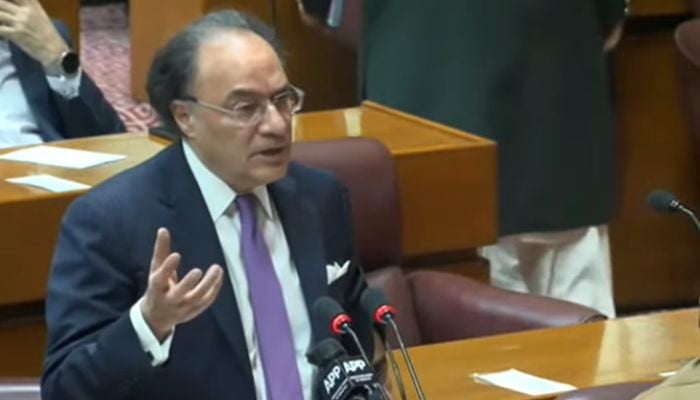
- The Finance Czar thanks MNAs for their participation in the budget debate.
- Praise opposition leader, finance committee leaders in both houses.
- Says some recommendations to be included in the Finance Act 2026.
ISLAMABAD: Finance Minister Muhammad Aurangzeb has dismissed opposition objections to the federal budget, saying allegations of discrepancies in budget documents were based on “wrong interpretation”.
Wrapping up the day-long budget debate in the National Assembly on Saturday, the finance czar said GDP and other key economic indicators were presented to the National Accounts Committee, which includes representation from all provinces, the federal government and relevant institutions.
He said some parliamentarians had expressed reservations about the budget, but added that the overall process was conducted in a transparent manner.
Aurangzeb thanked the lawmakers for their participation in the budget debate, including Opposition Leader Mehmood Khan Achakzai, as well as Finance Committee Chairs Saleem Mandviwala and Naveed Qamar in the Senate and National Assembly respectively.
He said the standing committees had reviewed budget proposals “with sincerity” and made recommendations for improvements, some of which would be incorporated into the Finance Bill 2026.
The finance minister also presented a positive outlook on the economy, stating that industries were functioning smoothly, the current account was in surplus, export performance was improving and IT exports had increased by 20%.
He added that the government has collected $14 billion in additional revenue over the past two years, calling it a record since 1988.
Referring to the agriculture sector, he said it is the backbone of the economy and the government is providing Rs300 billion in interest-free loans to small farmers. He added that about 750,000 small farmers would benefit from this initiative.
According to the federal minister, Prime Minister Shehbaz Sharif had set the economic direction in the previous budget, which had helped stabilize the economy.
Last week, the finance minister presented the FY27 budget with a total outlay of Rs18.771 billion. According to the details, the largest share – Rs8.054 trillion – is earmarked for mark-up payments, followed by Rs3 trillion for defense and Rs1 trillion for the federal development programme.
For the financial year 2026-27, the government has set the economic growth target at 4%, while average inflation is expected to remain at 8.2%.
The opposition calls for the adoption of the Senate’s proposal
Earlier in the day, opposition lawmakers also called for incorporating key proposals aimed at easing inflation and providing relief to the public.
Based on the Senate’s recommendations, JUI-F MNA Aliya Kamran supported a reduction in advance tax on telecom services under section 236 of the Income Tax Ordinance, 2001, from 15% to 8%, saying it would benefit mobile and internet users and help expand digital access in education, business and employment.
She also supported reductions in GST on essential goods including food, medicine, educational materials and agricultural inputs, saying lower taxation would ease pressure on low-income households.
On the energy sector, she supported targeted electricity subsidies for low-consumption users, reforms to address capacity payments and circular debt, and a cap on the oil tax with greater transparency in collection and use.
She emphasized that Balochistan required special attention in development financing and project execution.
PTI Chairman and MNA Gohar Ali Khan emphasized the need for a permanent and well-funded disaster management system. He called for joint federal and provincial contributions to a dedicated disaster risk fund, saying the recent floods had exposed serious gaps in preparedness at the district level and the country’s largely reactive response system.
MNA Asad Qaiser opposed the proposed 9% tax on tobacco crops, saying it would burden farmers instead of manufacturers. He said taxation should instead be imposed on finished tobacco products, while supporting higher taxes on cigarettes.
—With additional input from APP