
Condemns Houthi attack, warns any action against Pakistani ships will be considered a serious threat to national security
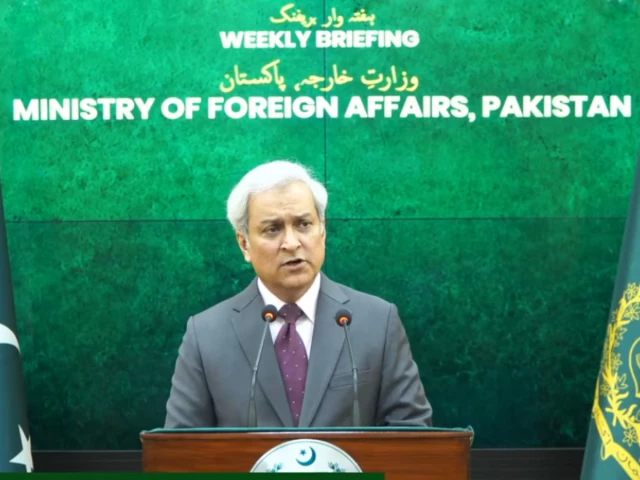
FO spokesman Tahir Andrabi holds a weekly press briefing in Islamabad. Photo: Screengrab
Pakistan on Thursday expressed “disappointment” over the EU’s latest GSP+ assessment, saying the report did not give a balanced picture of the country’s progress.
“I would be remiss if I did not express disappointment with the assessment and the overall narrative of the report, which does not provide a sufficiently balanced picture of Pakistan’s performance under the GSP+,” Foreign Ministry (FO) spokesperson Tahir Andrabi said during his weekly press briefing.
Andrabi said the assessment covered 60 recipient countries and included an individual report on Pakistan, describing it as “the final monitoring report under the current GSP+ framework on Pakistan’s compliance with the 27 international conventions.”
“So this is the final report, the last of such series,” he said.
The spokesman said Pakistan appreciated the report’s recognition of “Pakistan’s legislative progress during the reporting period and the country’s continued compliance with the 27 international conventions.”
However, he added that despite acknowledging “the breadth of reforms undertaken since Pakistan joined GSP+ in 2014”, the report placed “disproportionate emphasis on the lower than desirable level of progress in certain areas.”
Andrabi said the GSP+ scheme remained central to Pakistan’s economic relationship with the EU, “supporting exports, employment, women’s economic participation, poverty reduction and broader economic development.”
“It’s a mutually beneficial arrangement in that respect,” he said.
He added that Pakistan’s engagement with the EU extended beyond GSP+ to areas including “development, migration, counter-terrorism, regional stability, climate resilience, connectivity and many other areas.”
“We will remain constructively engaged with the European Commission and other EU institutions and remain committed to the effective implementation of international conventions underpinning the GSP framework,” Andrabi said.
“Any hostile act against Pakistani flag will be considered as a serious threat to national security”
Andrabi also unequivocally condemned continued threats against Saudi Arabia and commercial shipping in the Red Sea, warning that any hostile act against Pakistan’s flag or the country’s maritime interests would be considered a serious threat to its national security.
He said the Houthi militia had earlier this week threatened a maritime embargo against Saudi Arabia’s commercial shipping in the Red Sea and noted there had been reports of attacks against Saudi ships overnight.
“We reserve the right to take all necessary measures in self-defense in accordance with international law,” he added.
The spokesman said Pakistan “remains deeply concerned about attempts to draw the Kingdom of Saudi Arabia into the conflict in the Middle East” and reiterated its “unwavering support for the Kingdom’s security, sovereignty and territorial integrity.”
“We issued the details yesterday on this topic that you all covered,” Andrabi said.
Referring to last week’s attack on Saudi Arabia by armed groups in Yemen, he said Prime Minister Shehbaz Sharif had issued “a very eloquent, strong statement.”
“Given that the escalation has continued, our Prime Minister’s words resonate even more,” he added.
Andrabi said that amid growing hostilities and armed attacks, Pakistan reiterated its call on all parties “to exercise restraint” and “continues its diplomatic efforts in support of dialogue and diplomacy.”
Pakistan’s Recent Diplomatic Engagements
Andrabi also highlighted Pakistan’s recent diplomatic engagements aimed at easing regional tensions.
He said Iranian Interior Minister Eskandar Momineh visited Pakistan this week and met Prime Minister Shehbaz, Interior Minister Mohsin Naqvi and Defense Forces Chief and Army Chief of Staff Field Marshal Asim Munir.
“The visit reflects the two neighbors’ close coordination on regional development and Pakistan’s continued diplomatic engagement with Iran,” he said.
Andrabi said Pakistan has “repeatedly called for restraint from all sides” and maintained that “dialogue remains the only viable solution to prevent a regional conflict.”
He said that in line with Pakistan’s advocacy of dialogue and diplomacy, Deputy Prime Minister and Foreign Minister Ishaq Dar spoke with Kuwaiti Foreign Minister Sheikh Jarrah Jaber Al-Ahmad Al-Sabah on July 18, where they discussed regional developments and emphasized de-escalation, respect for sovereignty and implementation of the Islamabad MOU.
“Both sides agreed to remain in contact,” he added.
The spokesman said that on the sidelines of the ASEAN Regional Forum in Manila, FM Dar met the Egyptian Minister of Foreign Affairs, Immigration and Expatriate Dr. Badr Abdelatty.
According to Andrabi, the two leaders reviewed developments in the Middle East and stressed the importance of de-escalation and dialogue, while emphasizing respect for the sovereignty and territorial integrity of all states.
“They also discussed the wider implications of regional instability, particularly for global maritime trade, energy security and the world economy,” he said.
Andrabi said FM Dar also held a meeting in Manila with Omani Foreign Minister Sayyid Badr bin Hamad Al Busaidi, where the two leaders exchanged views on recent regional and international developments.
He said the Omani foreign minister appreciated Pakistan’s “constructive role in promoting dialogue, de-escalation and regional peace and security.”
“Both sides expressed concern over recent developments in the region, stressed the importance of maintaining ceasefire, respect for international law and working towards lasting peace and stability,” Andrabi said.
The spokesman added that FM Dar’s diplomatic outreach would continue in Bishkek where he would lead Pakistan’s delegation to the Shanghai Cooperation Organization (SCO) Council of Foreign Ministers meeting during his visit to the Kyrgyz Republic from July 23 to 24.
“During the visit, FM Dar will call on the President of the Kyrgyz Republic and hold a series of bilateral meetings with his counterparts from the SCO member states on the sidelines of the ministerial meeting,” Andrabi said.
He said that before leaving for Bishkek, FM Dar arrived in Manila to lead Pakistan’s delegation at the 33rd ARF Ministerial Meeting.
“Pakistan has been a member of the ARF since 2004. We remain committed to promoting regional peace, stability and cooperation through dialogue and we remain ASEAN’s partner in such endeavours,” Andrabi said.
He added that FM Dar held bilateral meetings with Philippine counterparts and other participating dignitaries on the sidelines of the forum.
Among the meetings held in Manila, Andrabi said FM Dar met Russian Foreign Minister Sergey Lavrov, where the two leaders reviewed “the entire spectrum of Pakistan-Russia bilateral relations” and reaffirmed their commitment to further strengthen cooperation in trade, energy, connectivity and other key areas, as well as improve coordination in multilateral fora.
“FM Dar also met Khalilur Rahman, the President-elect of the 81st session of the UN General Assembly and visited the headquarters of the Asian Development Bank (ADB) where he met the bank’s Director General for Central and West Asia, Leah Gutierrez,” he said.
According to Andrabi, they discussed the bank’s development agenda and partnership with Pakistan and appreciated the contribution of Pakistani professionals in ADB.
The spokesman said that FM Dar had also visited Shanghai on 16-17. July to participate in the signing ceremony that established the World Artificial Intelligence Cooperation Organization (WAICO).
“The initiative aims to strengthen international cooperation on artificial intelligence governance, research and capacity building,” Andrabi said.
He said Pakistan became a founding member of WAICO through FM Dar’s participation in the ceremony and looked forward to strengthening international cooperation on artificial intelligence, especially South-South cooperation for sustainable economic development.
While in Shanghai, FM Dar also met Chinese Foreign Minister Wang Yi, where the two leaders discussed the implementation of the China-Pakistan Economic Corridor (CPEC), regional relations, SCO cooperation, trade and the strategic partnership between Pakistan and China.
“They also reaffirmed Pakistan-China all-weather strategic cooperative partnership through multi-faceted sectoral cooperation,” Andrabi said.
The spokesman also referred to Canadian Foreign Minister Anita Anand’s official visit to Pakistan on July 20, describing it as the first visit by a Canadian foreign minister in 20 years.
He said Anita held delegation level talks with FM Dar and also met PM Shehbaz.
According to Andrabi, the two sides discussed bilateral relations, trade, investments, regional and global development, climate cooperation and people-to-people contacts.
He added that Pakistan and Canada signed a protocol on phytosanitary import requirements for genetically modified canola intended for food, feed and processing, facilitating agricultural trade between the two countries.
“They also agreed to expand cooperation in trade, investment, security and development, and reaffirmed their commitment to institutionalize bilateral engagement,” he said.
“We completely reject the claims of Amnesty International”
Responding to another question during the briefing, Andrabi rejected allegations made by Amnesty International regarding Pakistan’s counter-terrorism operations.
“We completely reject the allegations made by Amnesty International. It is unfortunate that such serious allegations have been made without any credible evidence,” he said.
Andrabi added that the Taliban regime continued to maintain “a permissive environment for a number of terrorist organizations, including the Tehreek-e-Taliban Pakistan (TTP), the Balochistan Liberation Army (BLA) and other affiliates.”
He said the freedom of these organizations to carry out terrorist activities, their access to bases and reserves on Afghan soil and their ability to recruit, finance and carry out cross-border attacks posed “a serious threat to regional peace and security.”
“Thousands of innocent Pakistani citizens have been martyred and injured due to terrorist attacks that have been planned, financed, supported and carried out from Afghan soil, all under the watch and patronage of active facilitation by the Taliban regime,” Andrabi said.
“No responsible state can remain passive when its civilians and security forces are repeatedly targeted,” he added.
Andrabi said any military strike by Pakistan had been carried out “in exercise of its right of self-defense under principles of necessity and as a last resort” and was aimed “only and exclusively against terrorists and their logistical support bases in Afghanistan.”
According to Andrabi, Pakistan’s response was proportionate to the level of threat while “strictly adhering to the principles of distinction, prudence and proportionality.”
“The scope and scale of this action reflected restraint, especially in light of the seriousness and frequency of terrorist attacks that Pakistan faces,” he said.
“Pakistan rejects any insinuation in this regard otherwise,” Andrabi said.
He called on Amnesty International and the international community “to bring strict scrutiny to the Taliban regime’s continued patronage of terrorist groups” and “to address the root causes that this Amnesty International report has conspicuously failed to address.”
He also called on the international community to hold the Afghan Taliban regime accountable for “its failure to comply with its obligations under the relevant UN Security Council resolutions, its own Doha Agreement and other related obligations to prevent Afghan soil from being used as a launching pad for terrorism.”
“Pakistan reserves the right to take all necessary measures to protect its sovereignty, territorial integrity and the safety and security of its people,” Andrabi said.


